
Why Falcon 1 Failed: Flights 1, 2 and 3
Source
SpaceX Updates 2006–2009 (Internet Archive); SpaceX Demo Flight 2 Flight Review, 15 June 2007
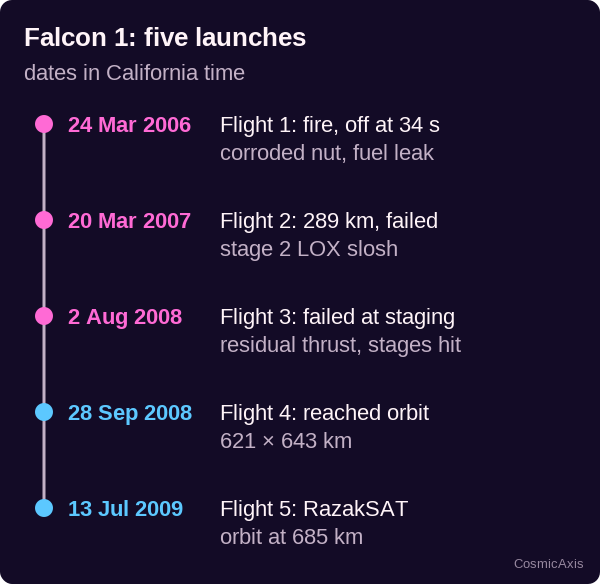
SpaceX's Falcon 1 failed on its first three flights for three different reasons: a corroded aluminum nut leaked fuel and caused a fire (24 March 2006), sloshing liquid oxygen cost stage 2 its control (20 March 2007), and residual thrust made stage 1 hit stage 2 (2 August 2008). Flight 4, on 28 September 2008, reached orbit (SpaceX).
01Knowledge
What kind of rocket is Falcon 1, and how many times did it fly?
Falcon 1 is SpaceX’s first rocket, a two-stage vehicle burning liquid oxygen and kerosene, 70 ft long, 61,000 lb, 78,000 lbf of thrust (NASA SP-2014-617), about 21 m, 28 t and 347 kN (CosmicAxis unit conversion). It flew 5 times from Omelek Island, Kwajalein Atoll: the first three flights failed, the last two reached orbit.
Merlin on stage 1 feeds propellant with a turbopump; Kestrel on stage 2 uses tank pressure. Staging raises delta-v, as the Tsiolkovsky rocket equation shows, but the stages must separate correctly.
| Flight | Date (California time) | Result | Source, date viewed |
|---|---|---|---|
| 1 | 24 March 2006 | Fire, thrust lost at second 34 | SpaceX, 25 July 2006 · 2026-10-03 |
| 2 | 20 March 2007 | Reached 289 km, stage 2 shut down early | SpaceX, 15 June 2007 · 2026-10-03 |
| 3 | 2 August 2008 | Failed right after stage separation | SpaceX, 6 August 2008 · 2026-10-03 |
| 4 | 28 September 2008 | Reached a 621 × 643 km orbit | SpaceX, 7 October 2008 · 2026-10-03 |
| 5 | 13 July 2009 | Put RazakSAT into a 685 km orbit | SpaceX, 15 July 2009 · 2026-10-03 |
Kwajalein time is 19 hours ahead of California, so many documents date flight 2 as 21 March 2007 (CosmicAxis time-zone conversion).
Why did the first Falcon 1 flight burn and shut down at second 34?
The first Falcon 1 flight (24 March 2006) burned and shut down at second 34 because fuel leaked at the fitting of the turbopump inlet pressure sensor and caught fire as soon as the engine ignited. According to the DARPA-convened review board, the leak began at T−400 s, fire caught around T−2 s and burned through a pneumatic line around T+25 s; falling pneumatic pressure closed the propellant valves until thrust was lost at T+34 s.
The most likely scenario is an aluminum flare nut (B-nut) cracked by stress corrosion cracking. The nut was anodized but sat outside the engine bay, and the rocket stood in sea air for days and weeks during a campaign lasting months. SpaceX replaced exposed aluminum nuts with welds or stainless steel nuts and raised the monitored software parameters to more than 700.
Why did flight 2 reach 289 km and still miss orbit?
Flight 2 (20 March 2007) reached 289 km without entering orbit because liquid oxygen sloshing in the stage 2 tank produced a growing oscillation that finally shut the Kestrel engine down early. According to SpaceX’s flight review of 15 June 2007, the oscillation appeared around T+265 s and produced a roll moment beyond the roll thrusters’ authority; centrifugal force threw propellant away from the tank outlet and Kestrel shut down around T+474 s.
Stage 2 had no slosh baffle because pre-flight simulation rated the risk low: it left out the hard rotation right after separation, the very disturbance that excited the waves. Every later flight carried a baffle. The report lists 7 other anomalies, one foreshadowing flight 3: at separation the Kestrel nozzle touched the interstage because the rocket rotated faster than expected.
Why did flight 3 fail exactly at stage separation?
Flight 3 (2 August 2008) failed at separation because the new regeneratively cooled Merlin 1C engine kept decaying in thrust longer than predicted, so residual thrust pushed stage 1 back into stage 2. According to SpaceX (6 August 2008), stage 1 flew perfectly up to 217 km and the pneumatic pusher delivered the correct impulse.
Merlin 1A on the previous flight used ablative cooling; Merlin 1C runs kerosene through channels around the chamber (regenerative cooling). After the shutdown command, kerosene trapped in the channels and manifold met leftover oxygen and kept burning, giving a small thrust just enough to beat the separation pusher’s impulse. Musk wrote that a “very small” increase in the time from shutdown command to separation would have saved the flight.
NASA MSFC (2010) cites this flight: thrust tail-off of the lower stage is a key factor in separation. Specific impulse explains why the same chamber pressure gives more thrust in vacuum.
Why did ground testing not catch all three faults?
Ground testing missed all three faults because each needed a condition the test stand cannot provide: weeks of sea-salt air (flight 1); vacuum, weightlessness and the rotation the simulation left out (flight 2); zero ambient pressure (flight 3), where residual chamber pressure of about 10 psi is barely visible on a Texas test stand with 14.5 psi ambient (SpaceX, 6 August 2008).
NASA MSFC adds that without a diffuser, flow in the de Laval nozzle unchokes before thrust falls to the level that matters at separation, so the tail-off curve is hard to know before flight.
The lesson is “test like you fly” in systems engineering: whatever cannot be tested as it will fly is recorded as an open risk. The Falcon 1 User’s Guide (2008) cites an Aerospace Corporation analysis: 91% of known launch vehicle failures lie in engines, electronics and stage separation.
02Practice
How do you estimate residual thrust and the moment two stages collide in Python?
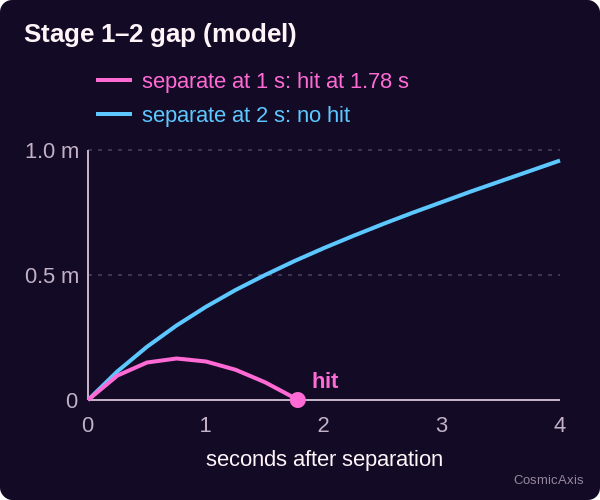
A short Python model estimates both: residual thrust decays exponentially, a pneumatic pusher gives the separation speed, and the gap between the stages is integrated. Stage 1 empty mass and thrust come from the Falcon 1 User’s Guide; the other parameters are CosmicAxis assumptions because SpaceX does not publish them: residual thrust of 1% of rated, separation speed of 0.5 m/s, and decay time constant τ = 0.3 s (ablative) and 1.0 s (regenerative). t_sep is the time from shutdown command to separation. The model illustrates the mechanism and does not reconstruct flight 3.
import math

m1 = 3000 * 0.45359237        # kg, empty first stage (User's Guide Rev 7)
F_rated = 78000 * 4.4482216   # N, Merlin 1C thrust (User's Guide Rev 7)
F_res = 0.01 * F_rated        # ASSUMPTION: residual thrust at cutoff = 1% of rated
v_sep = 0.5                   # ASSUMPTION: m/s, separation speed from the pneumatic pusher

def simulate(tau, t_sep, t_end=5.0, dt=0.001):
    x, v, t, x_max = 0.0, v_sep, 0.0, 0.0   # gap (m), relative speed (m/s), seconds
    while t < t_end:
        F = F_res * math.exp(-(t_sep + t) / tau)    # residual thrust decays exponentially
        v -= F / m1 * dt                             # stage 1 catches up with stage 2
        x += v * dt
        t += dt
        x_max = max(x_max, x)
        if x <= 0:
            return t, x_max
    return None, x_max

for name, tau, t_sep in [("1A ablative, separate after 1 s", 0.3, 1.0),
                         ("1C regenerative, separate after 1 s", 1.0, 1.0),
                         ("1C regenerative, separate after 2 s", 1.0, 2.0)]:
    t_hit, x_max = simulate(tau, t_sep)
    print(f"{name}: max gap {x_max:.2f} m,", f"collision at {t_hit:.2f} s" if t_hit else "no collision")

for tau in (0.3, 1.0, 1.5):
    wait = tau * math.log(F_res * tau / (m1 * v_sep))  # when remaining impulse equals m1*v_sep
    print(f"tau = {tau} s: wait at least {max(wait, 0):.2f} s before separating")
1A ablative, separate after 1 s: max gap 2.37 m, no collision
1C regenerative, separate after 1 s: max gap 0.17 m, collision at 1.78 s
1C regenerative, separate after 2 s: max gap 1.12 m, no collision
tau = 0.3 s: wait at least 0.13 s before separating
tau = 1.0 s: wait at least 1.63 s before separating
tau = 1.5 s: wait at least 3.05 s before separating
Source
CosmicAxis own model; stage 1 mass from the Falcon 1 User's Guide, Rev 7 (2008); residual thrust and decay time are assumptions
The result (CosmicAxis own calculation, Python 3.14.6, maximum gap in the first 5 s) matches Musk: separating 1 second later turns “collision” into “no collision”. Stage 1 catches stage 2 when residual impulse divided by stage 1 mass exceeds the separation speed: F_res · τ · e^(−t_sep/τ) / m₁ > v_sep. Waiting costs payload, NASA MSFC notes, because the burnt-out stage is dragged along.
How do you build a fault tree for stage separation?
A fault tree for stage separation puts “stage 2 does not reach orbit” at the top and splits it through OR gates, as in fault tree analysis. Falcon 1 supplies three branches:
- Collision at separation: residual thrust larger than predicted (flight 3) or rotation rate too high (flight 2). Mitigation: measure the thrust tail-off curve and wait long enough.
- Loss of upper-stage control: sloshing liquid resonates with the control loop (flight 2). Mitigation: baffles and simulation that includes disturbances.
- Separation device failure: exploding bolts or a pusher with too little impulse. Data from flights 2 and 3 confirm this branch did not occur.
Each leaf becomes a row in an FMEA table. Hobbyists flying multi-stage model rockets, using only certified commercial motors under NAR or Tripoli rules, can use the same frame: log lower-stage burnout and separation times from flight data and compare them with assumptions.
03Reality
How did Falcon 1 flights 4 and 5 succeed?
Flight 4 of Falcon 1 (28 September 2008, 23:15 UTC) reached orbit and, according to SpaceX, was the first privately developed liquid-fuel rocket to reach Earth orbit. Between flights 3 and 4 there was no technology upgrade; SpaceX did not publish details of the fix, but Musk described it as a longer time from shutdown command to separation.
According to SpaceX (7 October 2008), the first stage 2 burn ended at 330.5 km and 8.99° inclination, against a target of 330 km and 9.0°. Stage 2 coasted 43.5 minutes, burned again for 6.8 seconds, and reached 621 × 643 km.
Flight 5 (13 July 2009, California time) placed Malaysia’s RazakSAT into a near-equatorial orbit at 685 km and 9° inclination (SpaceX, 15 July 2009).
What did the three Falcon 1 failures leave for crewed rockets?
The three failures left SpaceX a flown Merlin 1C engine, tighter launch procedures, and enough credibility for NASA to order ISS cargo flights, the foundation for the later crewed Falcon 9.
| Milestone | Date | Value (USD) | Source, date viewed |
|---|---|---|---|
| NASA signs COTS agreement with SpaceX | 18 August 2006 | 278 million | NASA SP-2014-617 · 2026-10-03 |
| NASA orders 12 CRS cargo flights | 23 December 2008 | about 1.6 billion | NASA C08-069 · 2026-10-03 |
| First Falcon 9 flight, 9 Merlin engines | 4 June 2010 | — | NASA SP-2014-617 · 2026-10-03 |
The Commercial Orbital Transportation Services (COTS) agreement came between flights 1 and 2; the Commercial Resupply Services contract came less than three months after flight 4.
The lesson for crewed rockets: every change between flights, even a cooling method, must be rechecked at every interface; “launch early, learn fast” is acceptable only while no one is on board.
Falcon 9 later carried Crew Dragon and landed its first stage for reuse; the rocket launch cost comparison shows how far its price per kilogram fell below the Space Shuttle’s. Set beside Ariane 5 flight 501, Falcon 1 shows the same pattern: one change (a new trajectory, a new engine) broke an old assumption nobody rechecked. The other articles in the rocket propulsion phase go deeper into each subsystem.
04Milestone
Milestone: check yourself
If you can do all of these, move on to the next article in this phase.
- Can you state the root cause of each of the three Falcon 1 failures in one sentence, with the date and flight phase?
- Can you explain why a residual chamber pressure of about 10 psi is almost invisible on the Texas test stand yet enough to make two stages collide in vacuum?
- Can you run the Python code, change the decay time constant, and find the minimum wait that keeps the stages apart?
- Can you draw a fault tree for the event "stage separation fails" with at least three branches, each with one mitigation?
Frequently asked questions
How many times did Falcon 1 fail?
Falcon 1 flew 5 times from 2006 to 2009. The first three flights did not reach orbit, flight 4 (28 September 2008) did, and flight 5 (13 July 2009) put Malaysia's RazakSAT into a 685 km orbit (SpaceX).
When was SpaceX close to bankruptcy?
The primary sources never use the word bankruptcy. Musk's letter of 2 August 2008 says SpaceX had just received a significant investment to cover a failed flight 3; on 23 December 2008, NASA ordered 12 ISS cargo flights, about 1.6 billion USD.
How dangerous is propellant slosh for a rocket?
Liquid in a tank sloshes back and forth across the rocket body, and when it matches the rhythm of the control system the oscillation grows. On Falcon 1 flight 2 it made stage 2 roll and shut down its engine (SpaceX, 2007).
References
- SpaceX — Findings of the Falcon Return to Flight Board, 25 July 2006 (Internet Archive) — accessed
- SpaceX — Demo Flight 2 Flight Review Update, 15 June 2007 (Internet Archive) — accessed
- SpaceX — Falcon 1 Flight 3 Mission Summary, 6 August 2008 (Internet Archive) — accessed
- SpaceX — Flight 4 Launch Update, 28 September 2008 (Internet Archive) — accessed
- SpaceX — Flight 4 Launch Update, 7 October 2008 (Internet Archive) — accessed
- SpaceX — RazakSAT, 15 July 2009 (Internet Archive) — accessed
- SpaceX — Falcon 1 Payload User's Guide Rev 7, 2008 (Internet Archive) — accessed
- Richards — JANNAF Lessons Learned Panel Discussion, NASA MSFC, 2010 — accessed
- NASA — Contract Release C08-069, 23 December 2008 (Internet Archive) — accessed
- NASA SP-2014-617 — Commercial Orbital Transportation Services — accessed
Cite this article
CosmicAxis. (2026). Falcon 1 Failure: Why SpaceX Lost Its First 3 Launches. https://cosmicaxis.space/en/falcon-1-failure/