
Rocket Launch Cost: Cost per kg to Orbit
Source
Jones, NASA Ames ICES-2018-81, table A2 (2018 USD)
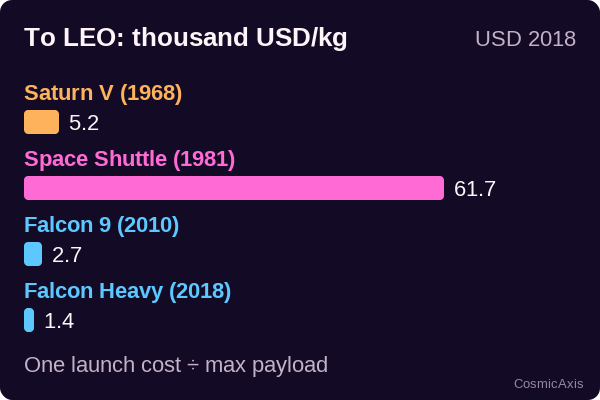
Rocket launch cost is usually quoted in dollars per kilogram to low Earth orbit: about $61,700/kg for the Space Shuttle and $2,700/kg for Falcon 9 (2018 USD, NASA Ames). In 2026 SpaceX sells rideshare at $7,000/kg with a 50 kg minimum, and one SLS launch costs at least $4.2 billion (NASA OIG).
01Knowledge
How much does a rocket launch cost?
A rocket launch costs from tens of millions to billions of dollars: in 2018 SpaceX listed $62 million for one Falcon 9 launch, while the Space Shuttle cost about $1.5 billion per flight (Jones, NASA Ames, ICES-2018-81). According to NASA OIG (IG-23-015, May 2023), one SLS launch of the Artemis program costs at least $4.2 billion.
Rockets differ in size, so analysts divide the cost of one launch by the maximum payload to low Earth orbit (LEO) to get dollars per kg. Payload depends on the delta-v budget of the target orbit, so compare two rockets only for the same orbit. This is one of the main topics of the manufacturing and regulation phase.
How much does it cost to put 1 kg into low Earth orbit?
Putting 1 kg into low Earth orbit costs about $61,700 on the Space Shuttle and about $2,700 on Falcon 9, converted to 2018 dollars with the consumer price index (Jones, NASA Ames, table A2). The Shuttle is about 23 times as expensive as Falcon 9.
| Rocket (first flight) | Payload to LEO (kg) | One launch (million 2018 USD) | 2018 USD per kg | Source, date viewed |
|---|---|---|---|---|
| Saturn V (1968) | 140,000 | 728 | 5,200 | Jones 2018, 2026-09-29 |
| Space Shuttle (1981) | 27,500 | 1,697 | 61,720 | Jones 2018, 2026-09-29 |
| Falcon 9 (2010) | 22,800 | 62 | 2,720 | Jones 2018, 2026-09-29 |
| Falcon Heavy (2018) | 63,800 | 90 | 1,410 | Jones 2018, 2026-09-29 |
The same report gives an average of $18,500/kg to LEO for 1970–2000. CSIS makes the same division but converts to fiscal-year 2021 dollars with the GDP deflator, so CSIS figures differ from Jones’s: whenever you quote dollars per kg, state the year of the dollar.
How does launch price differ from launch cost?
Price is what the customer pays the launch company, while cost is what the company actually spends; the difference is profit or loss. SpaceX publishes prices, not internal costs, so the $62 million for Falcon 9 is a price. For the Space Shuttle or SLS, the published figure is a program cost calculated by NASA OIG or by researchers.
- Nominal dollars (then-year dollars) are the amount recorded in the year of spending: about $1.5 billion per Shuttle flight.
- Inflation-adjusted dollars are expressed in the prices of one base year: the same flight is $1,697 million in 2018 dollars.
- Dollars per kg from maximum payload is the lowest figure possible; Jones notes that small satellites and limited fairing volume usually make the real price per kg higher.
Why do reusable rockets lower launch cost?
Reusable rockets lower launch cost because the most expensive part, the booster stage with its engines, flies many times instead of being dropped into the sea. According to SpaceX’s statistics page (viewed October 3, 2026), Falcon 9 has launched 690 times, with 643 booster landings and 609 reflights.
Jones (2018) quotes SpaceX President Gwynne Shotwell in 2017: refurbishing the CRS-8 booster for reflight cost less than half the price of a new one. The price of this is more expensive development and lower payload, because the booster must keep propellant for landing.
Reuse is not automatically cheap: the Space Shuttle reused its orbiter and main engines yet remains the most expensive row in the table, because refurbishment between flights was very costly (Jones 2018). The 2003 Columbia disaster, when the orbiter broke up during atmospheric reentry, also shows that refurbishment must come with strict safety inspection. Starship is designed so that both stages fly back and launch again.
Why does one SLS launch cost more than $4 billion?
One Artemis launch on SLS costs at least $4.2 billion for the first four flights, according to NASA OIG (IG-23-015, May 25, 2023); the OIG figure in 2021 was $4.1 billion, and the engine and solid-booster contracts make each SLS $144 million more expensive.
One reason is that SLS throws away its engines after every flight. The four RS-25 engines of Artemis I had flown 12, 4, 6 and 3 times on the Space Shuttle, but on SLS they fall into the ocean; each new RS-25 after Artemis VI is estimated at $70.5 million to build (IG-23-015). CosmicAxis calculates four new engines at $282 million per flight, more than four times the 2018 Falcon 9 list price. Engine efficiency is not the issue: specific impulse of the RS-25 is 452.3 s in vacuum (L3Harris), so the cost comes from discarding the hardware.
SLS Block 1 delivers more than 27 tonnes to the Moon (NASA, Dec 2025), so CosmicAxis calculates about $155,600 per kg to the Moon; the figure is only for scale, because that payload includes the crewed Orion capsule.
02Practice
How do you calculate CubeSat 1U and 3U rideshare launch cost in Python?
The launch cost of a CubeSat on a SpaceX rideshare equals mass times price per kg, but never less than the 50 kg minimum of the smallest slot. The price table on the rideshare booking page (viewed September 29, 2026) lists $7,000/kg for payment year 2026, up from $5,500/kg in 2023 and rising to $7,500/kg in 2027 (nominal dollars). A cheap shared ride also shares the rocket’s risk, as the 2006 Dnepr failure showed.
PRICE_PER_KG_2026 = 7000  # USD/kg, SpaceX Rideshare (viewed Sep 29, 2026)
MIN_KG = 50               # smallest slot: you pay for at least 50 kg

def rideshare_price(kg):
    return max(kg, MIN_KG) * PRICE_PER_KG_2026

# Maximum mass per CubeSat Design Specification Rev. 14.1
for name, kg in [("1U", 2), ("3U", 6), ("50 kg", 50)]:
    price = rideshare_price(kg)
    print(f"{name:>5}: {price:,} USD, {price / kg:,.0f} USD per real kg")
shared = rideshare_price(50) / 8  # eight 3U units share one slot, mass only
print(f"3U shared: {shared:,.0f} USD, {shared / 6:,.0f} USD per real kg")
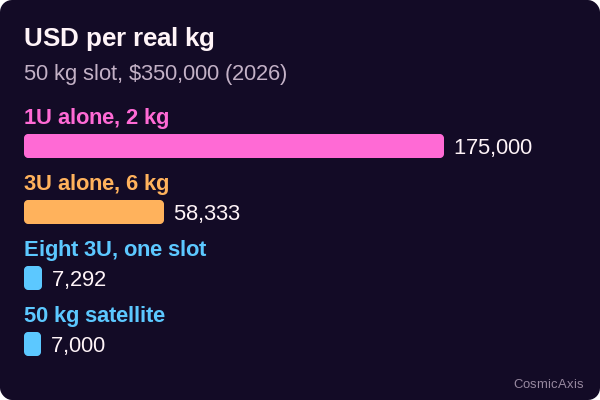
#    1U: 350,000 USD, 175,000 USD per real kg
#    3U: 350,000 USD, 58,333 USD per real kg
# 50 kg: 350,000 USD, 7,000 USD per real kg
# 3U shared: 43,750 USD, 7,292 USD per real kg
CosmicAxis ran this code on September 29, 2026 (Python 3.14): a 1U CubeSat weighs at most 2 kg, so booking a slot of its own costs $175,000 per real kg, 25 times the list price.
Source
CosmicAxis calculation from the SpaceX Rideshare 2026 price table
This is why CubeSats usually fly in groups or through space agency programs: NASA’s CSLI program pays launch costs of up to $300,000, usually enough for one 3U CubeSat (NASA CubeSat 101, Oct 2017). The deployer, volume and integration testing are separate money, not included in the division.
What share of a CubeSat mission’s cost is the launch?
The launch is only one line in the bill of materials (BOM) of the whole mission. The code below adds costs at mission level only. Only the launch line has a source; lines marked “ASSUMPTION” are numbers CosmicAxis set for illustration, not quotes.
BOM = [  # (item, nominal 2026 USD, source) for one 3U CubeSat
    ("Launch: 1/8 of a rideshare slot", 43_750, "SpaceX 2026"),
    ("Vibration + thermal-vacuum tests", 20_000, "ASSUMPTION"),
    ("Power system + solar panels", 22_000, "ASSUMPTION"),
    ("Flight computer + UHF radio", 13_000, "ASSUMPTION"),
]
CONTINGENCY = 0.30  # ASSUMPTION: for what is not yet known

total = sum(usd for _, usd, _ in BOM)
sourced = sum(usd for _, usd, src in BOM if src != "ASSUMPTION")
print(f"Sum {total:,} + contingency = {total * (1 + CONTINGENCY):,.0f} USD")
print(f"Sourced share of the money: {sourced / total:.0%}")
# Sum 98,750 + contingency = 128,375 USD
# Sourced share of the money: 44%
The last line matters most: only 44% of the money has a source, so this estimate cannot yet support a funding request. Exercise: replace each “ASSUMPTION” line with a real quote and its date, and rerun until the sourced share exceeds 90%. The radio line prices only hardware; whether the link closes is a link budget question, where CosmicAxis calculates that a 1 W CubeSat at 437 MHz loses 144.4 dB over 909 km. Balancing mass, power and money across subsystems is the job of systems engineering, and parts bought from the United States also need an ITAR export-classification check.
03Reality
How do Vietnamese-built CubeSats reach orbit?
Small satellites built by Vietnamese teams have reached orbit by three routes: release from the ISS with JAXA’s J-SSOD deployer, a shared ride on JAXA’s Epsilon rocket in its technology demonstration program, and a booked slot on a SpaceX rideshare flight.
| Satellite | Route to orbit | Date | Source, date viewed |
|---|---|---|---|
| F-1, PicoDragon (1U) | Released from the ISS by J-SSOD | Oct 4, 2012; Nov 19, 2013 | JAXA, 2026-09-29 |
| MicroDragon (about 50 kg) | Epsilon-4, Innovative Satellite Technology Demonstration-1 | Jan 18, 2019 | VNSC, 2026-09-29 |
| NanoDragon (3U) | Epsilon-5, Innovative Satellite Technology Demonstration-2 | Nov 9, 2021 | VNSC, 2026-09-29 |
| VEGAFLY-1 | Falcon 9, Transporter-16 flight | Mar 30, 2026 | VnExpress, 2026-09-29 |
The prices of these flights were not published. The nearest sourced figure is JAXA’s answer to a Vietnamese representative at the Kibo-ABC Q&A on May 19, 2016: the launch and release fee with J-SSOD is 3 million yen for 1U, 8 million yen for 3U and 104 million yen for a 50 kg-class satellite (nominal 2016 yen).
What do VINASAT and Commercial Crew show about launch cost?
VINASAT and Commercial Crew show that launch is only part of a mission’s cost and is usually not published separately. For the VINASAT satellites, VietNamNet (Dec 18, 2022) reports a total investment of roughly $300 million for VINASAT-1, with no price disclosed for the build-and-launch contract. VNPT paid about $21 million in insurance premium on a value of $177 million, covering launch through the first 12 months of operation (VietNamNet, Dec 20, 2007), about 7% of total investment (CosmicAxis calculation).
For crewed flight, NASA buys by the seat: NASA OIG (IG-20-005, Nov 2019) estimated about $55 million per SpaceX seat and $90 million per Boeing seat; the 2026 update is covered in the Commercial Crew program article. CosmicAxis multiplies four SpaceX seats to about $220 million, 3.5 times the 2018 Falcon 9 list price, because a seat price includes the Dragon capsule, human-rating certification and mission operations.
04Milestone
Milestone: check yourself
If you can do all of these, move on to the next article in this phase.
- Can you tell price, cost, nominal dollars and inflation-adjusted dollars apart?
- Can you explain why dollars per kg computed from maximum payload is always lower than what a satellite really pays?
- Can you run the Python code that prices a rideshare slot for a 1U and a 3U CubeSat?
- Can you add up a CubeSat mission's cost at mission level and mark which lines are sourced and which are assumptions?
Frequently asked questions
How much does a Falcon 9 launch cost?
In 2018 SpaceX listed $62 million for one Falcon 9 launch carrying up to 22,800 kg to low Earth orbit, about $2,720/kg (Jones, NASA Ames 2018). That is the price charged to customers, not SpaceX's internal cost.
How much cheaper are reusable rockets?
In 2017 SpaceX President Gwynne Shotwell said refurbishing the CRS-8 booster for reflight cost less than half the price of a new one (Jones, NASA Ames 2018). As of October 3, 2026, Falcon 9 boosters have landed 643 times and flown again 609 times (SpaceX).
How much does it cost to launch a CubeSat?
On a 2026 SpaceX rideshare, the smallest slot bills at least 50 kg, which is $350,000 (CosmicAxis calculation from the SpaceX price table). In 2016 JAXA quoted 3 million yen for a 1U CubeSat and 8 million yen for a 3U released from the ISS.
Why is the SLS rocket so expensive?
NASA OIG (May 2023) puts each Artemis launch at no less than $4.2 billion. One reason: the four RS-25 engines on SLS are discarded after every flight, and each new engine is estimated at $70.5 million to build.
References
- Jones — The Recent Large Reduction in Space Launch Cost (NASA Ames, ICES-2018-81) — accessed
- CSIS Aerospace Security — Space Launch to Low Earth Orbit: How Much Does It Cost? (Sep 1, 2022) — accessed
- SpaceX Rideshare — price table by year — accessed
- SpaceX — Falcon 9 statistics — accessed
- NASA OIG IG-23-015 — SLS Booster and Engine Contracts (May 25, 2023) — accessed
- NASA — SLS Fact Sheet (Dec 2025) — accessed
- NASA OIG IG-20-005 — Crew Transportation to the ISS (Nov 14, 2019) — accessed
- NASA CSLI — CubeSat 101 (Oct 2017) — accessed
- Cal Poly — CubeSat Design Specification Rev. 14.1 — accessed
- JAXA KUOA — Kibo-ABC Q&A on J-SSOD (May 27, 2016) — accessed
- JAXA — CubeSats deployed by J-SSOD — accessed
- VNSC — MicroDragon satellite launched successfully (Jan 18, 2019, in Vietnamese) — accessed
- VNSC — Update on NanoDragon (Dec 1, 2021, in Vietnamese) — accessed
- VnExpress — Private satellite VEGAFLY-1 (Apr 3, 2026, in Vietnamese) — accessed
- VietNamNet — VINASAT was insured (Dec 20, 2007, in Vietnamese) — accessed
- VietNamNet — project to replace the two VINASAT satellites (Dec 18, 2022, in Vietnamese) — accessed
Cite this article
CosmicAxis. (2026). Rocket Launch Cost: Price per kg to Orbit Compared. https://cosmicaxis.space/en/rocket-launch-cost/