
Dnepr Rocket Failure 2006: Why 18 Satellites Were Lost on One Rocket
Source
RussianSpaceWeb, Dnepr fails during launch, 2006; ISC Kosmotras, 15 August 2006
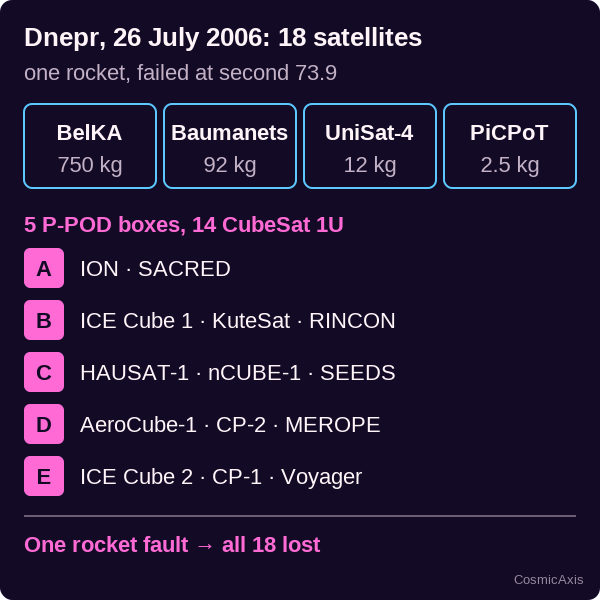
On 26 July 2006 a Dnepr rocket launched from Baikonur was shut down at second 73.9 because a hydraulic actuator steering one stage 1 combustion chamber malfunctioned (ISC Kosmotras). All 18 satellites aboard were lost at once, including Belarus's BelKA and 14 CubeSats in 5 P-POD boxes (Spaceflight Now).
01Knowledge
What happened to the Dnepr rocket on 26 July 2006?
The Dnepr rocket lifted off at 19:43 GMT on 26 July 2006 from a silo at Baikonur (Kazakhstan), and its control system commanded an emergency engine shutdown at second 73.90 when the vehicle lost stability during the stage 1 burn (ISC Kosmotras, 15 August 2006).
Dnepr is a retired R-36M ballistic missile converted to launch satellites. The target was a Sun-synchronous orbit at about 325 miles (523 km) (Spaceflight Now, 26 July 2006).
| Date | Event | Source, date viewed |
|---|---|---|
| June 2006 | Computer fault on the rocket, replaced with another vehicle | RussianSpaceWeb, 2026-10-03 |
| Second 73.90 | Emergency engine shutdown command | Kosmotras, 2026-10-03 |
| 28 July | Impact point 150 km from the pad, uninhabited area | Kosmotras (Roscosmos news), 2026-10-03 |
| 15 August | Preliminary cause published, Dnepr launches suspended | Kosmotras, 2026-10-03 |
| 17 April 2007 | Dnepr flies again successfully | Gunter’s Space Page, 2026-10-03 |
Early reports were off: a Russian news agency quoted officials giving second 86 (Spaceflight Now). This article uses Kosmotras’s figure from after the investigation.
Which satellites were on the 2006 Dnepr launch?
The Dnepr launch of 26 July 2006 carried 18 satellites: Belarus’s BelKA Earth-observation satellite (main payload, 750 kg), the Russian student satellite Baumanets, two Italian university microsatellites UniSat-4 and PiCPoT, and 14 CubeSats (Spaceflight Now; RussianSpaceWeb).
The 14 1U CubeSats sat in 5 P-POD boxes, the Cal Poly deployer, each holding up to 3U (NASA CubeSat 101). According to RussianSpaceWeb:
- A: ION (Illinois), SACRED (Arizona).
- B: ICE Cube 1 (Cornell), KuteSat (Kansas), RINCON (Arizona).
- C: HAUSAT-1 (Hankuk, South Korea), nCUBE-1 (Norway), SEEDS (Nihon, Japan).
- D: AeroCube-1 (The Aerospace Corporation), CP-2 (Cal Poly), MEROPE (Montana State).
- E: ICE Cube 2 (Cornell), CP-1 (Cal Poly), Voyager (Hawaii).
It would have been the largest CubeSat release to that date (SPACE.com, 30 August 2006), a milestone for small satellites and CubeSats; MEROPE was Montana State’s first satellite.
Why did the Dnepr rocket fail?
Dnepr failed because the hydraulic actuator of one stage 1 combustion chamber malfunctioned briefly, according to the investigation commission chaired by TsNIIMash, throwing the rocket off its flight path until the control system had to terminate the flight (Kosmotras, 15 August 2006).
The actuator swivels the combustion chamber to steer the rocket (thrust vector control). The commission recorded that the control system ran its preset logic correctly; it commanded shutdown because the rocket had lost stability.
According to Anatoly Zak (RussianSpaceWeb), the final conclusion pointed to the thermal protection of the hydraulic mechanism, a manufacturing defect rather than the rocket’s age. The final report is not public, so this article stops there. After the failure Kazakhstan banned Dnepr launches from Baikonur and set up its own commission to assess environmental damage (RussianSpaceWeb).
What launch-side risk do rideshare satellites carry?
Rideshare satellites carry the full risk of the rocket: a launch failure is a common cause failure that wipes out every satellite on the flight at once. Jacklin’s NASA report (2019) puts the worldwide launch vehicle failure rate at 6.1% on average for 2000–2017.
In fault tree analysis, a shared cause like this defeats redundancy. The risk is outside the team’s control, unlike the post-orbit faults in CubeSat failure rate. Secondary payloads face more:
- Schedule follows the main payload: the 2006 flight slipped from February, then March, then 28 June 2006 (RussianSpaceWeb).
- Early delivery: rockets often require the finished CubeSat 4 weeks to 6 months before launch; selecting and manifesting a flight takes 1–36 months (NASA CubeSat 101).
- Risk from “neighbors”: a team that runs out of money and cannot finish its CubeSat may get a co-passenger pulled from the flight (NASA CubeSat 101).
- No default insurance: Kosmotras mentions only third-party liability insurance.
In reliability terms (MTBF), the rocket is a link in series that the team did not design and cannot fix, only choose.
02Practice
How do you calculate the odds of losing a satellite on a shared launch in Python?
The odds come from multiplying probabilities, assuming independent launches with the same reliability p: putting k satellites on one launch loses all k with probability 1 − p; splitting them over k launches loses all k with probability (1 − p)ᵏ and loses at least one with probability 1 − pᵏ.
The code uses p = 93.9% (Jacklin) and Dnepr’s history: 6/6 successes before 26 July 2006 (Spaceflight Now), 21/22 over its lifetime (Gunter’s Space Page). Laplace’s rule of succession estimates p from s successes in n launches as (s + 1)/(n + 2).
p = 1 - 0.061                      # Jacklin, NASA/TM-2018-220034: launch vehicles fail 6.1% of the time
q = 1 - p

# 1) Estimate p from launch history with Laplace's rule (s + 1)/(n + 2)
for s, n in ((6, 6), (21, 22)):    # Dnepr before 26 July 2006 · Dnepr lifetime
    print(f"Dnepr {s}/{n}: raw {s / n:.1%}, Laplace {(s + 1) / (n + 2):.1%}")

# 2) Two CubeSats: one launch or two launches (independent, same p)
print(f"1 launch: lose >=1 {q:.2%}, lose both {q:.2%}, expected losses {2 * q:.3f}")
print(f"2 launches: lose >=1 {1 - p**2:.2%}, lose both {q**2:.3%}, expected losses {2 * q:.3f}")

# 3) 18 satellites in 2006 if each had flown on its own launch
print(f"18 launches: lose all {q**18:.1e}, lose >=1 {1 - p**18:.1%}")
# Dnepr 6/6: raw 100.0%, Laplace 87.5%
# Dnepr 21/22: raw 95.5%, Laplace 91.7%
# 1 launch: lose >=1 6.10%, lose both 6.10%, expected losses 0.122
# 2 launches: lose >=1 11.83%, lose both 0.372%, expected losses 0.122
# 18 launches: lose all 1.4e-22, lose >=1 67.8%
Output copied unchanged from a Python 3.14 run (CosmicAxis calculation). Six straight successes give a raw 100%, but Laplace gives only 87.5%: too few flights to trust the rocket.
Should CubeSats share one launch or fly on separate launches?
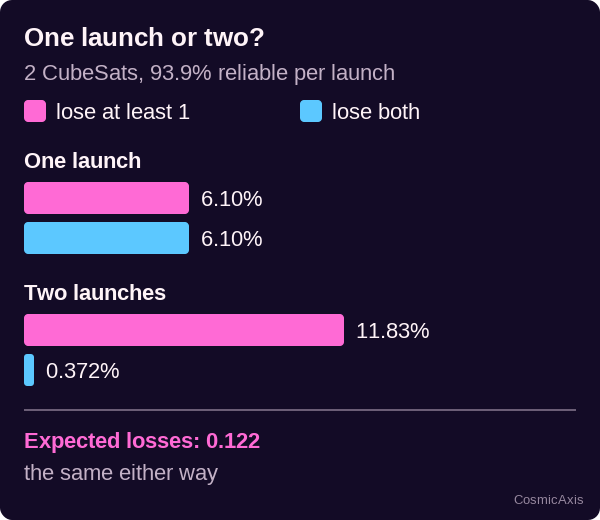
Splitting CubeSats across launches does not reduce the average number lost, only the kind of risk: with two CubeSats and a rocket 93.9% reliable, the expected loss is 0.122 satellites either way, but the probability of losing both drops from 6.10% to 0.372% (CosmicAxis calculation from Jacklin’s figure).
Source
Jacklin, NASA/TM-2018-220034 (launch vehicle failure rate 6.1%); CosmicAxis calculation
The cost is that the probability of losing at least one nearly doubles, to 11.83%. A team that needs “at least one working” (a test flight, a thesis) should split launches or keep a spare; a team that needs several at once (a constellation) has to share one launch.
In 2006, Cal Poly had CP-1 and CP-2 on the same flight and Cornell had ICE Cube 1 and 2 (RussianSpaceWeb). Assuming the same p on every launch is a simplification: new rockets usually fail more often, as the first three Falcon 1 failures show.
03Reality
What did the CubeSat community do after the Dnepr failure?
The CubeSat community flew again after 265 days: the next Dnepr launch on 17 April 2007 carried Cal Poly’s CP-3 and CP-4 and The Aerospace Corporation’s AeroCube-2 among other CubeSats (Gunter’s Space Page; day count by CosmicAxis). CP-4 flew CP-2’s mission again using the backup flight unit.
At a small satellite conference at Utah State University in August 2006, teams described the shock (SPACE.com, 30 August 2006):
- Jordi Puig-Suari (CubeSat project co-director, Cal Poly): the team could do almost nothing for two weeks.
- Dave Klumpar (Montana State): MEROPE was lost after about 5 years of work.
- Bob Twiggs (CubeSat project co-director, Stanford): getting a student satellite to the rocket had already met about 95% of the educational goal.
Twiggs’s remark explains why university programs did not stop. Dnepr returned too: from 2007 to 2015 it flew 15 more times without a failure, including the launch of 21 November 2013 that carried more than 30 satellites (Gunter’s Space Page).
How should a CubeSat team choose a launch after the Dnepr lessons?
A CubeSat team should treat launch failure as a risk that cannot be removed, about 6.1% per flight according to Jacklin, and prepare in advance: keep a backup flight unit, ask the launch provider the right questions, and have a reflight plan.
- Build two units. CP-4 flew again because Cal Poly had a backup flight model of CP-2 (Gunter’s Space Page). The backup must also pass environmental testing, so budget for the second unit from day one.
- Read rocket history with Laplace’s rule: a few flights without failure do not prove high reliability.
- Ask the launch provider four questions: the date the satellite must be delivered; what happens if the launch slips; the reflight policy if the rocket fails; and whether insurance covers the satellite itself or only third parties.
- Budget for a second launch. In 2006, launch fees were about 40,000 USD per 1U unit (SPACE.com); current prices are in the analysis of rocket launch cost.
Every launch route, whether ISS release, a shared ride on JAXA’s Epsilon or a SpaceX rideshare seat, raises the same question first: if this launch is lost, what does the team still have to fly again?
04Milestone
Milestone: check yourself
If you can do all of these, move on to the next article in this phase.
- Can you tell in two sentences what happened to Dnepr on 26 July 2006 and whether the cause was published?
- Can you explain why 6 successful launches in a row do not mean a rocket is 100% reliable?
- Can you run the Python code, change p and the number of satellites, and say when to split satellites across launches?
- Can you list four questions to ask the launch provider before signing a CubeSat launch contract?
Frequently asked questions
What is the Dnepr rocket?
Dnepr is a satellite launcher converted from the R-36M ballistic missile and sold by the Russian-Ukrainian joint venture ISC Kosmotras. It flew 22 times from 1999 to 2015 and failed once (Gunter's Space Page).
How much did a CubeSat launch cost in 2006?
In 2006, launch fees through companies such as Kosmotras were about 40,000 USD per 1U CubeSat unit (SPACE.com, 30 August 2006).
Were CubeSats insured against launch failure?
For the 2006 Dnepr flight, Kosmotras mentions only third-party liability insurance under Russian law. CosmicAxis found no source saying any CubeSat on the flight had insurance covering the satellite itself.
References
- ISC Kosmotras — Investigation of Dnepr LV Launch Failure occured on July 26, 2006, 15 August 2006 (Internet Archive) — accessed
- Spaceflight Now — Russian rocket fails, 18 satellites destroyed, 26 July 2006 — accessed
- Anatoly Zak, RussianSpaceWeb — Dnepr fails during launch with multiple payloads — accessed
- Gunter's Space Page — Dnepr (list of 22 launches) — accessed
- Gunter's Space Page — CP 2, 4 — accessed
- Leonard David, SPACE.com (republished by CNN) — CubeSat losses spur new development, 30 August 2006 — accessed
- NASA CSLI — CubeSat 101 (October 2017) — accessed
- Jacklin — Small-Satellite Mission Failure Rates, NASA/TM-2018-220034 — accessed
Cite this article
CosmicAxis. (2026). Dnepr Rocket Failure 2006: Lost 14 CubeSats, Rideshare Risk. https://cosmicaxis.space/en/dnepr-rocket-failure-2006/