
What is delta-v? How a delta-v budget works
Source
NASA TM-2015-218760; orbital speed calculated by CosmicAxis from NASA JPL GM
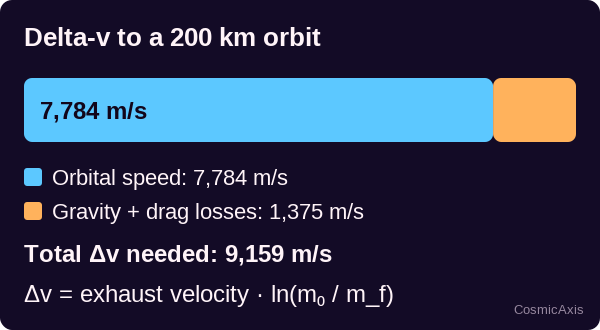
Delta-v (Δv) is a change in velocity, measured in m/s. In spaceflight it is the total velocity change the engines must supply for a whole mission. A two-stage rocket reaching a 200 km low Earth orbit needs 9,159 m/s, although circular orbital speed there is only 7,784 m/s (NASA TM-2015-218760, JPL).
01Knowledge
How does delta-v in physics differ from delta-v in spaceflight?
In introductory physics, delta-v (Δv) is the change in velocity: Δv = v₂ − v₁, measured in m/s. A car that speeds up from 10 m/s to 25 m/s has a Δv of 15 m/s. The Greek letter Δ (delta) means “change in”.
In spaceflight, delta-v is still a change in velocity, but it works as the currency of a mission. Every leg of flight (reaching orbit, changing orbit, leaving Earth, landing, returning to Earth) costs a fixed amount of delta-v. Adding the legs together gives the mission’s delta-v budget. A spacecraft can fly the mission only if its engines and propellant can produce that much delta-v.
Delta-v is more convenient than energy or thrust for one reason: the delta-v needed for a leg of flight does not depend on the mass of the spacecraft. A 1-tonne craft and a 100-tonne craft need the same delta-v to reach the same orbit. Mission designers therefore calculate the delta-v budget first, then choose the engine and the propellant load. Fixing requirements before choosing a design is the method of systems engineering. Calculating the delta-v budget is the first step of orbital mechanics and of every project to build a crewed spacecraft.
How does the rocket equation calculate delta-v?
The Tsiolkovsky rocket equation says that delta-v equals the exhaust velocity multiplied by the natural logarithm of the ratio of initial mass to final mass:
Δv = vₑ · ln(m₀ / m_f)
Here m₀ is the spacecraft mass at the start of the burn (propellant included), m_f is the mass when the engine shuts down, and vₑ is the effective exhaust velocity. Engineers usually rate an engine by its specific impulse (Isp), measured in seconds. The two are related through standard gravity g₀: vₑ = Isp · g₀, so the equation is also written Δv = Isp · g₀ · ln(m₀ / m_f) (NASA Glenn Research Center). The value g₀ = 9.80665 m/s² is a defined value with no uncertainty (NIST CODATA).
Delta-v grows only with the logarithm of the mass ratio, so doubling the propellant does not double the delta-v, while raising Isp raises delta-v in direct proportion. The ideal equation ignores gravity and drag; the delta-v those two forces take away is covered in the next section.
Why does reaching low Earth orbit take 9,159 m/s and not just 7.8 km/s?
Reaching low Earth orbit takes more delta-v than the orbital speed because the rocket must make up the delta-v that gravity and atmospheric drag take away on the way up.
Circular orbital speed follows v = √(GM / r), where GM is the gravitational constant times Earth’s mass and r is the distance from Earth’s center. With GM = 398,600.435507 km³/s² (NASA JPL) and an equatorial radius of 6,378.137 km (NASA NSSDCA), a circular orbit at 200 km altitude (r = 6,578.137 km) has a speed of 7,784 m/s. The same formula at ground level gives 7,905 m/s, the “first cosmic velocity” of textbooks.
A NASA Langley study of a two-stage rocket burning liquid oxygen and kerosene (LOX-RP) into a 200 km circular orbit shows the gap clearly. The rocket must carry propellant for a total delta-v of 30,050 ft/s (9,159 m/s), while the circular orbital speed at 200 km is only 7,784 m/s by the formula above. The report gives the orbital speed as “approximately 25,560 ft/s” (7,791 m/s): that figure is rounded and differs by 7 m/s from the formula. According to the report, the difference between total delta-v and orbital speed is mostly gravity loss and drag loss (NASA TM-2015-218760). In exact numbers the difference is 9,159 − 7,784 = 1,375 m/s, which is 15.0% of the total delta-v of the ascent.
Earth’s rotation also contributes. A rotation period of 23.9345 hours (NASA NSSDCA) gives the ground at the equator a speed of 465 m/s toward the east, and 409 m/s at the 28.5° latitude of Kennedy. A rocket launched east gets this speed for free, which is why the NASA Langley report chose to launch “due east from KSC” into an orbit inclined 28.5°.
What does a mission’s delta-v budget include?
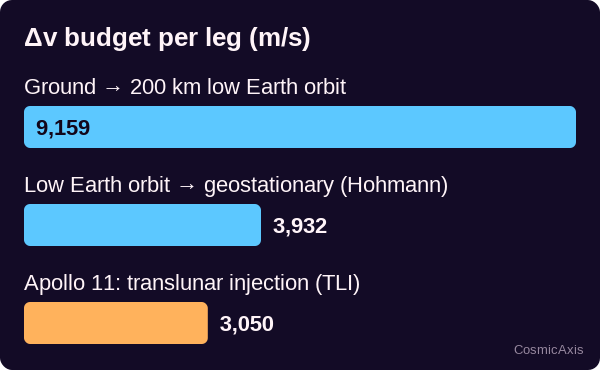
A delta-v budget is the sum of the delta-v of every leg of flight in a mission, plus a reserve. Each leg has its own number, and the numbers are added in flight order.
Source
NASA TM-2015-218760, SP-2000-4029; calculated by CosmicAxis from NASA JPL GM
| Leg of flight | Delta-v (m/s) | Source |
|---|---|---|
| Ground → 200 km circular orbit, two-stage rocket | 9,159 | NASA TM-2015-218760, accessed 2026-09-28 |
| 200 km orbit → geostationary orbit, coplanar Hohmann transfer | 3,932 | Calculated by CosmicAxis from NASA JPL GM, 2026-09-28 |
| Apollo 11: 183–186 km parking orbit → translunar orbit (TLI) | 3,050 | NASA SP-2000-4029, accessed 2026-09-28 |
The 3,932 m/s figure is an ideal Hohmann transfer between two coplanar circular orbits: a first burn of 2,455 m/s to enter the transfer ellipse and a second burn of 1,477 m/s to enter the circular geostationary orbit (radius 42,164 km). A rocket launched from 28.5° latitude must also rotate its orbital plane to the equator, so the real delta-v to geostationary orbit is larger than this figure.
The three legs in the table do not start from the same orbit. The NASA Langley study uses a 200 km circular orbit, while Apollo 11 fired for the Moon from a lower parking orbit of 183–186 km (NASA SP-2000-4029). To add legs into one budget, every leg must connect to the same orbit.
People often search for a “delta v map”: a diagram that lists the delta-v between orbits and bodies. A delta-v map is only a way to present a budget: read it by adding the legs along the route. Different maps give numbers that differ by a few hundred m/s because they assume different orbit altitudes, losses and plane changes. When using a number from a map, always check that map’s assumptions.
Why must rockets be split into stages?
Rockets are staged because a single stage can hardly carry enough propellant for 9,159 m/s and still have mass left for the structure, engines and payload.
The rocket equation shows this in numbers. For a hypothetical engine with Isp = 350 s, the exhaust velocity is 350 × 9.80665 = 3,432 m/s. To reach 9,159 m/s, the mass ratio m₀/m_f must equal e^(9,159 / 3,432) = 14.4. That means 93.1% of the liftoff mass must be propellant, and the remaining 6.9% must hold the tanks, engines, computers and payload together. NASA Glenn reaches the same conclusion: a rocket going to orbit is about 90% propellant and only about 1% payload.
Staging solves the problem by discarding empty tanks and spent engines. Each stage only has to push the mass that remains, so the delta-v of the stages add up. The two-stage rocket in the NASA Langley study weighs 1,000,000 lbm at liftoff and delivers 36,251 lbm to a 200 km orbit: payload is 3.6% of liftoff mass. The report also shows that splitting the delta-v evenly between stage 1 and stage 2 (50% each) is close to the optimal split. Because payload depends on the delta-v of the target orbit, rocket launch cost per kilogram can only be compared between two vehicles flying to the same orbit.
02Practice
How do you calculate delta-v in Python?
Calculating delta-v in Python needs only a logarithm and a square root, with no external library. The code below computes the delta-v of one rocket stage and the circular orbital speed, using exactly the constants cited above.
import math

# m/s², NIST CODATA
G0 = 9.80665
# km³/s², NASA JPL
GM = 398600.435507
# km, equatorial radius, NASA NSSDCA
R = 6378.137

def delta_v(isp, m0, mf):
    # Isp (s); m0, mf in the same unit
    return isp * G0 * math.log(m0 / mf)

def v_circ(h_km):
    # circular orbital speed, m/s
    return math.sqrt(GM / (R + h_km)) * 1000

print(round(delta_v(350, 100, 10)))
# 7903 m/s
print(round(v_circ(200)))
# 7784 m/s
print(round(v_circ(0)))
# 7905 m/s: first cosmic velocity
Exercise: change the altitude to 400 km to get the speed of the International Space Station, then try different Isp values to see that delta-v grows linearly with Isp but only logarithmically with the mass ratio. Specialized tools such as NASA’s GMAT or the poliastro library compute real losses and real orbits, but the two formulas above are the baseline for checking the output of any tool.
03Reality
How did Apollo 11 use delta-v to reach the Moon?
Apollo 11 used the S-IVB third stage of the Saturn V to produce 3,050 m/s of delta-v in 346.83 seconds, sending the spacecraft from a parking orbit around Earth onto a translunar trajectory.
The flight data in NASA’s “Apollo by the Numbers” lets us check the formula above. Apollo 11 entered its parking orbit with an apogee of 100.4 nautical miles and a perigee of 98.9 nautical miles (186 km and 183 km), at a speed of 25,567.8 ft/s, or 7,793 m/s. The formula v = √(GM / r) at 184 km altitude gives 7,794 m/s: a difference of less than 1 m/s from the measured 1969 flight.
The second burn of the S-IVB, called translunar injection (TLI), started the trajectory to the Moon at ground elapsed time 002:44:16 and lasted 346.83 seconds. The table lists the velocity change of the burn as 10,008.1 ft/s, or 3,050 m/s. Right after TLI the spacecraft was at 180.581 nautical miles (334 km) altitude with a speed of 35,545.6 ft/s, or 10,834 m/s.
A speed of 10,834 m/s is 64 m/s below the escape velocity at 334 km altitude (10,898 m/s, calculated from √(2GM / r)). Apollo 11 deliberately did not escape Earth: it flew a very elongated ellipse whose farthest point lies at the distance of the Moon, so lunar gravity could capture the spacecraft at the right moment. The delta-v for the mission is computed so precisely that an error of a few tens of m/s decides whether the spacecraft reaches the Moon or drifts off. Every Moon mission, including today’s Artemis program, must pay for this leg. The trip home costs far less: after the Apollo 13 oxygen tank explosion, two of the course-correction burns that steered the spacecraft home, made with the lunar module descent engine, were only 11.5 m/s (37.8 ft/s) and 262.3 m/s (860.5 ft/s) (NASA MSC-02680).
04Milestone
Milestone: check yourself
If you can do all of these, move on to the next article in this phase.
- Can you explain why reaching low Earth orbit takes more than 9,000 m/s when orbital speed is only about 7,800 m/s?
- Can you calculate the delta-v of a rocket stage from its Isp, initial mass and final mass?
- Can you calculate the circular orbital speed at 400 km altitude, the altitude of the ISS?
- Can you add up a delta-v budget for a flight from the ground to geostationary orbit?
Frequently asked questions
What are the units of delta-v?
Delta-v has the units of velocity: meters per second (m/s) in SI. Spaceflight documents often write km/s for large values; NASA Apollo documents use feet per second (ft/s), where 1 ft/s = 0.3048 m/s.
Does a mission's delta-v depend on the mass of the spacecraft?
The delta-v for a leg of flight does not depend on spacecraft mass: a 1-tonne craft and a 100-tonne craft both need 7,784 m/s to circle at 200 km altitude. Mass only decides how much propellant is needed to produce that delta-v.
How does first cosmic velocity differ from the delta-v to reach orbit?
First cosmic velocity (7,905 m/s) is the ideal circular orbital speed at ground level, ignoring air. The delta-v to reach low Earth orbit is larger (9,159 m/s in NASA's example) because the rocket must also make up gravity losses and atmospheric drag.
Why do rockets usually launch toward the east?
Earth rotates eastward, so a rocket launched east starts with the rotation speed already added: 465 m/s at the equator and 409 m/s at the 28.5° latitude of Kennedy. That head start reduces the delta-v the engines must produce.
References
- NASA Glenn Research Center — Ideal Rocket Equation — accessed
- NIST CODATA — Standard acceleration of gravity (g_n) — accessed
- NASA JPL Solar System Dynamics — Astrodynamic Parameters — accessed
- NASA NSSDCA — Earth Fact Sheet (updated 15 November 2024) — accessed
- Tartabini et al. — Payload Performance Analysis for a Reusable Two-Stage-to-Orbit Vehicle, NASA/TM-2015-218760, section 5.0 — accessed
- Orloff — Apollo by the Numbers, NASA SP-2000-4029, Apollo 11 table — accessed
- Apollo 13 Mission Report, MSC-02680, NASA, 9/1970 — accessed
Cite this article
CosmicAxis. (2026). Delta-v Budget: What Is Delta-v and How to Calculate It. https://cosmicaxis.space/en/delta-v-budget/