
The Tsiolkovsky rocket equation
Source
NASA Glenn equation; calculated by CosmicAxis
The Tsiolkovsky rocket equation says delta-v equals exhaust velocity times the natural logarithm of the initial-to-final mass ratio, Δv = vₑ · ln(m₀/m_f) (NASA Glenn). Each extra vₑ of delta-v multiplies the mass ratio by 2.718; Saturn V was 91.8% propellant at liftoff (NASA SP-2000-4029).
01Knowledge
What does the Tsiolkovsky rocket equation say?
The Tsiolkovsky rocket equation says that delta-v equals the exhaust velocity times the natural logarithm of the mass at the start of the burn divided by the mass at engine cutoff:
Δv = vₑ · ln(m₀ / m_f)
- Δv (m/s): the change in velocity the engine produces, before subtracting gravity and drag.
- vₑ (m/s): the effective exhaust velocity, measured relative to the rocket.
- m₀ (kg): the initial mass, including structure, engines, payload and all propellant.
- m_f (kg): the mass at engine cutoff, that is m₀ minus the propellant burned.
Engine efficiency is usually quoted as specific impulse (Isp) in seconds, with vₑ = Isp · g₀, so the equation can also be written Δv = Isp · g₀ · ln(m₀ / m_f) (NASA Glenn). The standard gravity g₀ = 9.80665 m/s² is a defined value with no uncertainty (NIST CODATA).
In orbital mechanics, the mission sets Δv, the engine sets vₑ, and the inverted equation m₀/m_f = e^(Δv / vₑ) gives the propellant to carry.
How is the rocket equation derived from conservation of momentum?
The rocket equation follows from conservation of momentum for the rocket and the gas it expels, integrated over mass. NASA Glenn’s derivation neglects gravity and drag:
- In a very short time, a rocket of mass M expels gas dm at velocity vₑ relative to the rocket; the rocket’s momentum rises by M · dv, the gas momentum changes by −vₑ · dm, and the total is zero.
- The expelled gas is mass the rocket loses, so dv = −vₑ · dM / M.
- Integrating from m₀ to m_f, the integral of dM / M is ln M, giving Δv = vₑ · ln(m₀ / m_f).
Without integrals, the “puffs of gas” picture in how rockets work shows the same thing: the more puffs the propellant is split into, the closer the final velocity gets to the equation’s value.
What are mass ratio, propellant fraction and structural fraction?
Mass ratio (MR) is m₀ / m_f; propellant fraction is the share of m₀ that is propellant; structural fraction is the share of a stage that is “shell”.
- Mass ratio MR = m₀ / m_f = e^(Δv / vₑ). NASA Glenn’s example, an Isp of about 350 s and about 25,000 ft/s to orbit, gives MR = 10.
- Propellant fraction = 1 − 1/MR. MR = 10 means 90% propellant, the figure NASA Glenn gives.
- Structural fraction ε = dry / (dry + propellant). Dry mass covers tanks, engines, frame and computers.
Let λ be the payload mass divided by m₀. Solving m₀ = propellant + dry + payload and m_f = dry + payload gives:
λ = (1/MR − ε) / (1 − ε)
The remaining 1/MR must hold structure and payload; when 1/MR falls below ε, λ is negative and the rocket cannot reach that delta-v even empty. The Saturn V S-IC stage has ε = 5.73% (calculated by CosmicAxis from NASA SP-2000-4029), so a single stage like it has room for payload only when MR is below 17.5.
Why does delta-v grow only with the logarithm of the mass ratio?
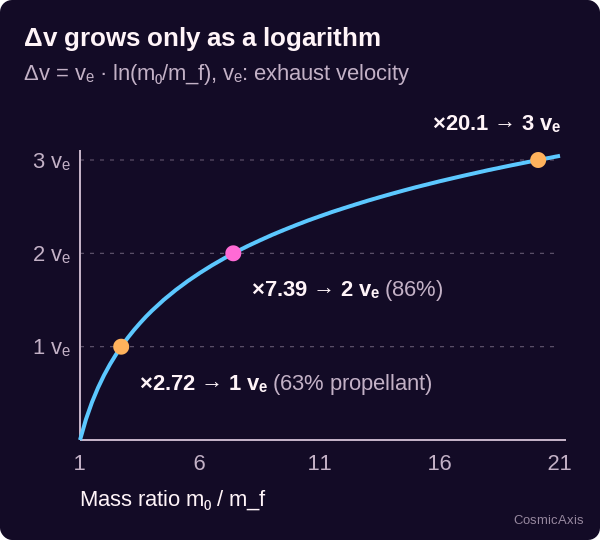
Delta-v grows only with the logarithm of the mass ratio because every additional vₑ of delta-v multiplies the mass ratio by another factor of e = 2.718 (calculated by CosmicAxis from the NASA Glenn equation):
- Δv = 1 vₑ: MR = 2.72, propellant 63.2%.
- Δv = 2 vₑ: MR = 7.39, propellant 86.5%.
- Δv = 3 vₑ: MR = 20.09, propellant 95.0%.
From 2 to 3 vₑ, propellant rises only from 86.5% to 95.0%, but the share left for structure and payload shrinks from 13.5% to 5.0%. The added propellant must itself be accelerated.
NASA astronaut Don Pettit called this the tyranny of the rocket equation in an article dated 1 May 2012. In Pettit’s account, the destination fixes delta-v, the propellant fixes exhaust velocity, and together they fix the propellant fraction; engineers can shave off only a few percent. Because vₑ sits in the exponent, raising it is the most effective lever.
Why is a single stage to orbit (SSTO) so hard?
A single stage to orbit (SSTO) is hard because the rocket equation leaves only a few percent of the mass for structure and payload, while the structure of a real rocket stage already takes almost all of it.
Source
NASA TM-2015-218760; SP-2000-4029; L3Harris; NASA MSFC; calculated by CosmicAxis
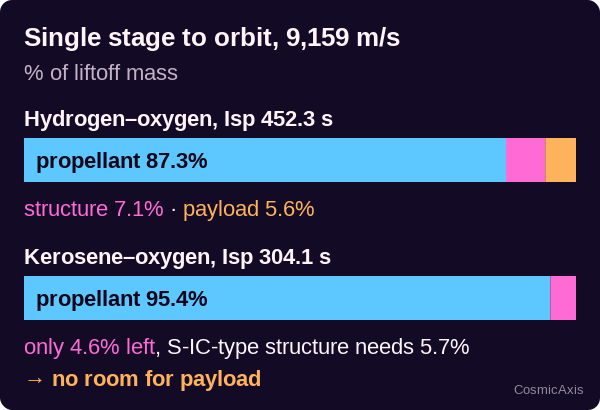
The calculation uses 9,159 m/s to a 200 km orbit (NASA TM-2015-218760) and vacuum Isp, the most optimistic case:
- Kerosene–liquid oxygen, Isp 304.1 s as for the F-1 engine (NASA MSFC): MR = 21.57, propellant 95.4%, leaving 4.64%. With the S-IC stage’s ε = 5.73%, λ = −1.16%: it cannot fly even with no payload.
- Liquid hydrogen–oxygen, Isp 452.3 s as for the RS-25 (L3Harris): MR = 7.88, propellant 87.3%. With the hydrogen S-II stage’s ε = 7.54%, λ = 5.56%.
The 5.56% figure is an upper bound: sea-level Isp is lower, and S-II thrust (1,120,216–1,157,707 lb) exceeds the stage’s fully fueled mass (1,059,171 lb) by only 6–9% (Apollo 11 Press Kit). Larger engines, heat shielding and landing gear all add to ε, and liquid hydrogen is less dense than kerosene, so its tanks are larger (NASA MSFC).
Pettit treats the 4% structure of the Space Shuttle External Tank, a tank with no engine, as the practical limit. An SSTO must push ε close to that, for example with composite materials; real rockets choose staging.
02Practice
How do I calculate mass ratio for different delta-v and Isp in Python?
Calculating mass ratio needs only math.exp in Python: MR = e^(Δv / (Isp · g₀)). The code tabulates MR for three delta-v and three Isp values, then computes the payload fraction of the single-stage rockets above.
import math

G0 = 9.80665  # m/s², exact by definition (NIST)

def mass_ratio(dv, isp):
    # m0/mf needed for delta-v dv (m/s) at specific impulse isp (s)
    return math.exp(dv / (isp * G0))

def payload_fraction(dv, isp, eps):
    # eps = dry / (dry + propellant); result is payload / m0
    return (1 / mass_ratio(dv, isp) - eps) / (1 - eps)

# Isp (s): F-1 sea level, F-1 vacuum (NASA MSFC), RS-25 (L3Harris)
ISP = {"F-1 SL": 265.4, "F-1 vac": 304.1, "RS-25": 452.3}
DV = {"TLI": 3050, "LEO→GEO": 3932, "To LEO": 9159}

print(f"{'':9}" + "".join(f"{k:>9}" for k in ISP))
for name, dv in DV.items():
    print(f"{name:9}" + "".join(f"{mass_ratio(dv, i):9.2f}" for i in ISP.values()))

for name, isp, eps in [("kerosene", 304.1, 0.0573), ("hydrogen", 452.3, 0.0754)]:
    print(f"1 stage {name}, eps {eps:.2%}: payload {payload_fraction(9159, isp, eps):.2%}")
Output from a real run on CosmicAxis’s machine (Python 3.14.6):
            F-1 SL   F-1 vac    RS-25
TLI           3.23     2.78     1.99
LEO→GEO       4.53     3.74     2.43
To LEO       33.75    21.57     7.88
1 stage kerosene, eps 5.73%: payload -1.16%
1 stage hydrogen, eps 7.54%: payload 5.56%
The delta-v values: 3,050 m/s is the Apollo 11 burn toward the Moon (see the trajectory to the Moon), 3,932 m/s is the Hohmann transfer from low orbit to geostationary, and 9,159 m/s is the total to low Earth orbit. With the same F-1 engine, burning at sea level needs MR 33.75 instead of 21.57: Isp drops 13% but MR rises 56%.
Exercise: add the 4,220 s Isp of the NEXT-C ion engine (NASA GRC), then vary ε from 0.04 to 0.10 to find the largest ε at which a single-stage hydrogen rocket still carries payload. For gravity and multiple burns, use NASA’s GMAT.
03Reality
What propellant fractions do Saturn V, the Space Shuttle and Falcon 9 have?
Apollo 11’s Saturn V weighed 6,477,875 lb (2,938 tonnes) at ignition, of which 5,943,946 lb was propellant in the three stages, or 91.8% (CosmicAxis sum from the NASA SP-2000-4029 mass tables).
| Rocket or stage | Propellant (% of mass) | Structure ε (%) | Source, date accessed |
|---|---|---|---|
| Stage 1 S-IC (kerosene–oxygen) | 94.2 | 5.73 | SP-2000-4029, CosmicAxis calc., 2026-10-03 |
| Stage 2 S-II (hydrogen–oxygen) | 92.3 | 7.54 | SP-2000-4029, CosmicAxis calc., 2026-10-03 |
| Stage 3 S-IVB (hydrogen–oxygen) | 89.9 | 9.52 | SP-2000-4029, CosmicAxis calc., 2026-10-03 |
| Space Shuttle, whole system | 85 | — | Pettit, NASA 2012, 2026-10-03 |
| Space Shuttle External Tank | 96 | 4 | Pettit, NASA 2012, 2026-10-03 |
| Soyuz (3 kerosene–oxygen stages) | 91 | — | Pettit, NASA 2012, 2026-10-03 |
The higher the stage, the larger ε, because a small stage still needs engines and pressurized tank walls. Pettit lists Saturn V as “85% propellant”, lower than the 91.8% summed from NASA’s table.
Payload is much smaller: Pettit gives Saturn V’s payload to orbit as about 4% of liftoff mass and the Space Shuttle’s as about 1%. Falcon 9 weighs 549,054 kg and carries 22,800 kg to low orbit (SpaceX, 2019), a payload fraction of 4.15% (calculated by CosmicAxis); SpaceX does not publish dry mass per stage. A reusable first stage helps lower the rocket launch cost.
NASA’s X-33 SSTO project ended before flying. The half-scale model of the single-stage VentureStar took off at 285,000 lb with 210,000 lb of hydrogen–oxygen (73.7% propellant) and would only have flown suborbital up to Mach 13 (NASA MSFC). NASA stopped funding on 1 March 2001 (NASA History).
Who found the rocket equation before Tsiolkovsky?
William Moore, a mathematics teacher at the Royal Military Academy, Woolwich (England), wrote rocket velocity as the natural logarithm of the mass ratio in papers from November 1810 and a book in 1813, nearly 100 years before Tsiolkovsky (Johnson 1995).
Moore took up the problem because of a 1810 prize question from the Copenhagen Academy; his vertical-flight formula has a “hyp. log” (natural logarithm) term of the mass ratio minus a gravity term (Johnson 1995).
Konstantin Tsiolkovsky applied the equation to spaceflight. In 1903 he published the report “Exploration of Outer Space by Means of Reaction Devices”, proposing liquid propellant and stating that a rocket’s velocity and range are limited only by its exhaust velocity (NASA Glenn). Pettit writes that Tsiolkovsky was the first to apply conservation of momentum to a rocket, so the equation carries his name.
Tsiolkovsky had no engine to test; Robert Goddard launched the first liquid-propellant rocket on 16 March 1926, flying 2.5 seconds to a height of 12.5 m (NASA Glenn). Since then the rocket equation has been the first calculation for every spacecraft, from Saturn V to Starship.
04Milestone
Milestone: check yourself
If you can do all of these, move on to the next article in this phase.
- Can you write the rocket equation and state what vₑ, m₀ and m_f mean?
- Can you calculate the mass ratio needed for 9,159 m/s at an Isp of 452.3 s?
- Can you explain why a structural fraction ε of 5.7% rules out a single-stage kerosene rocket?
- Can you recompute Saturn V's 91.8% propellant share from the NASA table?
Frequently asked questions
Who was Tsiolkovsky and what did he invent?
Konstantin Tsiolkovsky (1857–1935) was a Russian mathematics teacher who had been deaf since childhood (Smithsonian). In 1903 he published the rocket equation and proposed liquid-propellant rockets (NASA Glenn).
Does the Tsiolkovsky rocket equation include gravity?
The ideal form does not include gravity or drag. NASA Glenn also gives a version with weight: during ascent gravity subtracts delta-v in proportion to burn time, so real rockets carry extra propellant to cover that loss.
What is the tyranny of the rocket equation?
It is the title of a 2012 article by NASA astronaut Don Pettit: once the destination and propellant are chosen, the propellant share of a rocket can hardly be changed.
References
- NASA Glenn — Ideal Rocket Equation — accessed
- NIST CODATA — g_n — accessed
- Pettit — The Tyranny of the Rocket Equation, NASA, 2012 — accessed
- NASA Glenn — 20th Century and Beyond — accessed
- Smithsonian NASM — Pioneers of Flight: Tsiolkovsky — accessed
- Johnson — William Moore's Treatise on the Motion of Rockets, 1995 — accessed
- Orloff — Apollo by the Numbers, NASA SP-2000-4029 — accessed
- NASA — Apollo 11 Press Kit, 1969 — accessed
- NASA/TM-2015-218760 — accessed
- L3Harris — RS-25 spec sheet, 07/2024 — accessed
- NASA MSFC — Saturn F-1 Engine — accessed
- NASA Glenn — NEXT-C fact sheet — accessed
- SpaceX — Falcon 9, 2019 — accessed
- NASA MSFC — X-33 fact sheet — accessed
- NASA History — X-33 History Project — accessed
Cite this article
CosmicAxis. (2026). Tsiolkovsky Rocket Equation: Formula and Derivation. https://cosmicaxis.space/en/tsiolkovsky-rocket-equation/