
How Do Rockets Work?
Source
NASA Glenn Research Center
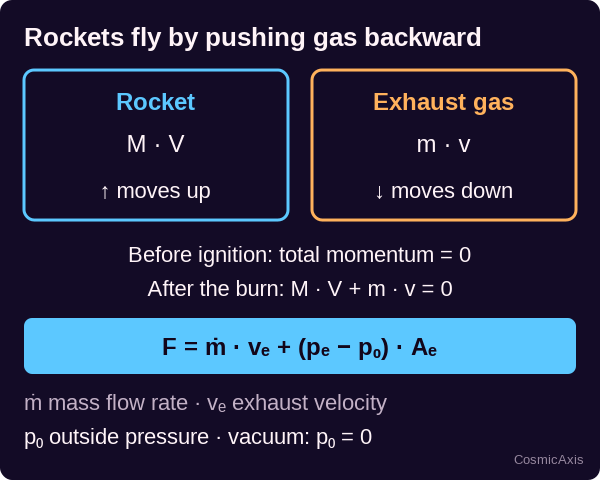
Rockets work by Newton's third law and conservation of momentum: the engine throws gas backward, and the gas pushes the rocket forward. Thrust equals mass flow rate times exhaust velocity, plus a pressure term at the nozzle exit (NASA Glenn), so a rocket needs no air to push against.
01Knowledge
What principle do rockets work by?
Rockets work by Newton’s third law: the engine pushes a mass of gas backward, and the gas pushes the rocket forward with a force equal in size and opposite in direction. NASA Glenn states it this way: when one object exerts a force on a second object, the second exerts an equal and opposite force on the first.
Physics calls this jet propulsion, and its law is conservation of momentum. Momentum is mass times velocity: p = m · v. A rocket standing on the pad has total momentum 0. When the engine throws gas of mass m downward at velocity v, the rocket of mass M moves up at velocity V so that M · V + m · v is still 0.
The two forces are equal, but the NASA Rockets Educator Guide points out that the mass of gas thrown out at any moment is far smaller than the mass of the rocket. The gas therefore accelerates a lot and the rocket accelerates a little. This opens the foundations stage: every spacecraft engine, from chemical rockets to ion thrusters, runs on this principle.
What is the rocket thrust formula?
Rocket thrust equals the mass flow rate times the exhaust velocity, plus the pressure difference at the nozzle exit times the exit area: F = ṁ · vₑ + (pₑ − p₀) · Aₑ (NASA Glenn). Here ṁ is the mass flow rate (kg/s), vₑ is the exhaust velocity, pₑ is the gas pressure at the exit of the de Laval nozzle, p₀ is the outside pressure, and Aₑ is the nozzle exit area.
The term ṁ · vₑ is the momentum of the gas thrown out each second, so it is Newton’s third law written as a formula. By CosmicAxis calculation, 1 kg of gas per second at 2,000 m/s gives 2,000 N, the weight of a 204 kg object (2,000 ÷ 9.80665). The pressure term is zero only at the nozzle’s design condition, which is why NASA Glenn uses the full equation. Dividing thrust by the weight of gas expelled per second gives specific impulse (Isp).
Why do rockets work in a vacuum?
Rockets work in a vacuum because a rocket pushes on the gas it throws out, not on the air around it. “No air needed” has two meanings. First, the rocket needs no air to lean on: it does not “kick” the air the way a foot kicks the ground, because the thrust comes from the exhaust (ṁ · vₑ). Second, the rocket needs no oxygen from the air: it carries its own oxidizer, while turbine engines and propellers must draw air in to run (NASA Glenn).
Outside air enters the thrust equation in one place, and there it reduces thrust. p₀ is the air pressure pressing back on the nozzle exit, so it is subtracted in the term (pₑ − p₀) · Aₑ. In a vacuum p₀ = 0, nothing presses back, and this term is at its maximum: the same engine pushes harder in a vacuum than on the ground.
The myth that “a rocket needs air to push against” once reached a major newspaper. According to NASA and the National Air and Space Museum (NASM), the New York Times editorial of 13 January 1920 said Robert Goddard did not understand action and reaction, and that a rocket needed something better than a vacuum to push against. The newspaper’s archive blocked access when CosmicAxis checked, so this article cites those two sources instead.
| Date | Event | Source, date viewed |
|---|---|---|
| 1919 | Smithsonian publishes Goddard’s report “A Method of Reaching Extreme Altitudes” | NASM, 2026-09-29 |
| 13 Jan 1920 | New York Times editorial mocks the idea of a rocket flying in a vacuum | NASA History, NASM, 2026-09-29 |
| 16 Mar 1926 | Goddard launches the first liquid-fueled rocket | NASA History, 2026-09-29 |
| 17 Jul 1969 | New York Times issues a correction, one day after Apollo 11 lifts off | NASA History, NASM, 2026-09-29 |
Goddard had tested exactly this before he was mocked. The summary of his manuscript says repeated burns in a vacuum chamber showed the exhaust velocity was real and not an effect of the jet pushing on air; at a pressure equal to an altitude of about 30 miles (48 km), the velocity was even higher than at atmospheric pressure. The 1969 correction said the experiment had confirmed Isaac Newton’s finding: a rocket works in a vacuum as well as in the atmosphere.
How does the rocket equation come from momentum conservation?
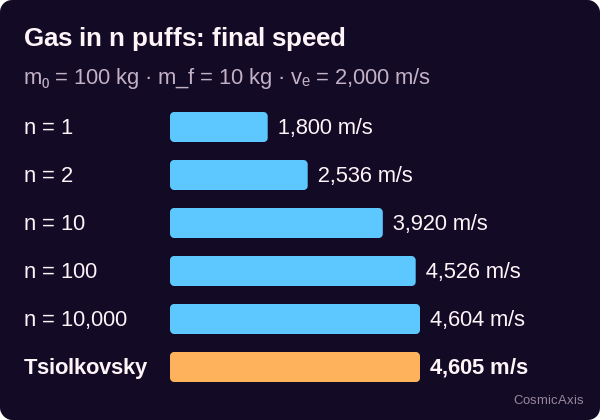
The Tsiolkovsky rocket equation is momentum conservation applied to a great many small puffs of gas thrown out one after another. The calculus derivation gives the same result: integrating dv = −vₑ · dm/m. The Python code below takes a 100 kg rocket, 90 kg of it propellant, at rest in space and expelling gas at 2,000 m/s relative to the rocket, with the propellant split into n puffs.
Source
CosmicAxis calculation
import math

U, M0, MF = 2000.0, 100.0, 10.0   # exhaust speed m/s, start mass kg, end mass kg

def burn_in_puffs(n):
    m, v, p_gas = M0, 0.0, 0.0
    dm = (M0 - MF) / n
    for _ in range(n):
        v_new = v + dm * U / m   # (m − dm)·v_new + dm·(v_new − U) = m·v
        p_gas += dm * (v_new - U)   # momentum carried away by this puff
        m, v = m - dm, v_new
    return v, m * v + p_gas

for n in (1, 2, 10, 100, 10000):
    v, p = burn_in_puffs(n)
    print(f"{n:>6} puffs: {v:7.1f} m/s | total momentum {round(p) + 0}")
print(f"Tsiolkovsky: {U * math.log(M0 / MF):7.1f} m/s")
Output (Python 3.14):
     1 puffs:  1800.0 m/s | total momentum 0
     2 puffs:  2536.4 m/s | total momentum 0
    10 puffs:  3920.4 m/s | total momentum 0
   100 puffs:  4525.5 m/s | total momentum 0
 10000 puffs:  4604.4 m/s | total momentum 0
Tsiolkovsky:  4605.2 m/s
The more puffs, the closer the speed gets to vₑ · ln(m₀ / m_f) = 2,000 × ln 10 = 4,605.2 m/s, the rocket equation from the delta-v budget article. One puff does much worse because all 90 kg of gas pushes while the rocket still weighs 100 kg; with gradual burning, later puffs push an already lighter rocket.
Exhaust velocity sits in the exponent, a point Goddard stressed in 1919. By CosmicAxis calculation, reaching 2,000 m/s with an exhaust velocity of 1,000 ft/s (305 m/s, the level Goddard measured for ordinary rockets of his day) needs a mass ratio of 707; with almost 8,000 ft/s (2,434 m/s, the level he reached with a steel chamber and nozzle) it needs only 2.27.
02Practice
How can you build a water rocket to see Newton’s third law?
A water rocket shows Newton’s third law with your own eyes: water pushed down is the force, and the bottle pushed up is the reaction (NASA Rockets Educator Guide). According to NASA, a bottle holding only compressed air does not fly high because the mass of air is tiny; with water, the air must push the water out first, the mass thrown out grows, and so does the thrust.
In Vietnam, water rockets are a familiar STEM activity. The 2025–2026 National STEM, AI and Robotics Championship added them for the first time: single-stage for lower secondary, two-stage for upper secondary, final on 10 May 2026 at Hoa Lac; the rules allowed only a PET bottle, water, air, and a hand or foot pump (Tiền Phong).
The NASA guide says a new PET bottle withstands about 100 psi or more and recommends a safety factor of 2, so students should not pump above 50 psi (3.4 bar); people near the launcher wear safety glasses, everyone else stands 15–30 ft (4.6–9.1 m) away, and the bottle is retired after 10 flights. Build water rockets in a club or a class with a teacher, on the school’s launcher; CosmicAxis does not give instructions for building pressure vessels yourself.
What should you practice after water rockets?
The next step is a model rocket with a certified commercial motor, flown under the rules of the National Association of Rocketry (NAR) or Tripoli. The NAR safety code requires certified commercial motors only, with no tampering. CosmicAxis gives no instructions for making motors or mixing propellant.
Once a model rocket can carry instruments, the next step is a flight computer that estimates altitude with a Kalman filter. Going step by step splits the job of building a crewed spacecraft the way systems engineering does.
03Reality
What did Goddard’s flight of 16 March 1926 prove?
Robert Goddard’s flight of 16 March 1926 proved that a liquid-fueled engine can lift a rocket: it burned gasoline and liquid oxygen, rose 41 ft (12.5 m) in 2.5 seconds, and landed 184 ft (56 m) from the launch stand in a cabbage field in Auburn, Massachusetts (NASA History).
Goddard put the engine on top and the tank below because he thought it more stable (NASA History). The NASA educator guide calls the flight unimpressive, yet it was the forerunner of the Saturn V that took people to the Moon 43 years later.
The lesson for engineers: a correct theory needs measurements, as Goddard measured exhaust in a vacuum chamber; and a misconception can live 49 years in a major newspaper, so check a claim’s source before believing it.
04Milestone
Milestone: check yourself
If you can do all of these, move on to the next article in this phase.
- Can you explain why the gas and the rocket feel equal forces, yet the rocket accelerates much less?
- Can you say which term of the thrust equation grows when a rocket reaches a vacuum?
- Can you run the code that burns gas in n puffs and see the result approach 4,605.2 m/s?
- Can you explain what the 1920 New York Times editorial got wrong?
Frequently asked questions
What law governs jet propulsion?
Jet propulsion follows conservation of momentum: the rocket and the exhaust gain equal and opposite momentum, so the total momentum of the system does not change.
Do rockets need air to push against?
No. A rocket pushes on the gas it throws out, and it carries its own oxidizer, so it can burn where there is no air (NASA Glenn).
What is the rocket thrust formula?
Rocket thrust is F = ṁ·vₑ + (pₑ − p₀)·Aₑ: mass flow rate times exhaust velocity, plus the pressure difference at the nozzle exit times the exit area (NASA Glenn).
How does a water rocket work?
A water rocket uses the same principle: compressed air pushes water down, and the water pushes the bottle up. Water adds mass to the exhaust, so thrust is larger than from air alone (NASA).
References
- NASA Glenn — Rocket Thrust Equation (updated 19 July 2024) — accessed
- NASA Glenn — Newton's Laws of Motion — accessed
- NASA — Rockets Educator Guide — accessed
- Goddard — A Method of Reaching Extreme Altitudes, 1919 manuscript, Smithsonian Libraries — accessed
- NASA History — 95 Years Ago: Goddard's First Liquid-Fueled Rocket — accessed
- NASM — Who Was the Original Rocket Man?, Air & Space Quarterly issue 19, 17 June 2026 — accessed
- NAR — Model Rocket Safety Code — accessed
- Tiền Phong — National STEM, AI and Robotics Championship tries water rockets, 10 May 2026 — accessed
Cite this article
CosmicAxis. (2026). How Do Rockets Work? Newton's Third Law and Thrust. https://cosmicaxis.space/en/how-rockets-work/