
Crew Dragon explosion in 2019: what happened?
Source
SpaceX, Update: In-Flight Abort Static Fire Test Anomaly Investigation (15 July 2019)
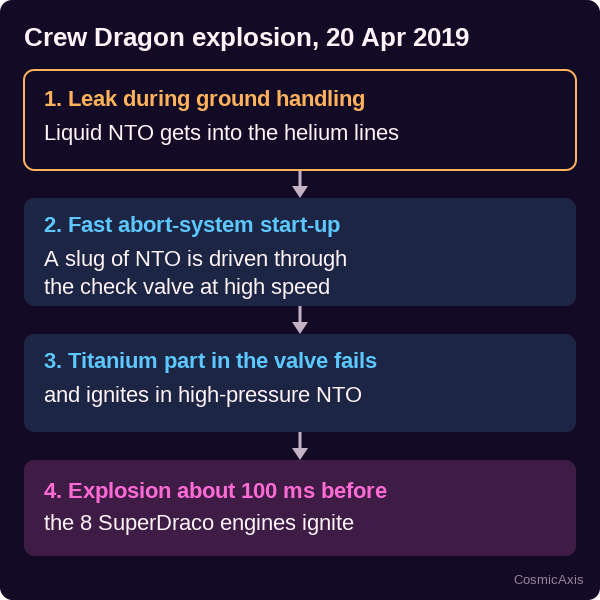
The Crew Dragon explosion destroyed the capsule that flew Demo-1, on 20 April 2019, during a static fire of 8 SuperDraco engines at Cape Canaveral. Per SpaceX (15 July 2019), NTO leaked into high-pressure helium lines, was driven through a check valve and ignited titanium; SpaceX replaced the valves with burst disks.
01Knowledge
What was the Crew Dragon explosion of 20 April 2019?
The Crew Dragon explosion destroyed a SpaceX Crew Dragon capsule at 18:13 UTC on 20 April 2019, during a static fire on a test stand at Landing Zone 1, Cape Canaveral (SpaceX, 15 July 2019). No one was injured (NASA, 28 May 2019).
The capsule had just flown the uncrewed Demo-1 mission: launched on 2 March 2019, docked with the International Space Station (ISS), splashed down in the Atlantic on 8 March 2019 (NASA). SpaceX was reusing it for the in-flight abort test and re-tested its propulsion on the ground first. The 12 Draco engines fired normally; the capsule was destroyed as the 8 SuperDraco engines were starting.
The capsule was in certification for the Commercial Crew program, so this is a case study in human-rating test programs.
Which two propulsion systems does Crew Dragon have, and why test SuperDraco on the ground?
Crew Dragon has two bi-propellant systems: a low-pressure one with 16 Draco engines for orbital maneuvers, and a high-pressure one with 8 SuperDraco engines used only for a launch abort (SpaceX, 15 July 2019).
Per NASA (28 May 2019), the static fire was to check the Dracos after flight and prove the SuperDracos work in the integrated, helium-pressurized system. Each SuperDraco had been tested hundreds of times, but single-engine tests cannot replace a whole-system test on a capsule that has just flown.
Why did a titanium check valve ignite in NTO?
The titanium check valve ignited because a slug of liquid NTO was driven through it at high speed, damaging the titanium inside, and damaged titanium in high-pressure NTO is enough to ignite (SpaceX, 15 July 2019). NTO (nitrogen tetroxide, N₂O₄) is a strong, toxic oxidizer.
SpaceX’s statement describes four steps:
- Leak during ground handling. A leaking component let liquid NTO into the high-pressure helium lines.
- A slug of liquid is driven. When the abort system was started quickly, the NTO slug was driven through the helium check valve at high speed, damaging the valve structure.
- Titanium ignites. Damaged titanium in high-pressure NTO ignited the valve, leading to the explosion.
- Timing. The event occurred about 100 milliseconds before the 8 SuperDracos were due to ignite, while the propulsion system was being pressurized.
The SpaceX-led team, with NASA participating and the FAA and NTSB observing, built a comprehensive fault tree. Debris showed burn marks in the valve, the recovered SuperDracos were intact, and titanium flammability in NTO was tested at McGregor, Texas.
The key sentence of the statement is that the reaction between titanium and NTO at high pressure was “not predicted”. Titanium, a common spacecraft metal, had been used safely for decades; in CosmicAxis’s reading, this mechanism lay outside the material data available to designers.
How is a check valve different from a burst disk, and why did SpaceX switch?
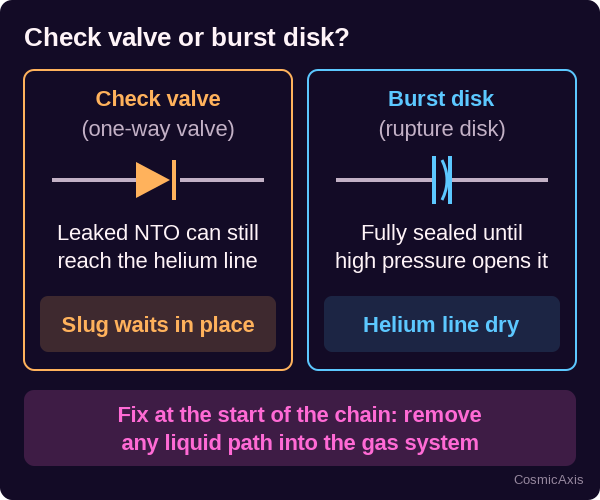
SpaceX replaced the check valve with a burst disk because a burst disk seals completely until high pressure opens it, so liquid propellant has no path into the pressurization system (SpaceX, 15 July 2019). A check valve normally lets fluid flow one way, so a flow path remains.
Source
SpaceX (15 July 2019); NASA OIG IG-20-005 (2019)
The fix targeted the start of the chain, not titanium. NASA OIG calls the burst disk a pressure-relief safety device, placed so liquid is not trapped in the lines during pressurization.
| Criterion | Check valve | Burst disk | Source, date viewed |
|---|---|---|---|
| How it blocks flow | Normally one direction only | Fully sealed until high pressure opens it | SpaceX 15 July 2019 · 2026-10-03 |
| Path for NTO into the helium line while the capsule waits | Present (occurred April 2019) | Removed | SpaceX 15 July 2019 · 2026-10-03 |
| Verification | — | Static fire repeated successfully 13 November 2019 | NASA 13 November 2019; ASAP 2019 · 2026-10-03 |
This matches failure modes and effects analysis (FMEA) logic: when a failure mode is not fully understood, removing its preconditions is sturdier than tuning material parameters.
02Practice
How can you build the Crew Dragon fault tree and compare two designs in Python?
The fault tree of the explosion is a single AND gate: the capsule explodes only if all four basic events occur (NTO leak, an open liquid path into the helium line, a slug driven through, titanium ignition), so the top-event probability is the product of the four. Building the tree and finding minimal cut sets is covered in fault tree analysis.
Every probability in the code is a CosmicAxis assumption, not a SpaceX or NASA number. cut_sets recurses through the gates and stops beyond 10 levels.
from itertools import product

# Chain per SpaceX 15 Jul 2019; every probability is a CosmicAxis ASSUMPTION
TREE = ("AND", [("AND", ["NTO_leak", "liquid_path_open"]), "slug_driven", "titanium_ignites"])

def cut_sets(node, depth=0):
    """Minimal cut sets of an AND/OR tree; stops if deeper than 10 levels."""
    if depth > 10:
        raise RecursionError("tree too deep")
    if isinstance(node, str):
        return [frozenset([node])]
    gate, children = node
    groups = [cut_sets(c, depth + 1) for c in children]
    if gate == "OR":
        return [s for g in groups for s in g]
    return [frozenset().union(*combo) for combo in product(*groups)]

def p_top(p):
    total = 0.0
    for s in cut_sets(TREE):  # rare-event approximation: sum the product of each cut set
        prod = 1.0
        for e in s:
            prod *= p[e]
        total += prod
    return total

print("Cut sets:", [sorted(s) for s in cut_sets(TREE)])
for ti in (0.0, 0.5):  # 0 = belief before 2019: titanium does not ignite in NTO
    check = {"NTO_leak": 1e-2, "liquid_path_open": 1.0, "slug_driven": 0.9, "titanium_ignites": ti}
    disk = dict(check, liquid_path_open=1e-3)  # disk stays sealed until high pressure opens it
    print(f"P(titanium ignites) = {ti}: check valve {p_top(check):.1e}, "
          f"burst disk {p_top(disk):.1e}")
# Cut sets: [['NTO_leak', 'liquid_path_open', 'slug_driven', 'titanium_ignites']]
# P(titanium ignites) = 0.0: check valve 0.0e+00, burst disk 0.0e+00
# P(titanium ignites) = 0.5: check valve 4.5e-03, burst disk 4.5e-06
Running it with Python 3.14 (CosmicAxis calculation) gives two lessons:
- A fault tree is only as good as its inputs. Believing titanium does not ignite in NTO (probability 0) makes the whole tree report 0, though the other three events can still happen. That was the situation before 20 April 2019.
- Cutting the start of the chain needs no complete physics. With an assumed ignition probability of 0.5, a burst disk (assumed to pass liquid 1 time in 1,000) cuts the explosion probability 1,000-fold, from 4.5×10⁻³ to 4.5×10⁻⁶, and the factor holds for any non-zero ignition probability.
Exercise: add an OR gate under “liquid path open” (burst disk leaks, burst disk opens early) and watch the cut sets change.
03Reality
How did the explosion change the Demo-2 schedule and the in-flight abort test?
The explosion forced SpaceX to reshuffle capsules: the one meant for Demo-2 became the in-flight abort test vehicle, and the one meant for the first operational mission, Crew-1, was reassigned to Demo-2 (SpaceX, 15 July 2019; NASA, 28 May 2019).
Per NASA OIG (14 November 2019), SpaceX’s crewed test flight, planned for December 2019, could slip because of burst disk testing and analysis. The explosion was not the only cause: OIG recorded that parachute design flaws also delayed the crewed flight by at least 3 months.
On 13 November 2019, after the pressurization system was redesigned, SpaceX repeated the static fire near Landing Zone 1 (NASA):
- 2 Draco engines fired twice, 1 second each time.
- 8 SuperDraco engines fired for their full duration, about 9 seconds.
- 2 more Dracos rotated the capsule to the parachute-deployment attitude and the 8 SuperDraco covers closed; the sequence lasted about 70 seconds.
That test cleared the way for the in-flight abort test on 19 January 2020, then Demo-2 with Behnken and Hurley on 30 May 2020 (NASA). The 2019 ASAP report records that the investigation produced several corrective actions and design changes.
What does the Crew Dragon explosion teach about testing crewed spacecraft?
The main lesson of the Crew Dragon explosion is that testing did its job: a potentially lethal failure mode showed up on a test stand, with an uncrewed capsule, instead of in a crewed flight. The test sequence required before crewed certification exists to catch this kind of flaw.
- Test the whole system in a realistic state. The flaw appeared only when the integrated system started on a capsule that had just flown and been through ground handling. That is why verification and validation, core activities of systems engineering, call for integrated-level testing, as close to flight as possible. Fixing the start of the chain, as the burst disk does, blocks the cause without full knowledge of titanium chemistry in NTO.
Hazards outside the design data have hidden elsewhere too: in the Challenger O-ring failure the seal design proved too sensitive to temperature, and in the SpaceShipTwo crash the NTSB found that a single human error had not been considered.
In the 2024 Starliner case, attitude-control thrusters failed with two astronauts already aboard; the Crew Dragon flaw surfaced before anyone entered the cabin.
04Milestone
Milestone: check yourself
If you can do all of these, move on to the next article in this phase.
- Can you recount the four steps of the failure chain as stated by SpaceX on 15 July 2019?
- Can you explain why a burst disk blocks the cause without anyone knowing exactly how titanium burns in NTO?
- Can you run the fault tree code and explain why assuming probability 0 for one basic event makes the whole tree report "safe"?
- Can you explain why finding the flaw in a ground test was a good outcome for a crewed program?
Frequently asked questions
Was anyone injured in the 2019 Crew Dragon explosion?
No one was injured in the Crew Dragon explosion on 20 April 2019 (NASA, 28 May 2019). According to SpaceX, the test area had been cleared under a predefined safety procedure.
How is a burst disk different from a check valve?
Per SpaceX (15 July 2019), a check valve normally lets fluid flow in one direction only, while a burst disk seals completely until high pressure opens it. That removes any path for liquid propellant into the pressurization system.
How much did the explosion delay the crewed Crew Dragon flight?
NASA OIG (November 2019) noted that SpaceX's crewed test flight, once planned for December 2019, could slip. OIG also cited parachute design flaws. Demo-2, carrying Behnken and Hurley, launched on 30 May 2020 (NASA).
References
- SpaceX — In-Flight Abort Static Fire Test Anomaly Investigation, 15 July 2019 — accessed
- NASA blog — Crew Dragon Static Fire Investigation, 28 May 2019 — accessed
- NASA blog — Crew Dragon Static Fire Tests, 13 November 2019 — accessed
- NASA blog — Demo-1 launch, 2 March 2019 — accessed
- NASA blog — Demo-1 splashdown on 8 March 2019, posted 30 May 2020 — accessed
- NASA OIG IG-20-005, 14 November 2019 — accessed
- NASA ASAP — 2019 annual report — accessed
- NASA — In-flight abort test, 19 January 2020 — accessed
- NASA — Demo-2 launch, 30 May 2020 — accessed
Cite this article
CosmicAxis. (2026). Crew Dragon explosion 2019: why did a titanium valve ignite?. https://cosmicaxis.space/en/crew-dragon-explosion/