
Verification and validation: what is the difference?
Source
NASA NPR 7123.1D appendix A; NASA SP-2016-6105 Rev2 sections 5.3, 5.4
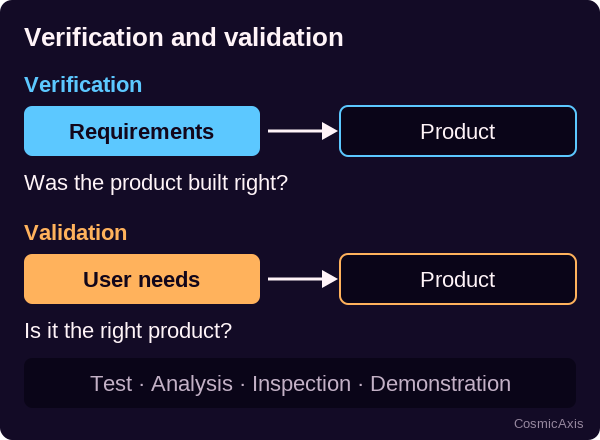
Verification proves a product meets every requirement: "did I build the product right?" Validation proves it does what users need in the intended environment: "did I build the right product?" (NASA NPR 7123.1D). Verification uses four methods: test, analysis, inspection and demonstration.
01Knowledge
What are verification and validation?
Verification is proving that a product meets the requirements written for it; validation is proving that the product does what users actually need. NASA’s systems engineering directive NPR 7123.1D (effective 5 July 2023) puts the two into two questions: “did I build the product right?” and “did I build the right product?”. Together they are called V&V.
Software testing uses the same pair: verification checks against the specification, validation against the need. V&V is the right-hand side of the V-model in systems engineering and the backbone of testing and human-rating, the phase that certifies spacecraft carrying people.
How do verification and validation differ?
Verification and validation differ in what the product is compared with: verification compares it with the approved set of requirements, validation with the concept of operations (ConOps) and the users’ expectations (NASA systems engineering handbook SP-2016-6105 Rev2, section 5.3).
| Criterion | Verification | Validation | Source (accessed 2026-10-03) |
|---|---|---|---|
| Question | Was the product built right? | Is it the right product? | NPR 7123.1D appendix A |
| Compared with | Requirements containing “shall” | ConOps, user expectations | SP-2016-6105 section 5.3 |
| Conditions | Controlled, detailed measurements | Real or simulated, real users | SP-2016-6105 section 5.3 |
| Also considers | — | Interfaces, training, crew health | SP-2016-6105 section 5.4 |
Per section 5.3, verification is done once per design; qualification is verification at the environmental margins; acceptance tests every flight unit to catch workmanship defects.
What are the four verification methods: test, analysis, inspection, demonstration?
NASA verifies each requirement by test, analysis, inspection, demonstration or a combination of them (NPR 7123.1D appendix A); the four initials form TAID.
| Method | What it does | Example, note | Source (accessed 2026-10-03) |
|---|---|---|---|
| Test | Operates the product, records detailed data | Uses the most resources | SP-2016-6105 section 5.3 |
| Analysis | Calculation, models, simulation | Before hardware exists; includes similarity to old designs | SP-2016-6105 section 5.3 |
| Inspection | Looks at the product, drawings, records | Safety pin with a red “Remove Before Flight” flag | SP-2016-6105 section 5.3 |
| Demonstration | Shows it works, no detailed measurement | Pilot reaches every switch in a mock cockpit | SP-2016-6105 section 5.3 |
Choosing a method trades certainty against cost. Analysis is cheaper than test but is trusted only in the range already checked against real tests, as with a finite element analysis (FEA) model. Similarity to a flown design is cheapest but valid only if the new design really matches the old one; the Genesis crash below shows what happens otherwise.
What is a verification matrix and requirements traceability?
A verification matrix is a table that lists every “shall” requirement with its own identifier, source document, verification method and result (NASA handbook, appendix D). A requirement without “shall” does not go in the matrix.
Each row must also trace both ways: up to its parent requirement and down to its child requirements (NPR 7123.1D appendix A). A requirement with no parent is an orphan: either redundant, or a root need was missed.
The handbook (section 5.3) treats a product as verified when there is objective evidence for every requirement (or an approved waiver) and every discrepancy report is closed.
A matrix is only as good as the evidence in it. The Hubble mirror flaw shows this: the primary mirror was ground and verified with a single measuring device, a lens inside that device was 1.3 mm out of place, so the measurement reported “pass” while the mirror had the wrong shape, and two other measurements that reported the error were dismissed as faulty (NASA, 11/1990).
What is “test like you fly” and when may you skip it?
“Test like you fly” means testing the system in the configuration, sequence and environment closest to flight; the NASA handbook (section 5.3) advises that the last end-to-end test be run on the flight unit itself, in flight configuration, before launch.
NPR 8705.2C (rationale for sections 2.4.3 and 2.4.4) calls testing the last line of defense against unforeseen subsystem interactions and requires both nominal and off-nominal scenarios. Not everything can be tested, so every exception needs two things:
- A reason why that item cannot or should not be tested as flown.
- An alternative validation, covering the flight environment and planned operating sequence.
After Genesis, the investigation board recommended approving “test like you fly” exceptions at every level of assembly (recommendation 11). For CubeSats, the most concrete form is long-duration testing, described in CubeSat failure rate.
Where does V&V fit in human-rating certification?
In NPR 8705.2C, verification and validation is one of 5 groups of certification requirements, alongside process and standards, design, flight test, certification and operations. How V&V is done, and its results, are recorded in the human-rating certification package (HRCP) at each review milestone.
| Review milestone | What goes into the HRCP | NPR 8705.2C section (accessed 2026-10-03) |
|---|---|---|
| SRR (system requirements review) | How technical requirements will be verified and validated | 2.4.1 |
| CDR (critical design review) | V&V of critical subsystems, including at integrated level; critical software tested with fault injection | 2.4.2–2.4.5 |
| ORR (operational readiness review) | V&V results; crew-loss risk model updated with test results | 2.4.6–2.4.10 |
Flight test (section 2.5) is the final validation step: it checks hardware, software and humans together in the real flight environment and also validates the analytical models themselves; NPR 8705.2C prefers an uncrewed test flight first. The other groups are covered in human-rated spacecraft.
02Practice
How do you build a verification matrix in Python?
A minimal verification matrix needs 5 columns: parent need, “shall” statement, planned method, method used and evidence ID. The Python below builds one for a hypothetical 1U CubeSat made up by CosmicAxis and marks “open” every row that lacks evidence (NASA handbook section 5.3), changes method without approval (the Genesis lesson) or has lost its parent (NPR 7123.1D).
# Verification matrix for a HYPOTHETICAL 1U CubeSat (made up by CosmicAxis)
# T = test, A = analysis, I = inspection, D = demonstration
PARENT = {"NC-1": "Survive launch", "NC-2": "Contact the ground"}

# id: (parent need, "shall" statement, planned method, method used, evidence)
MATRIX = {
    "R-1": ("NC-1", "Mass shall be <= 2.00 kg", "T", "T", "EV-01"),
    "R-2": ("NC-1", "Natural frequency shall be > 100 Hz", "A", "A", "EV-02"),
    "R-3": ("NC-1", "Safety pin shall have a red flag", "I", "I", None),
    "R-4": ("NC-2", "Antenna shall deploy on command", "T", "I", "EV-04"),
    "R-5": ("NC-2", "Link shall have >= 3 dB margin", "A", None, None),
    "R-6": ("NC-3", "Battery shall last >= 2 years", "A", "A", "EV-06"),
}

closed = 0
for rid, (parent, text, planned, used, evidence) in MATRIX.items():
    issues = []
    if parent not in PARENT:
        issues.append(f"orphan, no {parent}")
    if evidence is None:
        issues.append("no evidence")
    elif used != planned:
        issues.append(f"{planned}->{used} not approved")
    closed += not issues
    print(rid, "OPEN: " + "; ".join(issues) if issues else "CLOSED")
print(f"Closed {closed}/{len(MATRIX)} requirements")
# R-1 CLOSED
# R-2 CLOSED
# R-3 OPEN: no evidence
# R-4 OPEN: T->I not approved
# R-5 OPEN: no evidence
# R-6 OPEN: orphan, no NC-3
# Closed 2/6 requirements
Run on Python 3.14, only 2 of 6 requirements are closed. R-4 is exactly the Genesis kind of error: the plan says to test the antenna deployment, but in practice someone only looked at a drawing. R-6 connects to no need, so either a root need is missing or the requirement is superfluous. R-5 is a link budget row nobody has calculated.
Exercise: add a “verifier” column and flag rows the designer verified personally; add NC-3 “Operate for 2 years in orbit” so R-6 is no longer an orphan.
03Reality
Genesis 2004: how did a changed verification method crash the sample capsule?
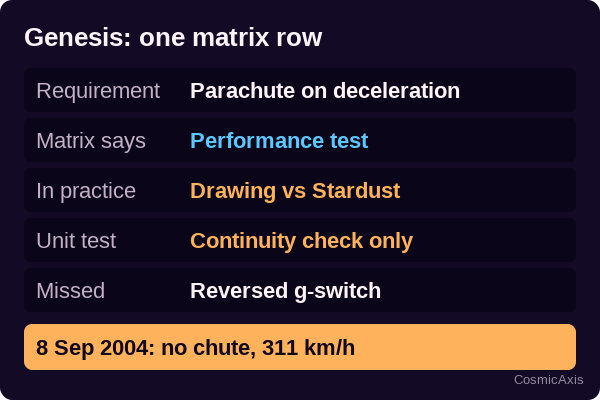
The Genesis sample capsule crashed at the Utah test range on 8 September 2004 because its g-switch (a deceleration threshold sensor) was installed backwards in the design itself, so it never sensed the deceleration on entry that should have commanded the parachute (Genesis Mishap Investigation Board report, volume I). The capsule tumbled and hit the ground at 311 km/h.
Source
Genesis Mishap Investigation Board Report, volume I (NASA, 2006)
The report records a chain of V&V errors:
- Requirement without a coordinate frame: the parachute requirement said “deceleration along the X axis” with no coordinate system or drawing of the vector direction.
- The right test was dropped: a centrifuge test to check sensor orientation was in the plan, then deleted and replaced by a drawing inspection; at two reviews the change was one obscure bullet and nobody asked.
- Method changed without paperwork: the matrix said “performance test”, but in practice the Genesis drawing was compared with the Stardust drawing, with no change request; the person comparing was an electrical engineer, unfamiliar with mechanical drawings, who got it wrong.
- The “unit test” measured the wrong thing: it checked continuity only, not installation direction.
The board listed “not testing as flown” and “unfounded confidence in heritage design” as two separate root-cause groups. Both sensor sets, side A and side B, were reversed identically, so redundancy could not rescue a common design error, just as the two identical inertial reference units failed together on Ariane 5 flight 501. A matrix row can be closed only when the approved method was followed, the person was qualified and the evidence measures the quantity the requirement names.
04Milestone
Milestone: check yourself
If you can do all of these, move on to the next article in this phase.
- Can you say what verification and validation each compare the product against?
- Can you pick a TAID method for a given requirement and justify it?
- Can you build a 6-row verification matrix with parent needs and find the open requirements?
- Can you explain why changing a verification method made the Genesis capsule crash?
Frequently asked questions
How do verification, qualification and acceptance differ?
Per the NASA systems engineering handbook (section 5.3), verification is done once per design; qualification is verification at the environmental margins; acceptance tests each flight unit to catch workmanship defects.
Can a product pass verification and still fail validation?
Yes. The NASA handbook (section 5.4) warns that a system can pass all verification and still fail validation if the concept of operations (ConOps) is weak; the usual result is a redesign.
What does TAID stand for?
TAID stands for test, analysis, inspection and demonstration, the four verification methods in NASA NPR 7123.1D appendix A. A requirement may also be verified by a combination of them.
Why did the Genesis capsule crash?
Its g-switch was installed backwards in the design, so it never sensed deceleration and never released the parachute. The capsule hit the ground at 311 km/h on 8 September 2004 (Genesis Mishap Investigation Board).
References
- NASA SP-2016-6105 Rev2, section 5.3 Product Verification — accessed
- NASA SP-2016-6105 Rev2, section 5.4 Product Validation — accessed
- NASA SP-2016-6105 Rev2, appendix D — accessed
- NASA NPR 7123.1D, appendix A — accessed
- NASA NPR 7123.1D, chapter 3 (sections 3.2.8, 3.2.9) — accessed
- NASA NPR 8705.2C, chapter 2 — accessed
- Genesis Mishap Investigation Board Report, volume I (NASA, 2006) — accessed
- Hubble Space Telescope Optical Systems Failure Report (NASA, 11/1990) — accessed
Cite this article
CosmicAxis. (2026). Verification and validation: V&V for spacecraft. https://cosmicaxis.space/en/verification-and-validation/