
Hubble Mirror Flaw (1990)
Source
Allen Report, NASA-TM-103443 (1990), chapter VIII and appendix D
The Hubble mirror flaw was a 2.4 m primary mirror ground 2.2 µm too flat at the edge (NASA), causing spherical aberration found in June 1990. The Allen report (1990) traced it to a lens in the test instrument misplaced by 1.3 mm, while two warning tests were dismissed. Mission STS-61 installed COSTAR and WFPC2 in December 1993.
01Knowledge
What was the Hubble mirror flaw of 1990?
The Hubble mirror flaw was an error in the shape of the 2.4 m primary mirror: its edge was ground 2.2 µm too flat (NASA), so the telescope could not focus starlight to a point. Space Shuttle Discovery launched the Hubble Space Telescope (HST) on 24 April 1990; the flaw was announced on 21 June 1990 (Allen report, 1990).
Hubble had to collect 70% of a star’s image energy within 0.1 arcsecond; real images needed 0.7 arcsecond. The Allen report expresses the error as a wavefront error of 0.4 wave root mean square (rms) at the 632.8 nm test wavelength, 10 times the tolerance.
This article follows the report of the board chaired by Lew Allen (NASA-TM-103443, November 1990), for the human-rating phase. Hubble carries no crew, but “trust one instrument, dismiss conflicting data” recurs in crewed-vehicle failures.
What is spherical aberration and why did the Hubble mirror have it?
Spherical aberration is an image error in which rays hitting the mirror edge focus at a different point from rays near the axis, so a star becomes a blurred spot with a halo. Hubble had it because too much glass was ground away at the edge (Allen report, appendix C).
The primary mirror is a concave hyperboloid, described by the vertex radius of curvature R (mm) and the unitless conic constant K: K = 0 is a sphere, K = −1 a paraboloid, K < −1 a hyperboloid. Tables E-1 and E-2 of the Allen report give R = 11,040.0 mm and K = −1.0022985 for the design, and K = −1.013236 as built (preliminary). A more negative K puts the edge lower than the correct shape, so edge rays focus farther from the mirror than designed.
The 0.3 m convex secondary mirror had no error: off-axis images show almost no coma, which a wrong secondary would produce.
How did the Perkin-Elmer null corrector end up 1.3 mm off?
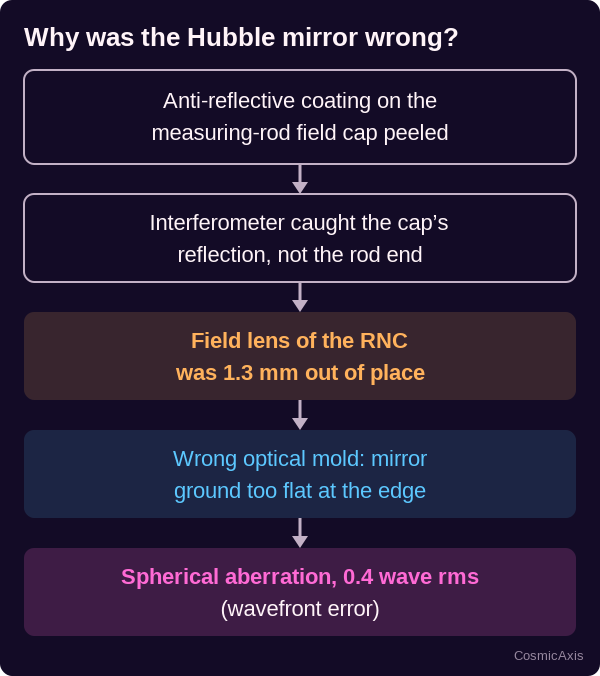
The field lens in Perkin-Elmer’s reflective null corrector (RNC) was placed about 1.3 mm too far from the mirror, while the spacing tolerance was only 10 µm (Allen report, chapters IV and VI). The RNC is the “mold” for polishing the primary mirror, so the mirror was ground to match a wrong mold, to better than 0.014 wave rms.
An aspheric mirror is hard to measure directly. A null corrector creates a reference wavefront so that a correct mirror shows straight, even fringes in an interferometer: “null” means no deviation is left. The RNC has two small spherical mirrors and a field lens.
Source
Allen Report, NASA-TM-103443 (1990), chapters VI and VII
The lens spacing was set with an Invar measuring rod, and the interferometer caught the reflection from the rod end. The field cap on the rod end had lost its anti-reflective coating around the hole; in the board’s reconstruction, the operator took the reflection from the cap surface instead. The lens ran out of adjuster travel, so a spacer was inserted; the nut was not locked as the procedure required, and no Material Review Board (MRB) record was found. The rod could not be fitted once the RNC was assembled, so nobody re-measured.
Why were two tests that reported the error dismissed?
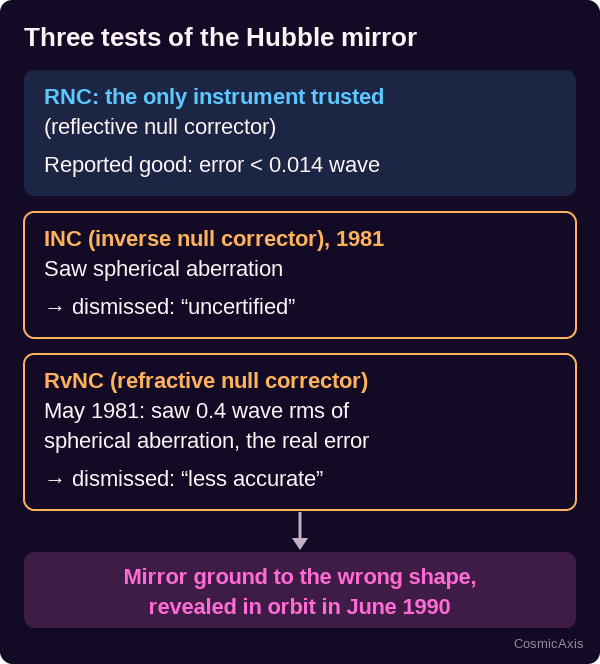
Two secondary tests saw spherical aberration in 1981 but were dismissed, because Perkin-Elmer treated the RNC as “certified” and the other two as “uncertified”; the board found no document recording any certification (Allen report, chapters VIII and IX).
- The inverse null corrector (INC) simulates a perfect primary mirror placed under the RNC. Its 1981 fringe images showed spherical aberration of the same size as the error found in orbit, but the result was blamed on the INC itself.
- The refractive null corrector (RvNC), used in May 1981 to measure the vertex radius of the mirror, saw 0.4 wave rms of spherical aberration, exactly the real error, but was considered less accurate.
The 1990 analysis showed the RvNC was accurate to 0.02 wave rms and the INC to 0.14: enough to catch a gross error, and they did. The board wrote that the independent data were rationalized away by the belief that only the RNC reached 0.01 wave. Perkin-Elmer’s Optical Operations department worked “behind closed doors”: a few people worried about the conflicting data, but the worry never left the department.
Why was the Hubble telescope not tested optically as a whole system before launch?
The telescope had no end-to-end optical test because a test at the required accuracy would have cost about as much as the whole Optical Telescope Assembly (OTA), needing two more large mirrors at least as big as the primary (Allen report, chapter IV.E).
The only post-assembly test used a 0.36 m auxiliary telescope to check focus position, with the OTA horizontal and sagging under gravity. According to the board, a much cruder test would have caught an error of this size; an advisory group proposed one late in the project, but nobody took it seriously, because they did not believe the risk was real and because of cost and schedule pressure.
The lesson is “Test Like You Fly”: checking each part does not replace checking the whole system, a gap that systems engineering verification and validation exist to close. In Ariane 5 flight 501, ground tests likewise never ran the real inertial reference system against an Ariane 5 trajectory. By contrast, the loose-screw fault of the James Webb Space Telescope in 2018 showed up in environmental testing on the ground.
02Practice
How do you compute the Hubble mirror error from conic constants in Python?
The mirror error is the sag of the as-built surface minus the sag of the designed surface. With the numbers in tables E-1 and E-2 of the Allen report, the edge (r = 1,200 mm) sits 2.1 µm lower than designed (CosmicAxis own calculation).
Sag is the depth of the surface below the plane tangent at the vertex: r² divided by R times one plus the square root of one minus (1 + K) r²/R²:
z(r) = r² / (R · (1 + √(1 − (1 + K) · r² / R²)))
Here z is the sag (mm), r the distance from the axis (mm), R = 11,040.0 mm the vertex radius of curvature, and K the conic constant. The focal length f is R/2 = 5,520 mm; divided by the diameter D = 2,400 mm it gives f/D = 2.3. The code changes only K and keeps the designed R, because a radius error mostly shifts the focus, which moving the secondary mirror compensates (appendix E).
from math import sqrt

# Allen report (1990), tables E-1 and E-2, units in mm
R = 11040.0              # vertex radius of curvature of the primary mirror
K_DESIGN = -1.0022985    # designed conic constant
K_BUILT = -1.013236      # as-built conic constant (preliminary)

def sag(r, k):
    """Sag z (mm) of a conic surface at distance r (mm) from the axis."""
    return r**2 / (R * (1 + sqrt(1 - (1 + k) * r**2 / R**2)))

print(f"f/D = {R / 2 / 2400:.2f}")
for r in (300, 600, 900, 1200):
    dz = (sag(r, K_BUILT) - sag(r, K_DESIGN)) * 1000  # mm → µm
    approx = (K_BUILT - K_DESIGN) * r**4 / (8 * R**3) * 1000
    print(f"r = {r:4d} mm: deviation {dz:+.3f} µm (approx. {approx:+.3f} µm)")
# f/D = 2.30
# r =  300 mm: deviation -0.008 µm (approx. -0.008 µm)
# r =  600 mm: deviation -0.132 µm (approx. -0.132 µm)
# r =  900 mm: deviation -0.667 µm (approx. -0.667 µm)
# r = 1200 mm: deviation -2.107 µm (approx. -2.107 µm)
The run with Python 3.14 shows two things:
- The error grows with the fourth power of r: the deviation is approximately ΔK · r⁴ / (8R³), with ΔK = as-built K minus designed K = −0.0109375. At half the radius it is only 0.13 µm; at the edge it is 2.1 µm.
- 2.1 µm against NASA’s 2.2 µm: the gap most likely comes from the preliminary conic constant.
Exercise: find the as-built K that puts the edge exactly at −2.2 µm.
03Reality
How did mission STS-61 repair the Hubble telescope?
Mission STS-61 repaired Hubble with corrective optics, without replacing the primary mirror: Space Shuttle Endeavour launched on 2 December 1993 with 7 astronauts, performed 5 extravehicular activities (EVAs) totaling 35 hours 28 minutes, and landed on 13 December 1993 (NASA).
The Allen board forbade any test that would move the RNC, the only way to know the true mirror shape the corrective optics needed (chapter VI).
- COSTAR (Corrective Optics Space Telescope Axial Replacement) is a phone-booth-sized optical unit that replaced the high-speed photometer and places 5 pairs of small mirrors in front of the FOC, FOS and GHRS instruments (NASA GSFC; Smithsonian).
- WFPC2 (Wide Field and Planetary Camera 2) replaced the original wide-field camera and has corrective optics built in (NASA GSFC).
COSTAR was removed in 2009 (Smithsonian). Hubble could be repaired in orbit because it was designed for instrument replacement every 3–5 years (Allen report).
What does Hubble teach about quality assurance for crewed spacecraft?
The main lesson of Hubble is that quality assurance (QA) must be independent and have access to every step: the Allen board concluded that rigorous application of the QA plan would most likely have prevented the error (chapter VII). Today the space industry organizes QA under the AS9100 standard.
Perkin-Elmer’s QA reported to the OTA project manager and was kept out of the measurement area; the RNC was assembled in a locked room without QA’s knowledge and, as a “standard test instrument”, escaped the records required of flight hardware. The board’s lessons:
- Do not trust a single source: a decisive measurement needs an independent check, even a less accurate one.
- Conflicting data must go to a higher level; Marshall Space Flight Center then preferred to resolve problems at the lowest level.
- QA needs authority to stop work and an independent reporting line to top management.
- Test equipment that affects flight hardware must be managed like flight hardware.
The board also wrote that fault tree analysis (FTA) might have exposed the risk of relying on one instrument. Schedule pressure and dismissed signals also appear in the Challenger O-ring failure and the Columbia disaster. For crewed vehicles, NASA gathers verification and certification requirements into the human-rating process; a gap between the instrument team and the mirror team is the kind of fault systems engineering must catch.
04Milestone
Milestone: check yourself
If you can do all of these, move on to the next article in this phase.
- Can you explain why a mirror edge ground too flat causes spherical aberration?
- Can you describe how the field lens of the RNC ended up 1.3 mm out of place?
- Can you name the two tests that reported the error and the reason each was dismissed?
- Can you compute the edge deviation of the mirror from two conic constants in Python?
Frequently asked questions
How wrong was the Hubble primary mirror?
NASA says the edge was ground 2.2 µm too flat; the Allen report (1990) gives a wavefront error of 0.4 wave rms at 632.8 nm, 10 times the tolerance.
Who ground the Hubble mirror?
Perkin-Elmer (now Hughes Danbury Optical Systems) ground it. The Allen report judged the Eastman Kodak backup mirror, measured by a different method, to have the correct shape.
What is COSTAR?
COSTAR (Corrective Optics Space Telescope Axial Replacement) places 5 pairs of small mirrors in front of the FOC, FOS and GHRS instruments to cancel the mirror error. Installed in 1993, removed in 2009.
References
- Allen et al. — The Hubble Space Telescope Optical Systems Failure Report, NASA-TM-103443 (11/1990) — accessed
- NASA GSFC — Hubble Servicing Mission 1 — accessed
- NASA — STS-61 — accessed
- Smithsonian NASM — COSTAR, Hubble, Flown — accessed
- ESA/Hubble — The Spherical Aberration Problem — accessed
Cite this article
CosmicAxis. (2026). Hubble Mirror Flaw: Why Was the 1990 Mirror Wrong?. https://cosmicaxis.space/en/hubble-mirror-flaw/