
Ariane 5 flight 501 failure
Source
Inquiry Board Ariane 501 (Lions, 1996), sections 2.1 and 3.1
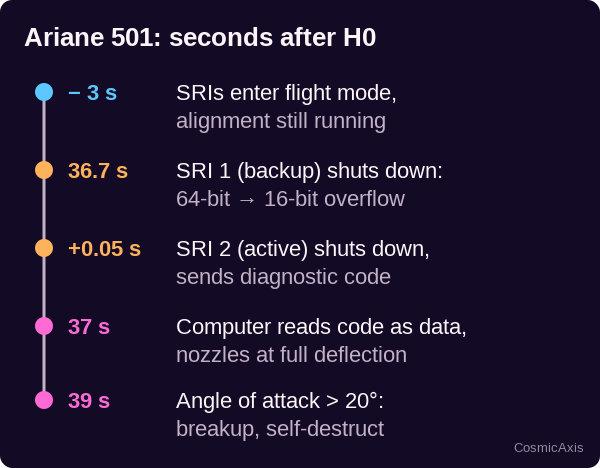
Ariane 5 flight 501 (4 June 1996) broke up and self-destructed 39 seconds after H0, and all 4 Cluster satellites were lost. According to the Inquiry Board (Lions, 1996), a conversion from a 64-bit number to a 16-bit integer overflowed and shut down both inertial reference systems (SRI); the on-board computer read the diagnostic code as flight data.
01Knowledge
What happened to Ariane 5 flight 501?
Ariane 5 flight 501, the first flight of the Ariane 5 rocket, left the Kourou launch pad on the morning of 4 June 1996, then broke up and self-destructed 39 seconds after H0, at an altitude of about 4 km. H0 is the moment the Vulcain main engine ignites. The rocket carried four ESA Cluster satellites and all four were lost (ESA press release 25–1996). Launch price is only one part of a mission’s cost, as the rocket launch cost comparison shows; here four satellites went down with the rocket.
The report of the Inquiry Board (chaired by Jacques-Louis Lions, 19 July 1996) traces the breakup back to its root cause. The CNES/ESA analysis annex in the same file gives times down to the millisecond:
| Time (s after H0) | Event | Source, date viewed |
|---|---|---|
| −3 | Both SRIs enter flight mode; the alignment function keeps running for 50 s | Report section 2.1, 2026-09-29 |
| 7.05 | Ignition of the two solid boosters | CNES annex, 2026-09-29 |
| 36.692 | SRI 1 (backup) fails | CNES annex, 2026-09-29 |
| 36.749 | SRI 2 (active) fails and sends a diagnostic bit pattern | CNES annex; report 2.1, 2026-09-29 |
| 37 | Nozzles swivel to the extreme | CNES annex, 2026-09-29 |
| 39 | Angle of attack above 20°, boosters separate, self-destruct system triggers | Report section 2.1, 2026-09-29 |
This article follows the whole chain of causes, from the 64-bit number to the destroyed rocket.
Why did converting a 64-bit number to 16 bits destroy the rocket?
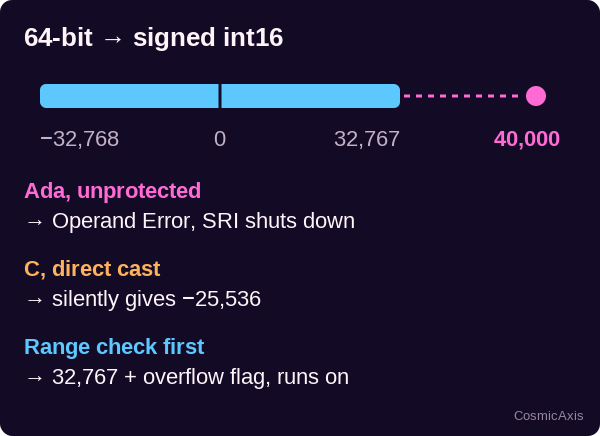
Converting a 64-bit floating-point number to a signed 16-bit integer destroyed the rocket because the value being converted was larger than 32,767, the upper limit of that type. In the Ada code of the inertial reference system (SRI, from its French name), an out-of-range conversion raises an operand error (Operand Error), and the code did not catch it.
Source
Inquiry Board Ariane 501, sections 2.1–2.2; CosmicAxis own calculation
The overflowing variable is BH (horizontal bias), an intermediate result of the alignment function, tied to horizontal velocity. The report does not publish the real value of BH; it only says Ariane 5 builds up horizontal velocity about five times faster than Ariane 4.
The development team had analyzed every conversion from floating point to integer and found seven variables at risk. Four were protected and three were left unprotected, BH among them. The reason: the SRI computer had a maximum workload target of 80% (a margin that lets every task meet its deadline, like the schedulability check in an RTOS), and the other three variables were believed to be limited physically or to have a large margin. For BH that reasoning was wrong, and the source code did not record why.
Why was the alignment function still running after the rocket left the pad?
The alignment function was still running after liftoff because the SRI software was copied almost unchanged from Ariane 4, where this function had to keep running for 50 seconds after the SRI entered flight mode. Alignment is the step in which the SRI determines its inertial reference frame from gravity and the rotation of the Earth; it is valid only while the rocket stands still and takes 45 minutes or more.
On Ariane 4, if the countdown was halted between about H0 − 9 s and H0 − 5 s, the function running on let the team restart the count at once and still meet a short launch window. According to the report, this feature was used only once, on flight 33 in 1989. Ariane 5 does not need it but kept it so that the software could be shared. The Ariane 5 SRI enters flight mode at H0 − 3 s, so the function runs until about H0 + 47 s (CosmicAxis own calculation: −3 + 50), which is about 40 s after liftoff. The report notes that alignment during flight is meaningless, because real motion is read as sensor error.
Why did both redundant SRIs fail at the same moment?
Both SRIs failed because they had identical hardware and identical software, so the same input caused the same fault. SRI 1, the backup, shut down about 0.05 s earlier, in the 72 ms data cycle just before, so the on-board computer (OBC) had nothing left to switch to.
The specification said that on any exception the SRI reports the error on the data bus, writes the context to EEPROM, and then shuts down the processor. That design suits random hardware failure, the only kind that, in the Board’s view, the Ariane program culture considered. The 501 fault was a systematic design error, a common-cause failure that a fault tree analysis (FTA) can draw: two redundant branches fail because of one root event.
After shutting down, SRI 2 sent a diagnostic bit pattern. The OBC treated it as attitude data, computed an attitude deviation that did not exist, and commanded a large correction. The nozzles swiveled to full deflection and the thrust, now pointing the wrong way, threw the rocket body sideways.
Why did ground testing not find the fault?
Ground testing missed the fault because no test ran the real SRI with an Ariane 5 trajectory. The parties had agreed not to put Ariane 5 trajectory data into the SRI specification, so equipment-level tests were rigorous about the environment but never checked the alignment function against the new trajectory.
At the ISF functional simulation facility, which runs closed-loop simulation of the whole flight, the project decided in 1992 to replace the real SRI with a software module, partly because the SRI cycle was 1 ms while the ISF cycle was 6 ms. The Board concluded that if the real SRI had been present, the fault would have shown up.
This is the gap between verification and validation in systems engineering: the SRI met its own specification exactly, but the specification did not describe the rocket that would use it.
02Practice
How do you reproduce a 16-bit integer overflow in Python?
A 16-bit integer overflow can be reproduced in a few lines of Python: convert 40,000 to int16 in two ways, then let a hypothetical variable grow along two trajectories. CosmicAxis ran the code on Python 3.14.6; the factor 6 is only for illustration and is not the real BH value.
import ctypes

LO, HI = -32768, 32767

def convert_ada(x):
    # Like the unprotected conversion in the SRI: out of range raises an exception
    if not LO <= round(x) <= HI:
        raise OverflowError(f"Operand Error: {x:.0f}")
    return round(x)

def convert_safe(x):
    # Range check: clamp to the limit, set a flag, keep running
    n = max(LO, min(HI, round(x)))
    return n, n != round(x)

print("C-style cast:", ctypes.c_int16(40000).value)
print("Range check:", convert_safe(40000.0))
for name, k in [("Trajectory A", 1), ("Trajectory B, 5x faster", 5)]:
    try:
        for i in range(401):          # 0-40 s, 0.1 s steps
            t = i / 10
            convert_ada(6.0 * k * t**2)
        print(f"{name}: peak {6.0 * k * t**2:.0f}, no overflow")
    except OverflowError as e:
        print(f"{name}: t = {t:.1f} s, {e}")
C-style cast: -25536
Range check: (32767, True)
Trajectory A: peak 9600, no overflow
Trajectory B, 5x faster: t = 33.1 s, Operand Error: 32868
Trajectory A keeps a margin of more than three times, while trajectory B overflows at 33.1 s. An equivalent C version (Apple clang 17) also gives −25,536 without any warning, so every type conversion should go through a range-check function such as convert_safe. Checking all parameters and return values is rule 7 of NASA’s Power of 10 rules.
What does a model rocket flight computer learn from Ariane 501?
A flight computer for a model rocket can learn four things from Ariane 501, each matching one recommendation of the Board:
- List every type conversion, with the expected value range and the source of that range (R5).
- Test with the real trajectory of that very rocket: replay the acceleration profile from an OpenRocket simulation or an earlier flight log through the flight code on the bench (R2, R10).
- Switch off every function not needed in flight, such as sensor calibration on the pad (R1).
- Never let a sensor go silent: on error, clamp the value, set a flag, and still send the best estimate (best effort data, R3); the filter downstream rejects any flagged measurement.
Each line of the conversion table becomes one line in the FMEA table of the flight computer: failure mode “overflow”, effect “loss of altitude data”, mitigation “range check, test with the real trajectory”. The same discipline carries over to a CubeSat. At model rocket level the computer only logs data and deploys the parachute; the rocket flies on certified commercial motors, under NAR/Tripoli rules.
03Reality
What did the Inquiry Board recommend, and how was Ariane 5 fixed?
The Inquiry Board made 14 recommendations (R1–R14), focused on software and testing rather than on changing the rocket’s architecture. R12 is the most memorable: treat critical justification documents as seriously as source code.
According to ESA press release 33–1996 (23 July 1996), the Ariane 5 program accepted every recommendation: switch off the alignment function after liftoff, fix the exception handling so that it does not shut down the processor, simulate the real trajectory on the SRI electronics, and review all the flight software. The four Cluster II satellites were launched in two batches, on 16 July and 9 August 2000.
The biggest lesson is the Board’s sentence about culture: software must be assumed to be faulty until it is shown to be correct. The same way of reading a primary inquiry report applies to the Challenger O-ring failure, where the Rogers Commission delivered its report on 6 June 1986. For the avionics and flight software stage, Ariane 501 is the reason every guidance algorithm needs a range-check layer and a test with the real trajectory. In 2016 the Schiaparelli failure on Mars showed the same lesson: software that meets its specification can still lose the vehicle when a sensor value falls outside a range the specification did not foresee. Schiaparelli repeated the pattern of the Mars Polar Lander loss described in Mars entry, descent and landing: a brief signal at parachute deployment was held too long by the software.
04Milestone
Milestone: check yourself
If you can do all of these, move on to the next article in this phase.
- Can you retell the chain of events from H0 − 3 s to H0 + 39 s and say exactly why the backup SRI could not save the rocket?
- Can you explain why the alignment function is useful only before launch, yet kept running for about 40 seconds after liftoff?
- Can you run the Python code and see 40,000 become −25,536 with a cast and 32,767 with a flag when a range check is used?
- Can you list every variable your own flight computer converts between types, with the value range taken from real flight data?
Frequently asked questions
What is an integer overflow?
An integer overflow happens when a value is larger than the integer type that holds it. A signed 16-bit integer holds only −32,768 to 32,767; outside that range Ada raises an exception, while C silently produces a wrong number.
Why did Ariane 4 run the same software without this failure?
The first 40 seconds of an Ariane 4 trajectory never pushed the variable BH past its limit, while Ariane 5 builds up horizontal velocity about five times faster, so BH overflowed (Inquiry Board report, section 3.1 o–p). According to the CNES annex, this SRI had flown well on 23 Ariane 4 flights from July 1994 to May 1996.
Which satellites did Ariane 5 flight 501 carry?
Flight 501 carried four ESA Cluster satellites that study the Earth's magnetosphere, and all four were lost in the explosion (ESA press release 25–1996). ESA rebuilt them and launched Cluster II in two batches, on 16 July and 9 August 2000 (ESOC).
References
- Lions et al. — Ariane 5 Flight 501 Failure, Report by the Inquiry Board, 19 July 1996 (with the CNES/ESA Immediate Post-Accident Analysis annex) — accessed
- ESA — N° 33–1996: Ariane 501, Presentation of Inquiry Board report, 23 July 1996 — accessed
- ESA — N° 25–1996: Ariane-5 and Cluster update, 27 June 1996 — accessed
- ESA ESOC — Cluster II — accessed
Cite this article
CosmicAxis. (2026). Ariane 5 flight 501 failure: how a 16-bit overflow broke it. https://cosmicaxis.space/en/ariane-5-flight-501-failure/