
Schiaparelli lander crash
Source
ESA DG-I/2017/546/TTN, Schiaparelli Anomaly Inquiry, 18 May 2017, section 5
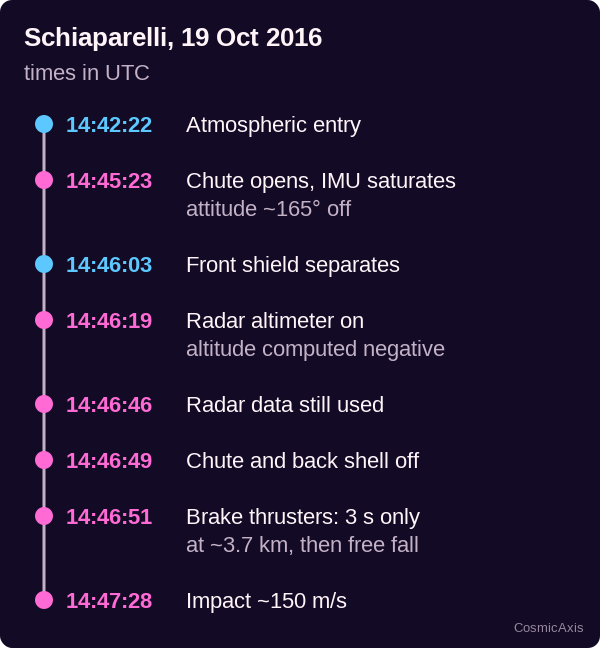
The Schiaparelli lander crashed on Mars on 19 October 2016 because its IMU saturated when the parachute opened. The saturation flag was held too long, so the software estimated attitude about 165° wrong and computed a negative altitude. The lander released its parachute, cut the braking thrusters after 3 seconds and fell freely from about 3.7 km (ESA, 2017).
01Knowledge
What was Schiaparelli and what happened on 19 October 2016?
Schiaparelli was the test lander of the ExoMars 2016 mission (ESA and Roscosmos), built to prove Mars entry, descent and landing (EDL). According to the ESA inquiry report (DG-I/2017/546/TTN, 18 May 2017), it weighed 577 kg, was 2.4 m across and carried a 12 m supersonic parachute, nine 400 N hydrazine thrusters, one inertial measurement unit (IMU) and a Doppler radar altimeter.
It launched on 14 March 2016 and separated from the Trace Gas Orbiter on 16 October. On 19 October atmospheric reentry and heat-shield braking went as planned; the trouble began when the parachute opened:
| Time UTC, 19 Oct 2016 | Event | Source, date viewed |
|---|---|---|
| 14:42:22 | Accelerometer detects atmospheric entry | ESA 2017 §5 · 2026-10-03 |
| 14:45:23 | Parachute deployed at 12 km, 1,730 km/h; about 0.2 s after peak parachute load the IMU saturates | ESA 2017 §5; ESA 23 Nov 2016 · 2026-10-03 |
| 14:46:03 | Front shield separated at 7.8 km | ESA 2017 §5; ESA 23 Nov 2016 · 2026-10-03 |
| 14:46:19 | Radar altimeter switched on | ESA 2017 §5 · 2026-10-03 |
| 14:46:46 | Radar data still used although the consistency check has failed | ESA 2017 §5 · 2026-10-03 |
| 14:46:49 | Back shell and parachute released | ESA 2017 §5 · 2026-10-03 |
| 14:46:51–14:46:54 | Braking thrusters fire for 3 s instead of 30 s, altitude about 3.7 km | ESA 2017 §5; ESA 24 May 2017 · 2026-10-03 |
| 14:47:28 | Impact at about 150 m/s; planned touchdown 14:48:05 | ESA 2017 §5 · 2026-10-03 |
A HiRISE image of 25 October 2016 (NASA/JPL-Caltech/UArizona) shows the parachute, back shell, front shield and impact site within about 1.5 km in Meridiani Planum.
Why did the Schiaparelli IMU saturate when the parachute opened?
The IMU saturated because the lander’s real rotation rate right after parachute opening exceeded the measuring range of its gyroscopes, not because the IMU was faulty. Saturation is the moment a real quantity exceeds the largest value a sensor can measure; the IMU then raises a saturation flag. Sensor saturation differs from actuator saturation in a PID controller.
According to the ESA report (sections 5 and 6), the parachute opened at Mach 2.05 and made the lander oscillate at about 2.5 Hz. The board retested the IMU at high angular acceleration and compared accelerometer-derived rates with the gyroscopes: the IMU measured correctly. Canopy area oscillation alone explains the shaking, and the simulator’s parachute model lacked it. A NASA/JPL Monte Carlo simulation produced many cases above the saturation level, so in the board’s words saturation “should have been foreseen”.
Why did holding the saturation flag too long make the lander think it was underground?
Holding the flag too long made the lander think it was underground because, while the flag was up, the guidance, navigation and control (GNC) software integrated a constant rotation rate equal to the saturation limit, while the real lander only swung back and forth. The error accumulated into an attitude estimate about 165° wrong, so the lander was almost upside down (ESA, 2017, section 5).
ESA (23 November 2016) reports saturation lasting “about one second”. At acceptance the hold time was not recorded and believed to be 15 ms; with 15 ms, the board says, the lander would probably have landed.
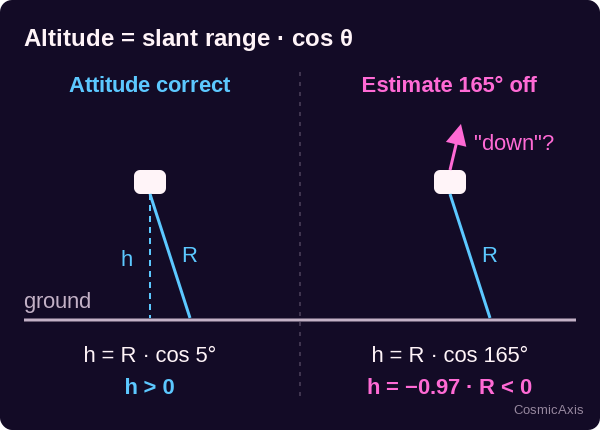
A wrong attitude becomes a wrong altitude once the radar is on. Altitude equals the radar slant range times the cosine of the angle between the radar axis and the vertical: h = R · cos(θ). When the estimated angle exceeds 90° the cosine is negative, so the altitude is negative.
Source
ESA DG-I/2017/546/TTN, section 5 h; CosmicAxis concept diagram
The IMU-radar consistency check failed continuously for more than 5 seconds, but the on-board logic treated the radar as mandatory for landing and kept feeding it into the control loop without questioning attitude. Seeing a negative altitude, the software released the parachute; the thrusters shut off when estimated energy fell below a threshold, and the negative altitude made it negative at once, so they stopped after 3 seconds at about 3.7 km.
Why did simulation and testing not catch the error?
Simulation and testing missed the error because each verification tool lacked exactly one piece. The ESA report (sections 4 and 6.3) lists:
- A parachute model without deployment disturbances: no lateral motion, no canopy area oscillation, no off-centre opening.
- Too thin a margin: pre-flight simulations had shown rotation rates above 150°/s were possible, but nobody ran a worst-case analysis around that case.
- No IMU in a closed-loop test: the bench IMU was used only for electrical interface tests; the IMU’s mathematical model came from the prime contractor, and saturation was not retested after delivery.
- Fault detection that only considered the radar: failure detection, isolation and recovery (FDIR) analysis covered radar failures only.
The board adds that lack of funds changed the project midway from redundant electronics to a single string, and that the 26-month Mars launch window held the schedule. The test-as-you-fly principle of systems engineering applies directly.
02Practice
How do you reproduce IMU saturation in Python?
A short Python model reproduces it: the lander swings with a decaying 2.5 Hz oscillation (ESA report), the gyroscope exceeds its limit, the flag stays up for a hold time, and the software integrates the limit value itself. The 15° amplitude, 200°/s limit, 6,000 m slant range and two sanity checks are CosmicAxis assumptions, because the public report does not give the real limit.
import math

F, AMPLITUDE, LIMIT, DT = 2.5, 15.0, 200.0, 0.001  # Hz (ESA); ASSUMED: deg, deg/s; s

def attitude_error(hold_s):
    true_angle = est_angle = hold = sign = 0.0
    for k in range(int(3 / DT)):
        t = k * DT
        w = AMPLITUDE * 2 * math.pi * F * math.cos(2 * math.pi * F * t) * math.exp(-t)  # true rate, deg/s
        if abs(w) > LIMIT:
            hold, sign = hold_s, math.copysign(1, w)  # saturation flag goes up
        w_used = sign * LIMIT if hold > 0 else w          # flag up: integrate the limit itself
        hold = max(0.0, hold - DT)
        true_angle += w * DT
        est_angle += w_used * DT
    return est_angle - true_angle

def altitude(slant, tilt_deg, h_prev):
    h = slant * math.cos(math.radians(tilt_deg))
    return h, h > 0 and abs(h - h_prev) < 500          # ASSUMED: not negative, no jump over 500 m

for hold_s in (0.015, 1.0):
    err = attitude_error(hold_s)
    h, ok = altitude(6000.0, err, 6050.0)
    print(f"flag held {hold_s * 1000:4.0f} ms: attitude error {err:6.1f}°, estimated altitude {h:6.0f} m,",
          "passes check" if ok else "BLOCKED")
flag held   15 ms: attitude error   -0.5°, estimated altitude   6000 m, passes check
flag held 1000 ms: attitude error  207.3°, estimated altitude  -5332 m, BLOCKED
Result (computed by CosmicAxis, Python 3.14.6): for the same swing, a 1 s hold instead of 15 ms pushes the attitude error past 200° and flips the sign of altitude. Schiaparelli had no altitude sanity check; in the model, “not negative” and “no jump over 500 m” block it.
How do you add sanity checks to a flight computer?
Sanity checks are physical conditions that an estimate must satisfy, run before any irreversible decision such as releasing a parachute. Recommendation 05 of the ESA board lists five checks that a model rocket builder can reuse:
- Check the estimated attitude.
- Altitude is not negative.
- While descending, downward acceleration is not larger than gravitational acceleration.
- Altitude cannot go from 3.7 km to a negative number in one second.
- Altitude and acceleration match the expected profile over time.
A check helps only with a defined action on failure: the Schiaparelli software detected the radar-IMU inconsistency but was programmed to keep blending the two. Rule 5 of the NASA Power of 10 rules likewise demands a recovery action for every failed assertion; for a model rocket the simple fallback is a precomputed backup timer. The Kalman filter has a check in the same spirit: if the innovation, the gap between measurement and prediction, is too large, the measurement is rejected.
03Reality
What did the ESA inquiry conclude and recommend?
The inquiry board, chaired by the ESA Inspector General and including a JPL chief engineer, found four root causes (section 6.3): a parachute dynamics model that was not conservative enough; an unsuitable IMU saturation hold time and GNC handling of saturation; an insufficient FDIR approach and design robustness; and errors in subcontractor management and hardware acceptance.
It made 16 recommendations. Eight general ones call for fixing the parachute model, worst-case analysis for each flight phase, on-board sanity checks, a degraded landing GNC mode and stricter acceptance. According to the board, the radar could still determine attitude in two axes, so a path to landing existed.
The other eight are for ExoMars 2020, whose rover ESA now calls Rosalind Franklin. That mission inherits the 2016 GNC design and parachute model but changes the IMU; recommendation 12 asks for a correct saturation limit and use of both IMUs, recommendation 16 that the launch schedule not outweigh the technical risk.
How is Schiaparelli similar to and different from Ariane 501?
Schiaparelli resembles the Ariane 5 flight 501 failure in that software ran exactly to specification and still lost the vehicle, because the specification did not foresee out-of-range sensor values. The mechanism differs: on Ariane 501 an overflow raised an exception and shut down both identical inertial reference systems; on Schiaparelli there was no error message, and the software kept integrating a “valid” but wrong number and trusted it.
The Mars Climate Orbiter failure of 1999 belongs to the same family of “assumptions nobody rechecked”. The lesson for crewed vehicles, where every landing phase is irreversible: no estimate may drive a parachute-release or engine-cutoff command without a sanity check, and every sensor must be tested in its saturated region too. The other articles of the avionics and flight software stage go deeper into each piece of this chain.
04Milestone
Milestone: check yourself
If you can do all of these, move on to the next article in this phase.
- Can you retell the sequence from parachute opening to impact, with UTC times?
- Can you explain why an attitude error of 165° produces a negative altitude?
- Can you run the Python code and find the shortest flag hold time that makes the estimated altitude negative?
- Can you write three sanity checks for altitude in a flight computer?
Frequently asked questions
Was the Schiaparelli IMU faulty?
No. The ESA inquiry board retested the IMU and concluded that it worked correctly: the rotation rate above the limit was real motion of the lander under its parachute (ESA, 2017, section 6.2.1).
How fast did Schiaparelli hit the ground?
The ESA inquiry report estimates an impact at about 150 m/s (the ESA release states 540 km/h), after about 34 seconds of free fall from an altitude of about 3.7 km.
What came after Schiaparelli in Europe's Mars programme?
The ExoMars 2020 mission, whose rover is now named Rosalind Franklin. The 2017 inquiry report gave 8 of its 16 recommendations to that mission, including the use of both IMUs.
References
- ESA — EXOMARS 2016 Schiaparelli Anomaly Inquiry, DG-I/2017/546/TTN, 18 May 2017 (Internet Archive) — accessed
- ESA — Schiaparelli landing investigation makes progress, 23 November 2016 — accessed
- ESA — Schiaparelli landing investigation completed, 24 May 2017 — accessed
- NASA/JPL-Caltech/UArizona — HiRISE ESP_048041_1780, ExoMars EDM Landing Site in Meridiani Planum — accessed
- ESA — ExoMars rover (Rosalind Franklin) — accessed
Cite this article
CosmicAxis. (2026). Schiaparelli lander crash (2016): the IMU saturation error. https://cosmicaxis.space/en/schiaparelli-lander-crash/