
SpaceShipTwo crash: why did the vehicle break up in flight?
Source
NTSB AAR-15/02 (2015), sections 1.1 and 1.2
The SpaceShipTwo crash was the in-flight breakup of Virgin Galactic's test vehicle on 31 October 2014: the co-pilot unlocked the feather tail mechanism at Mach 0.82 instead of 1.4, aerodynamic loads lifted the tail, and the co-pilot died. The NTSB found that Scaled Composites had not considered a single human error (AAR-15/02).
01Knowledge
What was the SpaceShipTwo crash of 31 October 2014?
The SpaceShipTwo crash was the in-flight breakup of the suborbital rocket plane SpaceShipTwo (SS2, registration N339SS) at 10:07:32 California time on 31 October 2014, during its fourth powered test flight (PF04). The pilot was seriously injured, the co-pilot died, and no one on the ground was hurt (NTSB AAR-15/02).
Scaled Composites built and flew SS2 for Virgin Galactic. The carrier aircraft WhiteKnightTwo (WK2) released SS2 at about 46,400 ft (14.1 km, CosmicAxis conversion); a hybrid rocket motor drove a near-vertical climb, and about 13 seconds later the vehicle broke apart.
The National Transportation Safety Board (NTSB) concluded on 28 July 2015 that the motor performed normally; the fault lay in the tail mechanism and the hazard analysis. It belongs to the human rating phase: testing and certifying vehicles that carry people.
How does the feather work, and why must it be unlocked at Mach 1.4?
The feather is a mechanism that rotates SS2’s tail assembly and two tail booms from 0° to 60° to hold attitude and add drag on the way down (NTSB). A folded tail makes the vehicle descend like a badminton shuttlecock, a particular solution to atmospheric reentry.
Two hook locks hold the feather, and two pneumatic actuators raise and lower it. The flight card told the co-pilot to unlock it during boost at Mach 1.4, between two limits (NTSB, section 1.3.2.1):
- Not later than Mach 1.8: if the locks jam, the crew must learn early enough to shut the motor down; beyond Mach 1.8 the climb is too high for reentry without the feather.
- Not earlier than the subsonic range: from Mach 0.8 to 1.0 the tail feels an upward load the actuators were not designed to hold; above Mach 1.0 a downward load holds the feather in place.
How did the co-pilot unlock the feather early?
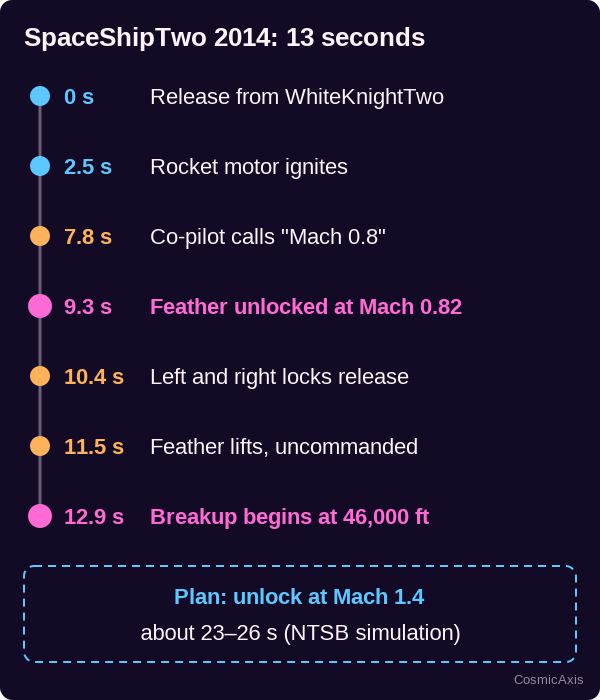
The co-pilot unlocked the feather at about Mach 0.82, right after calling “Mach 0.8”, while the NTSB simulation shows Mach 1.4 only 23–26 seconds after release. From cockpit camera and telemetry, in seconds after release from WK2:
- 0 s: release; 2.5 s: motor ignition; 7.8 s: “Mach 0.8” call.
- 9.3 s: the co-pilot says “unlocking” and moves the lock lever; the display shows Mach 0.82.
- 10.4 s: both locks release; 11.5 s: the feather lifts on its own, uncommanded.
- 12.9 s: the vehicle begins to break up at 46,000 ft.
The pilot was thrown out with his seat and his parachute deployed automatically at 10,870 ft.
The NTSB found no sign that the co-pilot misread the display. Three tasks to recall from memory fell within about 15 seconds of boost, under 2.4–2.5 G of axial acceleration (see g-force) and vibration that 112 simulation runs could not reproduce. Time pressure, vibration and an unfamiliar sustained load led him to misremember the order of tasks (NTSB).
Why did the NTSB assign the root cause to Scaled Composites?
The NTSB assigned the root cause to Scaled because the company “failed to consider and protect against the possibility that a single human error could result in a catastrophic hazard”; the co-pilot’s error was a consequence (NTSB, section 2.2). Scaled’s analysis saw the hazard but missed the path to it:
- The functional hazard assessment (FHA) rated “feather operates uncommanded during boost” as catastrophic.
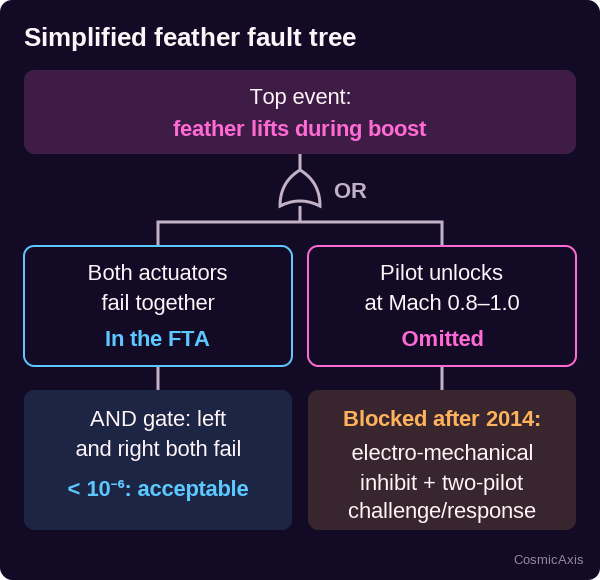
- The fault tree for that hazard (21 June 2011) assumed the pilot always unlocks at the right time. The feather then lifts only if both actuators fail, below 10⁻⁶ per flight, the level called “extremely remote”.
Advisory circular AC 23.1309-1D, written for small aircraft, lets the probability that a pilot performs one “reasonable” action correctly be taken as 1. But the unlock action had never been verified and validated under real vibration and loads, a gap systems engineering exists to close, and one wrong lever movement was missing from the tree; a fault tree analysis (FTA) is valid only with enough basic events.
The NTSB cited the order of precedence for safety measures: design change, engineered devices, warnings, and training last. Against early unlocking Scaled relied on training alone: the feather had no barrier, no cue for “time to unlock”, and the company had no human factors specialist.
02Practice
How do you add a “human error” row to a hazard analysis?
Human error is recorded like any other failure mode in a failure modes and effects analysis (FMEA) table: an action done wrongly, at the wrong time or omitted, with its consequence and control. The NTSB suggested a human-factors process FMEA plus probabilistic risk assessment (PRA). “Tier” is the tier of the control: 1 is design, 4 is training.
| Failure mode (boost phase) | Consequence | Control | Tier | Source, date viewed |
|---|---|---|---|---|
| Locks jam, do not open | Reentry without feather if past Mach 1.8 | Unlock at Mach 1.4, alert at 1.5 | 3 + 4 | NTSB 1.3.2.1, 2026-10-03 |
| Both actuators fail after unlock | Feather lifts, vehicle lost | Independent left and right actuators | 1 | NTSB 1.4.1.3, 2026-10-03 |
| Pilot unlocks at Mach 0.8–1.0 (original design) | Feather lifts, vehicle lost | None, training only | 4 | NTSB 1.4.1.4, 2026-10-03 |
| Same, after the fix | Same | Electro-mechanical inhibit + two-pilot challenge/response | 1 + 4 | NTSB 1.6, 2026-10-03 |
Source
NTSB AAR-15/02 (2015), sections 1.4.1.3 and 1.6
The third row is a single-event branch: one lever movement at the wrong time was enough to lose the vehicle, the kind of single-point failure redundancy exists to remove.
How much does an inhibit reduce the chance of losing the vehicle? Calculate with Python
The top-event probability of that fault tree is approximately the sum of the OR gate’s two branches: P = p_a² + p_h · k_c · k_i, per flight. Here p_a is one actuator failing, p_h the pilot unlocking in the subsonic range, k_c the second pilot missing the error in the callout, k_i the inhibit failing in the non-blocking state; k_c and k_i equal 1 without that layer. The probabilities are CosmicAxis assumptions; only the timestamps and the 10⁻⁶ level have sources.
# Timestamps from NTSB AAR-15/02, section 1.1 (seconds after 10:07:00 PDT)
T_RELEASE, T_UNLOCK = 19.1, 28.4   # release from WK2; "unlocking" called at Mach 0.82
T_MACH_14 = (23.0, 26.0)           # NTSB simulation: Mach 1.4, seconds after release
t = T_UNLOCK - T_RELEASE
print(f"Unlocked at {t:.1f} s, early by {T_MACH_14[0] - t:.1f}-{T_MACH_14[1] - t:.1f} s")

# ASSUMPTIONS (CosmicAxis), per-flight probabilities, not Scaled or NTSB figures
P_ACTUATOR, P_INHIBIT, P_CREW_2 = 5e-4, 1e-3, 0.1
TARGET = 1e-6  # "extremely remote" per AC 437.55-1

def p_top(p_human, callout=False, inhibit=False):
    human = p_human * (P_CREW_2 if callout else 1) * (P_INHIBIT if inhibit else 1)
    return P_ACTUATOR ** 2 + human  # OR of the equipment branch (AND) and the human branch

print(f"Human error left out (as Scaled did): {p_top(0):.1e}")
for p in (1e-2, 1e-3):  # columns: no barrier | callout | inhibit | both; * = meets target
    res = [p_top(p), p_top(p, True), p_top(p, inhibit=True), p_top(p, True, True)]
    print(f"p_human {p:.0e}: " + " | ".join(f"{x:.1e}{'*' * (x < TARGET)}" for x in res))
Unlocked at 9.3 s, early by 13.7-16.7 s
Human error left out (as Scaled did): 2.5e-07
p_human 1e-02: 1.0e-02 | 1.0e-03 | 1.0e-05 | 1.2e-06
p_human 1e-03: 1.0e-03 | 1.0e-04 | 1.2e-06 | 3.5e-07*
Python 3.14 output (CosmicAxis own calculation) gives three lessons:
- Dropping one event changes the verdict: without the human branch the tree gives 2.5×10⁻⁷, meeting the target; adding it with p_h = 10⁻³ raises the probability 4,000 times.
- One layer is not enough: with p_h = 10⁻³ the inhibit cuts the human branch 1,000 times, yet the total is 1.2×10⁻⁶.
- Independent layers are needed: only inhibit plus callout, at p_h = 10⁻³, falls below 10⁻⁶.
The code uses the difference of two timestamps (9.3 seconds); the report says “about 9.8 seconds”. Exercise: set P_INHIBIT = 0.01 and find the largest p_h that still meets 10⁻⁶.
03Reality
How did the FAA permit SpaceShipTwo and waive requirements?
The Federal Aviation Administration (FAA) let SS2 fly under an experimental permit from May 2012, then on 9 July 2013 granted itself a waiver of exactly two requirements, the analyses of software failure and of human error, that Scaled’s application did not meet (NTSB, section 1.4.2). Scaled did not ask for a waiver; the FAA granted two more, in May and October 2014.
An experimental permit (created by a 2004 law) is reviewed faster than an FAA launch license and does not allow paying passengers. Under 14 CFR 437.55 the applicant must still identify hazards caused by human error, because the permit protects the public and property. The FAA judged the waiver to be in the public interest, but did not examine whether Scaled’s controls could stop a single human error, or check that Scaled implemented them.
The NTSB made 10 recommendations: 8 to the FAA, such as requiring applicants to list every single pilot action that is catastrophic if done at the wrong time, and 2 to the Commercial Spaceflight Federation.
What changed at Virgin Galactic and in spaceflight law after the crash?
Virgin Galactic fitted its second SS2 with an electro-mechanical inhibit that prevents unlocking the feather by mistake in the dangerous phase, and required two pilots to use challenge/response before any safety-critical action (NTSB, section 1.6). A failed device reverts to the non-blocking state and has an independent override, avoiding the opposite hazard of a feather that cannot be unlocked.
US law does not certify commercial vehicles as safe for people: under 14 CFR 460.45 the operator must state in writing that the Government has not certified the vehicle as safe, describe the known and unknown hazards, and obtain signed informed consent. A “learning period” since 2004 bars the FAA from regulating to protect occupants, with narrow exceptions (GAO-24-106184); current law lets it propose such rules only from 1 January 2028 (51 U.S.C. § 50905).
NASA took a different path: a vehicle carrying NASA astronauts must go through human-rating certification. NASA’s NPR 8705.2C requires human error analysis in every mission phase (section 2.3.11) and error management in order: design to prevent errors, then reduce their likelihood and let people detect and correct them, and last limit the consequences (section 2.3.12). SS2 lacked these steps. NASA’s own programs were examined after the Challenger O-ring failure (Rogers Commission, June 1986) and the Columbia disaster (CAIB, August 2003).
04Milestone
Milestone: check yourself
If you can do all of these, move on to the next article in this phase.
- Can you explain why the feather must be unlocked at Mach 1.4, neither earlier nor later?
- Can you say why the NTSB assigned the root cause to Scaled Composites and not to the co-pilot?
- Can you add a human-error row to a hazard analysis table and rank its controls by precedence?
- Can you run the Python code and explain why one protective layer cannot reach 10⁻⁶?
Frequently asked questions
Why did SpaceShipTwo crash in 2014?
The co-pilot unlocked the feather at about Mach 0.82, in the subsonic range, instead of Mach 1.4. Aerodynamic loads overcame the actuators, the feather lifted on its own and the vehicle broke apart (NTSB AAR-15/02).
Whom did the NTSB hold responsible for the SpaceShipTwo accident?
The NTSB assigned the root cause to Scaled Composites: it did not consider or guard against a single human error being catastrophic. The co-pilot's early unlocking was a consequence.
Does the FAA certify space tourism vehicles as safe?
The FAA does not. Under 14 CFR 460.45, an operator must tell participants in writing that the US Government has not certified the vehicle as safe for carrying people, and obtain their informed consent.
References
- NTSB AAR-15/02 — In-Flight Breakup During Test Flight, SpaceShipTwo, N339SS (28 July 2015) — accessed
- NTSB — abstract of the board meeting of 28 July 2015 — accessed
- NASA NPR 8705.2C, chapter 2 — accessed
- 14 CFR 437.55 (eCFR) — accessed
- 14 CFR 460.45 (eCFR) — accessed
- GAO-24-106184 (February 2024) — accessed
- 51 U.S.C. § 50905 (Cornell LII) — accessed
Cite this article
CosmicAxis. (2026). SpaceShipTwo crash 2014: why the vehicle broke apart. https://cosmicaxis.space/en/spaceshiptwo-crash/