
Technology readiness level (TRL): the NASA 1–9 scale
Source
NASA NPR 7123.1D, appendix E; NASA SP-20205003605 (2020), section 2.1
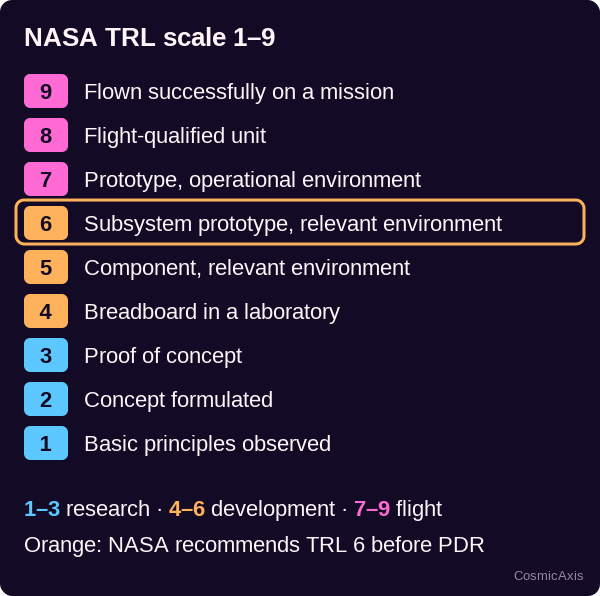
Technology readiness level (TRL) is a nine-level scale of technology maturity, from TRL 1, basic principles observed, to TRL 9, flown on a mission (NASA NPR 7123.1D, appendix E). NASA recommends new technology reach TRL 6, a subsystem prototype tested in a relevant environment, before the preliminary design review (PDR).
01Knowledge
What is TRL, and who created the 1–9 scale?
TRL (technology readiness level) is a nine-level scale that measures how far a technology has been proven, from TRL 1, “basic principles observed”, to TRL 9, “flown successfully on a mission”. The definition in force is in appendix E of NPR 7123.1D (effective 5 July 2023).
According to GAO-20-48G, a NASA researcher drew up the first scale in 1974 with 7 levels and defined it formally in 1989. John Mankins (NASA) published today’s nine-level version on 6 April 1995.
TRL measures technology maturity, not a part-quality grade such as space-grade or COTS. It feeds the reviews of systems engineering and is a topic of the manufacturing and regulation stage.
How do the nine NASA TRL levels differ?
The nine levels differ in how close the test article is to the flight unit and how close the test environment is to space. TRL 1–3 are the idea stage; from TRL 4, each level asks for a different kind of test article (NPR 7123.1D, appendix E):
| Level | Test article | Test environment | Source, date accessed |
|---|---|---|---|
| TRL 4 | Breadboard | Laboratory | NPR 7123.1D, 2026-10-04 |
| TRL 5 | Component, mid-fidelity board | Relevant environment | NPR 7123.1D, 2026-10-04 |
| TRL 6 | High-fidelity subsystem prototype | Relevant environment | NPR 7123.1D, 2026-10-04 |
| TRL 7 | System prototype | Real operational environment | NPR 7123.1D, 2026-10-04 |
| TRL 8 | Final product, flight-qualified | Expected environment | NPR 7123.1D, 2026-10-04 |
| TRL 9 | Final product | Actual mission | NPR 7123.1D, 2026-10-04 |
A relevant environment is the part of the operational environment that puts the technology at risk, simulated on the ground, such as thermal vacuum or vibration (SP-20205003605, section 2.2.3).
In the NPR 7123.1D TRL 6 example, a camera with a 3 m mirror has every part at TRL 6 except the mirror assembly, so the team builds two full-size mirrors and a support structure to test thermal distortion and launch vibration. The most common path skips TRL 7 and goes from TRL 6 straight to TRL 8 (SP-20205003605, section 2.1).
What evidence do you need to reach a TRL level?
A technology reaches a TRL level only when every question for that level has objective evidence, such as test reports, signed documents or analysis results (NASA SP-20205003605, section 3.1.4). This is a technology readiness assessment (TRA). The TRL 6 questions fall into four groups:
- Agreements: critical technologies, requirements, relevant environment, and test integration level (a subsystem at minimum).
- Analysis: predicted performance and uncertainty, written before the test.
- Test: whether results fall inside that uncertainty, and whether surprises have a known root cause.
- Data: whether the data package is agreed as complete.
Three rules prevent inflated TRLs:
- The weakest element decides: the TRL of an integration level is no higher than the lowest TRL of its elements (SP-20205003605, section 3.1.5).
- Elements never tested together score lower, even if each one is high (NASA SP-2016-6105 Rev 2, appendix G.4).
- Heritage hardware whose architecture and environment change falls back to TRL 5 at first (same appendix).
A TRA does not replace verification and validation: V&V proves a design meets its requirements, while a TRA asks whether the technology is mature enough to design with.
Why do NASA and GAO demand TRL 6 before PDR?
NASA wants TRL 6 before the preliminary design review (PDR) because from that level the risk of a new technology is close to that of a new design built with standard engineering (SP-20205003605, section 2.1). Right after PDR, at key decision point C, NASA commits to cost and schedule baselines (GAO-26-108556).
GAO sets the bar one level higher: TRL 7 at the start of system development, and it accepts TRL 6 only when testing in the operational environment is unrealistic, as with the space environment (GAO-20-48G).
Source
GAO-06-391 (31 March 2006)
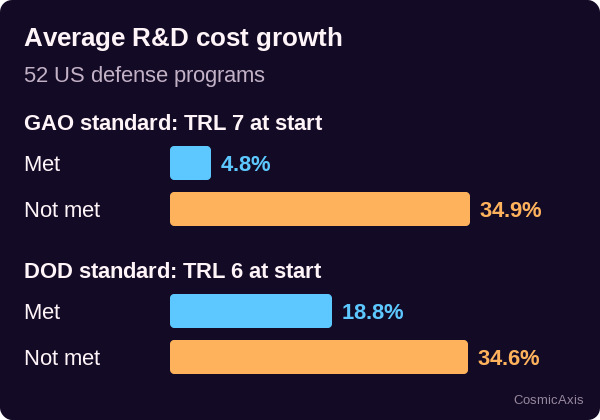
Among the 52 US defense programs GAO reviewed in 2006, those that started with immature technology saw R&D cost grow by 34.9% on average, against 4.8% for those with mature technology (GAO-06-391). Even the lower US Department of Defense standard (TRL 6) was not enough: programs that met it still grew by 18.8%.
Where is the technology “valley of death”?
The valley of death is the stretch where a technology works in the laboratory but nobody has paid to prove it in a real environment. The term has no standard definition: SP-20205003605 calls TRL 4–6 the development and demonstration stretch, while a 2015 NASA ESTO and JPL team placed the valley at the step from TRL 6 to TRL 7, because flight tests are rare and expensive.
Cost per level climbs: an internal ESTO illustrative model puts TRL 5 to TRL 6 at nearly 4 times all earlier steps combined (Bauer, Millar, Norton, 2015). One cheap bridge is the InVEST program, which takes TRL 5 or 6 technology and flies it on a 3U CubeSat, under 4 million USD per contract. Every unflown technology, from a student board to a nuclear thermal rocket, has to cross this stretch.
How do MRL and ISO 16290 differ from NASA’s TRL scale?
MRL measures repeatable manufacturing, and ISO 16290 is the international version of TRL; NPR 7123.1D (section 5.1.6) requires NASA projects using another scale to convert it to TRL.
- Manufacturing readiness level (MRL) has 10 US Department of Defense levels, each demanding a minimum TRL: MRL 6, at the start of system development, needs TRL 6; MRL 8, at low-rate production, needs TRL 7 or 8 and a completed first article inspection (GAO-20-48G, appendix V), as AS9100 also requires.
- ISO 16290:2013 is used by ESA through ECSS-E-AS-11C (1 October 2014).
The key difference is at TRL 7: ISO 16290 allows demonstration in the operational environment “on the ground, or in space if needed”, while NASA requires the real operational environment.
02Practice
How do you assess the TRL of a 1U CubeSat power system in Python?
The Python code below scores four elements of a 1U CubeSat power system on an evidence ladder, finds the weakest, then adds a cost contingency by TRL. Solar panel pricing follows the Pumpkin price list (4 × 2,500 USD); the other prices, the evidence and the contingency rates are CosmicAxis assumptions.
EVIDENCE = {3: "proof of concept", 4: "breadboard",  # NPR 7123.1D appendix E
            5: "component, relevant environment", 6: "subsystem, relevant environment",
            7: "flight demonstration", 8: "flight-qualified unit", 9: "flown in mission"}
CONTINGENCY = {9: .05, 8: .10, 7: .15, 6: .20, 5: .30, 4: .40, 3: .50}  # CosmicAxis assumption
EPS_1U = {  # name: (price USD, levels with evidence, heritage but new environment?)
    "Solar panels": (10000, range(3, 10), False),
    "COTS Li-ion battery": (400, range(3, 6), False),
    "In-house EPS board": (6000, range(3, 5), False),
    "Off-the-shelf OBC": (4000, range(3, 10), True),
}

def assess_trl(evidence, new_environment):
    trl = 2
    for level in EVIDENCE:  # climb one step at a time; a missing step stops it
        if level not in evidence:
            break
        trl = level
    return min(trl, 5) if new_environment else trl  # SP-2016-6105 appendix G.4

results, total, reserve = {}, 0, 0
for name, (price, ev, new_env) in EPS_1U.items():
    trl = results[name] = assess_trl(ev, new_env)
    total, reserve = total + price, reserve + price * CONTINGENCY[trl]
    print(f"{name:<20} TRL {trl}  contingency {CONTINGENCY[trl]:>3.0%}  missing: {EVIDENCE.get(trl + 1, '-')}")
weakest = min(results, key=results.get)
print(f"Power system TRL: {results[weakest]} (weakest: {weakest})")
print(f"Price {total} USD + contingency {reserve:.0f} USD = {total + reserve:.0f} USD")
# Solar panels         TRL 9  contingency  5%  missing: -
# COTS Li-ion battery  TRL 5  contingency 30%  missing: subsystem, relevant environment
# In-house EPS board   TRL 4  contingency 40%  missing: component, relevant environment
# Off-the-shelf OBC    TRL 5  contingency 30%  missing: subsystem, relevant environment
# Power system TRL: 4 (weakest: In-house EPS board)
# Price 20400 USD + contingency 4220 USD = 24620 USD
CosmicAxis ran the code on 4 October 2026 (Python 3.14):
- The power system sits at TRL 4 because the in-house EPS board has only run on a bench; the TRL 9 solar panels do not lift the whole system.
- The off-the-shelf OBC is capped at TRL 5 even though it has flown, because it enters a new system and a new environment.
- The EPS board accounts for 2,400 of the 4,220 USD contingency. Thermal-vacuum and vibration tests at subsystem level to reach TRL 6 would cut that share to 1,200 USD.
Exercise: build a flatsat from a CubeSat kit, record real evidence per board, and add an “integrated test done” flag that lowers the whole block’s TRL until integration happens.
03Reality
What does the James Webb telescope show about TRL 6 not being enough?
The James Webb Space Telescope (JWST) shows TRL 6 is necessary but not sufficient: the project reviewed its technology carefully, yet cost nearly doubled and launch slipped more than 7 years past the 2009 baseline (GAO-21-406).
- Early technology review. In January 2007, with PDR moved to March 2008, the project reviewed whether 10 critical technologies had reached TRL 6; 9 have since flown (Menzel et al., 2024).
- One evidence gap. The cryocooler was rated mature in 2008, but the demonstration unit’s mechanical design differed from the flight unit, which fell short of performance; at CDR only 60% of drawings were complete, below the 90% GAO recommends (GAO-14-72, January 2014).
- A budget wrong from the start. The 2010 ICRP panel found cost growth to that point came from budgeting and management, not engineering: NASA believed it had a 70% chance of launching in June 2014 for nearly 5 billion USD, but contingency was under 20% in the two heaviest-spending years.
- Outcome. The cost baseline reset in 2018 was 9.7 billion USD; Webb launched on 25 December 2021 (NASA).
The lesson: TRL evidence must come from a test article matching the flight unit, and TRL does not replace contingency. GAO-26-108556 (23 July 2026) reports that as of May 2026 SpaceX had not demonstrated propellant transfer in orbit, which the Starship lander of the Artemis program needs to put people on the Moon.
04Milestone
Milestone: check yourself
If you can do all of these, move on to the next article in this phase.
- Can you name the evidence needed to reach TRL 4, TRL 5 and TRL 6?
- Can you explain why the TRL of a whole system is no higher than its weakest element?
- Can you run the Python code that assesses the TRL of a CubeSat power system and change the evidence scenario?
- Can you say why the James Webb cryocooler was rated mature yet the flight unit still fell short of performance?
Frequently asked questions
What does TRL stand for?
TRL stands for technology readiness level. NASA created the nine-level scale, and its current definition is in appendix E of NPR 7123.1D.
What is the difference between TRL 6 and TRL 7?
TRL 6 is a subsystem prototype working in a relevant environment simulated on the ground. TRL 7 is a system prototype working in the real operational environment (NPR 7123.1D).
Is a part that has flown before automatically TRL 9?
No. NASA SP-2016-6105 Rev 2 (appendix G.4) says heritage hardware whose architecture and environment change starts back at TRL 5.
References
- NASA NPR 7123.1D, appendix E — accessed
- NASA SP-20205003605 (2020) — accessed
- NASA SP-2016-6105 Rev 2 — accessed
- Mankins, TRL White Paper (1995) — accessed
- GAO-20-48G (2020) — accessed
- GAO-06-391 (2006) — accessed
- GAO-26-108556 (23 July 2026) — accessed
- ECSS-E-AS-11C, applying ISO 16290 (2014) — accessed
- Bauer, Millar, Norton (NASA, 2015) — accessed
- Menzel et al. (JATIS, 2024) — accessed
- NASA, JWST ICRP report (29 October 2010) — accessed
- GAO-14-72 (January 2014) — accessed
- GAO-21-406 (13 May 2021) — accessed
- NASA Science, Webb page — accessed
Cite this article
CosmicAxis. (2026). Technology Readiness Level (TRL 1–9): NASA Scale. https://cosmicaxis.space/en/technology-readiness-level/