
What is a nuclear thermal rocket?
Source
NASA NTRS 20120003776; NASA SR-1 Freedom; NASA JPL Mars 2020 Press Kit
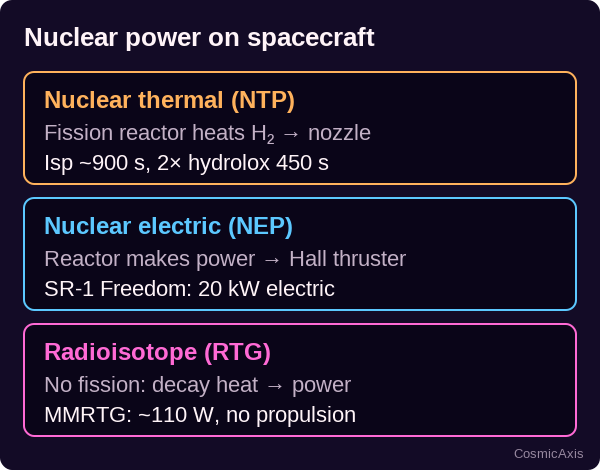
A nuclear thermal rocket (NTP) heats hydrogen in a fission reactor and expels it through a nozzle, reaching a specific impulse of about 900 s, twice the 450 s of liquid hydrogen–oxygen engines (NASA, DOE). Nuclear electric propulsion (NEP) uses the reactor only to generate electricity.
01Knowledge
How does a nuclear rocket engine differ from a chemical one?
A nuclear rocket engine differs from a chemical one in its energy source: the heat comes from fission of uranium in a reactor instead of from combustion (Borowski, NASA GRC 2012), so the propellant can be the lightest element, hydrogen.
“Nuclear power on a spacecraft” covers three different things:
- Nuclear thermal propulsion (NTP): a reactor heats hydrogen, which leaves through a nozzle.
- Nuclear electric propulsion (NEP): a reactor only generates electricity for an electric thruster.
- Radioisotope thermoelectric generator (RTG): not a reactor, only a power source.
The advantage is clearest on long legs, so the topic belongs to deep space operations.
How does a nuclear thermal rocket (NTP) work?
A nuclear thermal rocket pumps liquid hydrogen through channels in a fission reactor core; the hydrogen heats to a very high temperature and expands through a supersonic nozzle to produce thrust (Borowski 2012). The pumping resembles an expander-cycle liquid engine, with the reactor core in place of the combustion chamber.
Hot hydrogen gives a high specific impulse (Isp) because the lighter and hotter the exhaust gas, the faster it leaves: a hydrogen–oxygen engine expels mostly water vapour, while a nuclear thermal engine expels pure hydrogen.
| Engine | Vacuum Isp (s) | Source, date accessed |
|---|---|---|
| RS-25, liquid hydrogen–oxygen | 452.3 | L3Harris, 2026-09-29 |
| Liquid hydrogen–oxygen (round figure) | 450 | DOE, 2026-09-29 |
| Nuclear thermal, initial target | 900 | DOE; Borowski 2012, 2026-09-29 |
| Nuclear thermal, Mars DRA 5.0 study | 875–950 | Borowski 2012, 2026-09-29 |
The price is a heavy reactor core and shield, plus very large liquid hydrogen tanks. Reactor and fuel specifications are outside CosmicAxis’s scope and often export-controlled under ITAR.
How does nuclear electric propulsion (NEP) differ from NTP?
Nuclear electric propulsion differs from nuclear thermal propulsion in that the reactor does not heat the propellant but only generates electricity for an ion thruster or Hall thruster. NASA’s SR-1 Freedom uses a closed Brayton-cycle conversion system for 20 kW of electric power, a 12 kW AEPS Hall thruster, and high-assay low-enriched uranium (HALEU) fuel (NASA, updated 15 September 2026).
NTP gives high thrust and burns for only a few tens of minutes per manoeuvre (Borowski); NEP gives an Isp many times higher but very low thrust, so it must push for months. NASA says it opens the way to high-power missions beyond Jupiter, where solar panels stop being effective (NASA, 24 March 2026).
How does an RTG differ from a reactor?
An RTG has no fission and no chain reaction: it converts the heat of natural plutonium-238 decay into electricity with thermocouples and has no moving parts (NASA RPS FAQ). An RTG supplies power only and does not propel the spacecraft.
The MMRTG on the Perseverance rover gives about 110 W of electric power at the start of the mission, weighs about 45 kg with 4.8 kg of plutonium dioxide, and runs for at least 14 years; it is identical to the MMRTG on Curiosity (NASA JPL). The United States has used radioisotope power sources since 1961 (NASA).
The 12 kW Hall thruster on SR-1 Freedom needs more than 100 times the electric power of one MMRTG (calculated by CosmicAxis), which is why electric propulsion needs a reactor.
02Practice
Calculation: how much does an Isp of 900 s shorten a trip to Mars?
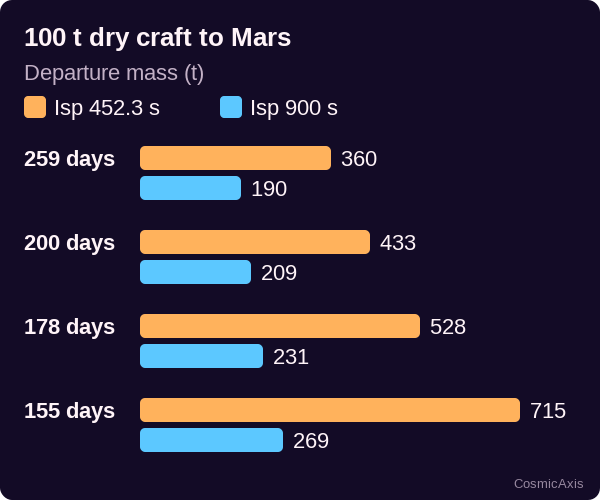
A 100 t dry spacecraft sent to Mars on a 259-day Hohmann transfer orbit needs 360 t at departure from a 200 km orbit with an Isp of 452.3 s, but only 190 t with an Isp of 900 s. At the same initial mass as the chemical trip, the 900 s engine cuts the flight to 127 days (calculated by CosmicAxis).
Source
calculated by CosmicAxis from NASA JPL and NASA NSSDCA constants; Isp: L3Harris, NASA NTRS 20120003776
The code adds the delta-v of the departure burn from a 200 km Earth orbit and the capture burn into a 500 km Mars orbit, then converts it to a mass ratio with the rocket equation m₀/m_f = e^(Δv / (Isp · g₀)). A faster trip means leaving faster and braking harder.
import math

G0 = 9.80665  # m/s², NIST CODATA
GM_SUN, GM_EARTH, GM_MARS = 1.32712440041e11, 398600.435507, 42828.375816  # km³/s², NASA JPL
R1, R2 = 149.598e6, 227.956e6  # km, semi-major axes of Earth and Mars (NASA NSSDCA)
R_LEO, R_LMO = 6378.137 + 200, 3396.2 + 500  # km, parking orbit radii

def burn(v_inf, gm, r):
    # one burn from a circular orbit of radius r to gain or shed excess speed v∞
    return math.sqrt(v_inf**2 + 2 * gm / r) - math.sqrt(gm / r)

def trip(v_inf):
    # leave Earth at v∞ (km/s), reach Mars' orbit: flight days, total Δv (km/s)
    v = math.sqrt(GM_SUN / R1) + v_inf
    a = 1 / (2 / R1 - v**2 / GM_SUN)
    e = 1 - R1 / a
    nu = math.acos(max(-1.0, min(1.0, (a * (1 - e**2) / R2 - 1) / e)))
    E = 2 * math.atan(math.sqrt((1 - e) / (1 + e)) * math.tan(nu / 2))
    days = (E - e * math.sin(E)) * math.sqrt(a**3 / GM_SUN) / 86400
    h = R1 * v
    v_arr = math.hypot(GM_SUN / h * e * math.sin(nu), h / R2 - math.sqrt(GM_SUN / R2))
    return days, burn(v_inf, GM_EARTH, R_LEO) + burn(v_arr, GM_MARS, R_LMO)

def mass_ratio(dv, isp):
    return math.exp(dv * 1000 / (isp * G0))  # m₀/m_f, rocket equation

v_h = math.sqrt(GM_SUN / R1) * (math.sqrt(2 * R2 / (R1 + R2)) - 1)  # Hohmann
for v_inf in [v_h, 3.2, 3.5, 4.0]:
    days, dv = trip(v_inf)
    print(f"{days:.0f} days, Δv {dv:.2f} km/s: {100 * mass_ratio(dv, 452.3):.0f} t / {100 * mass_ratio(dv, 900):.0f} t")

# same mass ratio as the chemical Hohmann trip: how fast can Isp 900 s fly?
dv_max = 900 * G0 * math.log(mass_ratio(trip(v_h)[1], 452.3)) / 1000
lo, hi = v_h, 20.0
for _ in range(60):
    mid = (lo + hi) / 2
    lo, hi = (mid, hi) if trip(mid)[1] < dv_max else (lo, mid)
print(f"Isp 900 s, Δv {dv_max:.2f} km/s: {trip(lo)[0]:.0f} days")
Output (Python 3.14), Isp 452.3 s on the left, Isp 900 s on the right:
259 days, Δv 5.68 km/s: 360 t / 190 t
200 days, Δv 6.50 km/s: 433 t / 209 t
178 days, Δv 7.38 km/s: 528 t / 231 t
155 days, Δv 8.72 km/s: 715 t / 269 t
Isp 900 s, Δv 11.31 km/s: 127 days
- Speed is expensive: from 259 to 155 days, the initial mass at Isp 452.3 s doubles, but at Isp 900 s it rises only 42%, because delta-v sits in an exponent divided by Isp.
- Limits: the code assumes circular, coplanar orbits and lumps engines and tanks into the dry mass, so the real advantage is smaller; DOE says a nuclear thermal engine could shorten a Mars trip by up to 25%.
03Reality
What did the Rover/NERVA programme test between 1955 and 1973?
The US Rover and NERVA (Nuclear Engine for Rocket Vehicle Application) programmes designed, built and ground-tested twenty rocket reactors from 1955 to 1972, then were cancelled in 1973 before any flight test (Borowski 2012; Gerrish, NASA MSFC 2014).
Borowski lists thrust levels from the “Pewee” engine at 25,000 lbf to “Phoebus-2A” at 250,000 lbf, a single burn of more than 62 minutes (NRX-A6), and restart: NRX-XE ran for more than 2 hours in total over 28 starts and shutdowns.
NASA’s Mars DRA 5.0 study chose a nuclear thermal engine because it cut more than 400 t of mass launched to low Earth orbit, equal to the mass of the ISS, with each leg taking about 6 months (Borowski 2012).
What did SNAP-10A and Kosmos 954 teach about reactors in orbit?
SNAP-10A, the only reactor the United States has ever launched, ran for 43 days and then stayed on a high orbit; the Soviet Kosmos 954 fell on Canada in 1978 and scattered radioactive debris.
SNAP-10A launched on 3 April 1965 to a 500 nautical mile orbit, about 926 km (unit conversion by CosmicAxis), and initially produced more than 600 W of electric power. After 43 days the reactor was shut down by a high-voltage fault in the Agena spacecraft’s electrical system, not by a nuclear fault; it remains in polar orbit (DOE ETEC).
Kosmos 954 carried a uranium reactor. According to Canada’s claim for damages, the satellite entered Canadian airspace at 11:53 GMT on 24 January 1978; every recovered fragment but two was radioactive, some at lethal levels. Canada claimed 6,041,174.70 Canadian dollars and received 3 million under the Protocol of 2 April 1981.
On 14 December 1992 the UN General Assembly adopted Resolution 47/68, the Principles Relevant to the Use of Nuclear Power Sources in Outer Space (UNOOSA):
- Principle 3: a reactor may operate only on interplanetary missions or in a sufficiently high orbit (a low orbit requires boosting it afterwards), and must not go critical before reaching its operating orbit.
- Principle 5: a launching State must promptly inform the States concerned when a spacecraft with a nuclear power source malfunctions and risks falling to Earth.
Where are DRACO and SR-1 Freedom in 2026?
In 2026 the United States has no nuclear thermal flight-test project; nuclear electric propulsion has SR-1 Freedom, aimed at launch by the end of 2028 (NASA).
- DRACO (Demonstration Rocket for Agile Cislunar Operations): a DARPA–NASA project announced on 24 January 2023, using HALEU fuel and aiming to test a nuclear thermal engine in Earth orbit in fiscal year 2027 (DARPA).
- May 2025: NASA’s fiscal year 2026 budget funds no nuclear thermal or electric propulsion project, citing high cost, long development and earlier options for the Mars leg; the document records that the partner cancelled DRACO, and the DARPA page now says the programme has ended.
- 24 March 2026: NASA announced the launch of SR-1 Freedom, weighing about 12,000 kg, to fly past Mars before the end of 2028 as a nuclear electric propulsion test, while pausing the Gateway station in its current form in the Artemis programme.
A nuclear thermal engine has therefore never flown. SpaceX’s Starship plan for Mars still relies on chemical engines, so a crewed trip must allow hundreds of days of weightlessness.
04Milestone
Milestone: check yourself
If you can do all of these, move on to the next article in this phase.
- Can you explain why hot hydrogen gives twice the Isp of a hydrogen–oxygen engine?
- Can you tell NTP, NEP and an RTG apart?
- Can you run the Python code and explain why an Isp of 900 s needs 190 t instead of 360 t for the same Mars trip?
- Can you name the two 1992 UN principles linked to the Kosmos 954 accident?
Frequently asked questions
Can a nuclear rocket engine explode like an atomic bomb?
No. A nuclear thermal engine uses a controlled fission reactor as a heat source, not an explosive device. The main risk is radioactive material falling back to Earth if the rocket fails (UN 1992 Principles).
What is an RTG?
A radioisotope thermoelectric generator converts the heat of natural plutonium-238 decay into electricity with thermocouples, without fission (NASA). The Perseverance rover's MMRTG gave about 110 W at the start of the mission.
Is NASA still developing a nuclear thermal rocket?
NASA's proposed fiscal year 2026 budget funds no nuclear propulsion project and records DRACO as cancelled. In March 2026 NASA announced SR-1 Freedom, a nuclear electric spacecraft aimed at launch by the end of 2028.
References
- Borowski — NTP: A Proven Growth Technology, NASA GRC, 2012 — accessed
- Gerrish — Raising NTP TRL Above 3, NASA MSFC, 2014 — accessed
- DOE — 6 Things About Nuclear Thermal Propulsion (2025) — accessed
- L3Harris — RS-25 spec sheet (2024) — accessed
- DARPA — NASA nuclear thermal rocket engine (24/1/2023) — accessed
- DARPA — DRACO — accessed
- NASA — FY 2026 Budget Technical Supplement — accessed
- NASA — Space Reactor-1 Freedom (updated 15/9/2026) — accessed
- NASA Release — National Space Policy (24/3/2026) — accessed
- NASA JPL — Mars 2020 Launch Press Kit, Power — accessed
- NASA — Radioisotope Power Systems FAQ — accessed
- DOE ETEC — SNAP Overview — accessed
- Canada — Claim for damage caused by Cosmos 954 (JAXA) — accessed
- Canada — Protocol, Cosmos-954 claim (2/4/1981) — accessed
- UNOOSA — NPS Principles (A/RES/47/68) — accessed
- NASA JPL — Astrodynamic Parameters — accessed
- NASA NSSDCA — Earth Fact Sheet — accessed
- NASA NSSDCA — Mars Fact Sheet — accessed
Cite this article
CosmicAxis. (2026). Nuclear Thermal Rocket: NTP, NEP and RTG Explained. https://cosmicaxis.space/en/nuclear-thermal-rocket/