
Why do astronauts float in space? What weightlessness is
Source
Gravitational parameter GM from NASA JPL; calculated by CosmicAxis
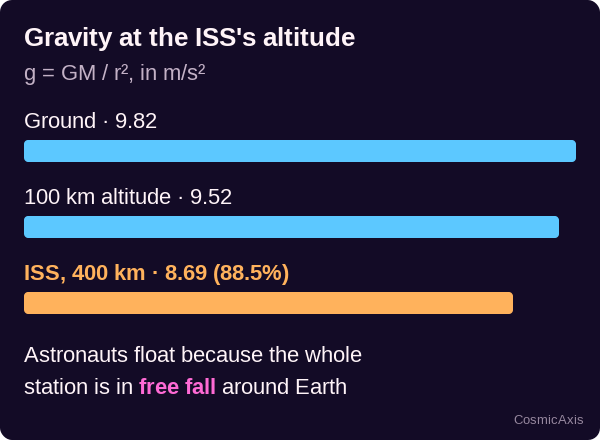
Astronauts float because they and their spacecraft are in free fall, so apparent weight is zero. At the ISS's 400 km altitude, gravity is still 88.5% of its ground value (CosmicAxis calculation from NASA JPL GM): the whole station is falling around Earth.
01Knowledge
What is weightlessness?
Weightlessness is the state of an object that feels only gravity and is in free fall, so nothing supports it: its apparent weight is zero. Gravity does not disappear; only the feeling of being heavy does.
Two ideas from foundational knowledge are easy to mix up:
- Gravitational force is Earth’s pull on an object, m · g. It depends only on mass and distance from Earth’s center.
- Apparent weight is the force an object presses on its support, which is what a scale reads. It also depends on the support’s acceleration.
NASA’s educational guide (EG-1997-08-110-HQ) defines microgravity as an environment where a system’s apparent weight is small compared with its true weight due to gravity.
How is apparent weight in an elevator calculated?
Apparent weight in an elevator equals mass times the difference between g and the elevator’s downward acceleration: P = m · (g − a). When the elevator is in free fall, a = g and P = 0.
It follows from Newton’s second law. NASA’s example uses g = 9.8 m/s² and a 60 kg person:
- Elevator at rest: the scale reads 60 × 9.8 = 588 N.
- Elevator accelerating downward at 0.5 m/s²: the scale reads 60 × (9.8 − 0.5) = 558 N.
- Cable cut, elevator falling at 9.8 m/s²: the scale reads 0 N, because the person and the scale fall with the same acceleration.
An accelerometer measures exactly this quantity, called specific force: on a table it reads 1 g, known as g-force, and in free fall 0. A Kalman filter must therefore compensate for the gravity part.
How does gravity change with altitude?
Gravitational acceleration falls with the square of the distance from Earth’s center: g(h) = GM / (R + h)², with GM = 398,600.435507 km³/s² (NASA JPL) and a mean radius R = 6,371.0 km (NASA NSSDCA). At 400 km altitude, g is 8.69 m/s², which is 88.5% of ground level (CosmicAxis calculation).
| Altitude | g (m/s²) | Share of ground g (%) | Source, date |
|---|---|---|---|
| Ground | 9.820 | 100 | Calculated; NASA NSSDCA gives 9.820, 2026-09-29 |
| 100 km | 9.519 | 96.9 | Calculated from NASA JPL GM, 2026-09-29 |
| 370 km (lowest ISS) | 8.772 | 89.3 | Altitude: NASA; g calculated, 2026-09-29 |
| 400 km | 8.694 | 88.5 | Calculated, 2026-09-29 |
| 460 km (highest ISS) | 8.542 | 87.0 | Altitude: NASA; g calculated, 2026-09-29 |
NASA gives the International Space Station an altitude of 370–460 km, and its educational page rounds the result to 90%: 100 pounds on the ground would be 90 pounds at the top of a ladder reaching the station.
Why do astronauts float on the ISS?
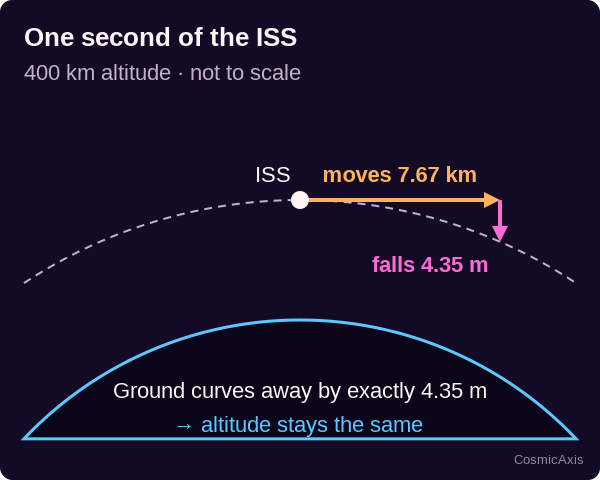
Astronauts float on the ISS because the station and everyone inside it fall with the same acceleration, 8.69 m/s² at 400 km, while moving sideways fast enough that the ground curves away by exactly the distance fallen.
Source
Gravitational parameter GM from NASA JPL; calculated by CosmicAxis
In 1 second the station falls ½ · g · t² = 4.35 m and travels 7.67 km. Over those 7.67 km, Earth’s surface curves away by v² · t² / (2r) = 4.35 m (CosmicAxis calculation). The two numbers match because a circular orbit satisfies v² / r = g, the same relation that gives the first cosmic velocity.
NASA’s guide reuses Newton’s cannon on a mountaintop: fire fast enough and the cannonball falls all the way around Earth. It also names two wrong answers: “engines always push the station up” and “there is no gravity in space”.
How is microgravity different from “zero-g”?
Microgravity is the correct name for the environment on an orbiting spacecraft, because the leftover acceleration is not zero but about one millionth of g; “zero-g” is only an approximation.
According to NASA’s educational guide, on the Space Shuttle drag and the vehicle’s own rotation give about 10⁻⁶ g, and vibration from fans, pumps and moving crew (g-jitter) adds a background of about 10⁻⁴ g.
NASA’s example: a rock dropped from 5 m lands after 1 second, but at one millionth of g it would take 1,000 seconds. Reducing Earth’s gravity itself to one millionth would need a distance nearly 17 times the Moon’s; letting a laboratory fall freely is much cheaper.
How does weightlessness change fluids, fire and the human body?
Weightlessness removes natural convection, stops liquids from settling at the bottom of a container, and shifts body fluids toward the head.
- No convection: hot gas no longer rises. NASA describes candle flames in microgravity as spherical, because oxygen reaches the flame only by diffusion. Exhaled air does not disperse either, so life support must circulate cabin air actively.
- Propellant drifting in tanks: a NASA Glenn report (Hartwig, NTRS 20170000667) states that in microgravity surface tension decides where liquid sits: liquid clings to the tank wall, gas sits in the middle. Gas entering an engine can cause unstable combustion or damage. Upper stages on short flights (under 6 hours) usually fire settling thrust to push propellant to the outlet before restarting a liquid-fuel engine.
- The body: NASA HRP records that body fluids shift toward the head, which can press on the eyes and reduce vision; weight-bearing bones lose 1–1.5% of mineral density per month on average; balance and hand-eye coordination are disturbed, and some people get space sickness. Artificial gravity could reduce these effects, but no crewed spacecraft uses it yet.
Weightlessness ends when atmospheric reentry brakes the spacecraft with drag. A separate hazard of the same environment is space radiation, from outside the Solar System, the Sun and the Van Allen belts.
02Practice
How do you calculate gravity at altitude in Python?
Gravity at altitude needs only GM and Earth’s radius. This code computes g at several altitudes and the distance the ISS falls in 1 second.
import math

GM = 398600.435507  # km³/s², NASA JPL (DE440)
R = 6371.0          # km, mean radius, NASA NSSDCA

def g(h_km):
    # gravitational acceleration at altitude h, m/s²
    return GM / (R + h_km) ** 2 * 1000

for h in [0, 100, 370, 400, 460]:
    print(f"h = {h:>3} km: g = {g(h):.3f} m/s² ({g(h) / g(0):.1%})")

# ISS at 400 km: how far it falls in 1 s vs how far the ground curves away
r = (R + 400) * 1000           # m
v = math.sqrt(GM * 1e9 / r)    # m/s
fall = 0.5 * g(400) * 1 ** 2   # m
curve = v ** 2 / (2 * r)       # m
print(f"v = {v:.0f} m/s, falls {fall:.2f} m, ground curves away {curve:.2f} m")
Output (Python 3.14):
h =   0 km: g = 9.820 m/s² (100.0%)
h = 100 km: g = 9.519 m/s² (96.9%)
h = 370 km: g = 8.772 m/s² (89.3%)
h = 400 km: g = 8.694 m/s² (88.5%)
h = 460 km: g = 8.542 m/s² (87.0%)
v = 7673 m/s, falls 4.35 m, ground curves away 4.35 m
Exercise: find the altitude where g is half its ground value, then compute the free-fall time √(2h / g) for the 132 m drop of NASA’s Glenn tower and compare it with NASA’s published 5.18 seconds.
How can a water bottle with a hole show weightlessness?
A bottle with a hole shows weightlessness in under 1 second: while the bottle flies freely, water stops flowing out because water and bottle fall with the same acceleration. It is the “Can Throw” activity in NASA’s educational guide, with a plastic bottle instead of an aluminum can for safety.
You need an empty plastic bottle, a basin and water. Ask an adult to punch one small hole near the bottom with a nail.
- Cover the hole with a finger and fill the bottle with water.
- Hold the bottle still over the basin and release your finger: the water jets out.
- Cover the hole again, stand about 2 m from the basin and toss the bottle gently into it without spinning it. Do this outdoors, never toward people.
- Watch the hole in flight: the jet switches off, even while the bottle is still rising.
The jet stops because in free flight the water no longer presses on the bottom, so no pressure pushes it through the hole. NASA notes the same effect on parabolic flights. Film it in slow motion to see the moment clearly.
03Reality
How long do drop towers and parabolic flights give microgravity?
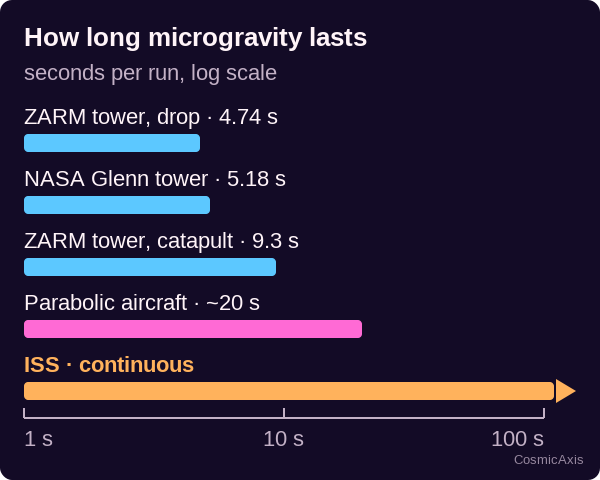
Drop towers give microgravity for 4.74 to 9.3 seconds and parabolic flights for about 20 seconds each time; only a spacecraft in orbit holds microgravity continuously for months.
Source
ESA, ZARM, NASA Glenn Research Center
| Method | Per run (s) | Residual acceleration (g) | Source, date |
|---|---|---|---|
| ZARM tower, Bremen: drop | 4.74 | < 10⁻⁶ | ESA, ZARM, 2026-09-29 |
| ZARM tower: catapult up, then fall | 9.3 | < 10⁻⁶ | ESA, ZARM, 2026-09-29 |
| NASA Glenn tower, Cleveland | 5.18 | < 10⁻⁵ | NASA Glenn, 2026-09-29 |
| A310 Zero-G parabolic flight | about 20 | 10⁻² – 10⁻³ | ESA; g level: NASA EG-1997, 2026-09-29 |
| Sounding rocket | a few minutes | about 10⁻⁵ | NASA EG-1997, 2026-09-29 |
The ZARM tower (Germany) is 146 m tall with a vacuum tube inside. The capsule is released from 120 m (ESA); 4.74 seconds of free fall corresponds to a 110 m drop (CosmicAxis calculation). In catapult mode the capsule is pushed up from the bottom and falls back, nearly doubling the time, but it endures up to 35 g at launch and up to 50 g during braking.
NASA’s Glenn tower (USA) has operated since 1966: the capsule falls 132 m in a vacuum chamber, then stops in a container of foam pellets.
ESA’s parabolic flights use an Airbus A310 Zero-G, 31 parabolas per flight. Each time the aircraft pulls up at about 1.8 g, then flies a free-fall trajectory for about 20 seconds. Alternating between heavy and floating earned such aircraft the nickname “Vomit Comet” (NASA).
Towers, aircraft and sounding rockets share one limit NASA points out: after seconds or minutes, the ground gets in the way. Experiments lasting months must go into orbit, as on the ISS.
04Milestone
Milestone: check yourself
If you can do all of these, move on to the next article in this phase.
- Can you explain why gravity at the ISS's altitude is still 88.5% of ground level while astronauts float?
- Can you calculate the apparent weight of a 60 kg person in an elevator accelerating downward at 0.5 m/s²?
- Can you modify the Python code to find the altitude where g falls to half of its ground value?
- Can you run the water-bottle experiment and explain why the water stops flowing while the bottle is in flight?
Frequently asked questions
What is the difference between microgravity and zero gravity?
NASA calls the environment on an orbiting spacecraft microgravity, because leftover accelerations are about one millionth of g, not exactly zero. Zero gravity and zero-g are informal names for the same condition.
When does weightlessness happen?
Weightlessness happens whenever an object feels only gravity, which means free fall: an elevator with a cut cable, a diver before hitting the water, an aircraft flying a parabola, or a spacecraft with its engines off in orbit.
Is weightlessness the same as having no gravity?
No. Having no gravity would mean no pull at all, which never happens near Earth. Weightlessness means apparent weight is zero while gravity is still about 90% of ground level at the altitude of the ISS (NASA).
References
- NASA EG-1997-08-110-HQ — Microgravity: A Teacher's Guide — accessed
- NASA — What Is Microgravity? (Grades 5-8) — accessed
- NASA JPL — Astrodynamic Parameters — accessed
- NASA NSSDCA — Earth Fact Sheet — accessed
- NASA — International Space Station (reference) — accessed
- ESA — Airbus A310 Zero-G — accessed
- ESA — The ZARM drop tower in Bremen — accessed
- ZARM — Drop Tower — accessed
- NASA Glenn — Zero Gravity Research Facility — accessed
- NASA HRP — Hazard: Gravity Fields — accessed
- Hartwig (NASA Glenn) — Propellant Management Devices, NTRS 20170000667 — accessed
Cite this article
CosmicAxis. (2026). Why Do Astronauts Float? Weightlessness in Space Explained. https://cosmicaxis.space/en/why-astronauts-float/