
How much radiation do astronauts get in space?
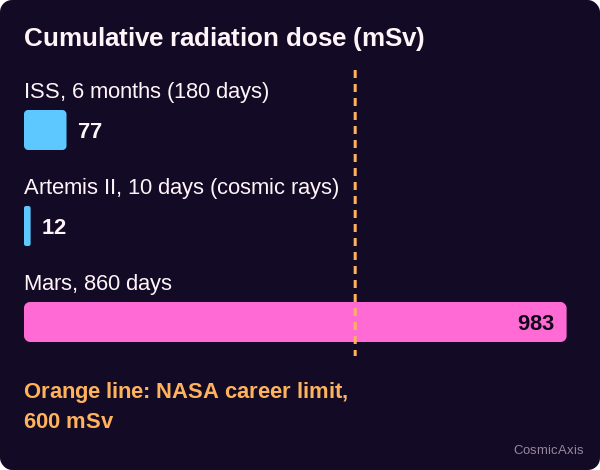
Source
CosmicAxis calculation from Garrett-Bakelman 2019, George 2024, SwRI 2013; limit from NASA-STD-3001 Vol. 1 Rev C
Space radiation is energetic particles from outside the Solar System, from the Sun and from the Van Allen belts. ISS astronauts receive about 0.43 mSv a day and Mars-bound crews 1.8 mSv a day (MSL RAD); NASA-STD-3001 limits career dose to below 600 mSv.
01Knowledge
What is space radiation and what is it made of?
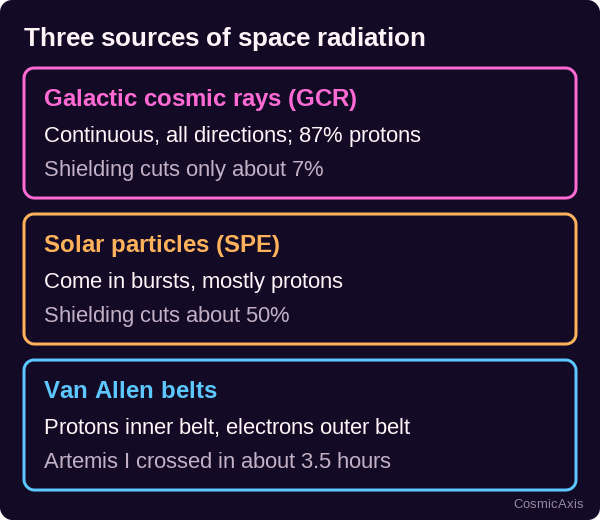
Space radiation is a stream of high-energy charged particles that can knock electrons off atoms (ionizing radiation) as they pass through the body. According to NASA OCHMO-TB-020 (2025), astronauts face three sources:
- Galactic cosmic rays (GCR): atomic nuclei from outside the Solar System, 87% protons, 12% helium and 1% heavier nuclei (Simonsen and Slaba, NASA 2023). They arrive continuously from every direction.
- Solar particle events (SPE): bursts of protons thrown out by the Sun, most frequent around the peak of the solar cycle.
- The Van Allen belts: particles trapped by Earth’s magnetic field, discovered in 1958 by James Van Allen’s team with Explorer 1 and Explorer 3 (NASA). The inner belt is mostly protons and the outer belt mostly electrons (George et al., 2024).
Source
NASA OCHMO-TB-020 Rev G (2025); Simonsen and Slaba, NASA 2023; George et al., Nature 2024
On the ground, the atmosphere and the magnetic field stop almost all three. Radiation protection is one strand of life support.
How do gray, sievert and mSv differ?
The gray (Gy) measures the radiation energy absorbed per kilogram of matter, while the sievert (Sv) measures the harm to the body; both equal J/kg (NIST SP 811). Equivalent dose is absorbed dose times the quality factor of the particle type: H = Q · D. Inside Orion on Artemis I, the measured mean Q was 2.30 to 3.06 (George et al., 2024).
Example: Scott Kelly’s dosimeters recorded 76.18 mGy over 340 days on the ISS, while the effective dose NASA computed was 146.34 mSv (Garrett-Bakelman et al., 2019), about 1.9 times higher (CosmicAxis calculation).
How much radiation do astronauts get each day?
ISS astronauts receive about 0.43 mSv a day and a crew on the way to Mars 1.8 mSv a day, about 65 and 274 times ground background (CosmicAxis calculation from the table). The weightlessness aboard the ISS comes from free fall around Earth, and the same orbit keeps the crew partly inside the magnetic shield.
| Place | Dose rate (mSv/day) | Source, date accessed |
|---|---|---|
| Ground (2.4 mSv/year) | 0.0066 | UNSCEAR 2000, 2026-09-29 |
| ISS (Scott Kelly) | 0.43 | Twins Study 2019, 2026-09-29 |
| Mars surface (Curiosity) | 0.67 | SwRI 2013, 2026-09-29 |
| Inside Orion, outside the belts | 0.96 to 1.24 | George 2024, 2026-09-29 |
| Cruise to Mars | 1.8 | SwRI 2013, 2026-09-29 |
The ISS flies inside the protection of Earth’s magnetic field and collects extra trapped particles only when it crosses the South Atlantic Anomaly (OCHMO-TB-020). A 6-month stay therefore adds a dose equal to 13% of the career limit (CosmicAxis calculation). The RAD instrument on the Curiosity rover showed that the two cruise legs of the shortest round trip to Mars alone deliver 0.66 ± 0.12 Sv (Zeitlin et al., Science 2013).
What is NASA’s radiation limit for astronauts?
NASA limits each astronaut’s career effective dose to below 600 mSv, the same for every age and sex (NASA-STD-3001 Vol. 1 Rev C, [V1 4030], approved 15 September 2023), so that the added risk of cancer death stays under 3%. The standard also requires:
- Each reference solar storm (the sum of the October 1989 events): dose below 250 mSv [V1 4031].
- Missions over 60 days: cosmic-ray dose below 1.3 mSv/day in space and below 0.9 mSv/day on a planetary surface [V1 4033].
- The ALARA principle: keep dose as low as reasonably achievable [V1 4029].
Is space radiation dangerous?
Space radiation is dangerous in two ways: low doses over a long time raise the risk of cancer and nerve damage, while one large solar storm can cause acute radiation sickness such as nausea, vomiting, fatigue, and damage to skin and bone marrow (NASA OCHMO-TB-020). NASA-STD-3001 (table 4.8-1) adds separate limits:
- Lens of the eye: 1,000 mGy-Eq in 30 days, to avoid severe early cataracts after a solar storm. The standard admits cosmic rays can still cause mild cataracts later.
- Central nervous system (scored at the hippocampus): 1,500 mGy over a career, and only 250 mGy for heavy ions alone.
- Cardiovascular system: 1,000 mGy-Eq over a career.
This is technical knowledge, not medical advice.
What shields spacecraft from radiation?
Spacecraft shield with mass placed between people and the source, usually aluminum, polyethylene and hydrogen-rich material such as water (NASA OCHMO-TB-020). Aluminum and polyethylene cut solar particle dose by 50% on average, but galactic cosmic ray dose by only 7%. Shielding thickness is measured as mass per area:
| Vehicle or surface | Median shielding (g/cm²) | Source, date accessed |
|---|---|---|
| Apollo-era spacesuit | 2 | OCHMO-TB-020, 2026-09-29 |
| Apollo command module | 11 | OCHMO-TB-020, 2026-09-29 |
| Orion | 32 | OCHMO-TB-020, 2026-09-29 |
| Mars atmosphere | 42 | OCHMO-TB-020, 2026-09-29 |
| ISS | 54 | OCHMO-TB-020, 2026-09-29 |
| Earth’s atmosphere and magnetic field | 1,000 | OCHMO-TB-020, 2026-09-29 |
Thick walls barely stop cosmic rays: on Artemis I, about 80% more shielding mass cut equivalent dose by only about 30% (George et al., 2024). Against a once-in-100-years solar storm, NASA recommends a shelter equivalent to 10 cm of water, built by rearranging water containers and cargo, so life-support water doubles as shielding.
On Orion the shelter is two bays under the seats, between the floor and the heat shield; the crew has up to 1 hour to pile stowage bags around themselves and can stay up to 24 hours (NASA, Crew Systems). The design limit for a large storm inside the shelter is 150 mSv (George et al., 2024).
02Practice
How do you calculate cumulative radiation dose for a mission in Python?
Cumulative dose is the sum of dose rate times days for each leg: H = Σ (days × mSv/day). The code below uses the dose rates from the table for 180 days on the ISS, 10 days for Artemis II, and 860 days to Mars (180 days of flight each way, 500 on the surface).
# mSv/day: ISS (Twins Study), Orion (Artemis I, high end), Mars (MSL RAD)
ISS = 146.34 / 340
ORION = 1.24
MARS_CRUISE, MARS_SURFACE = 1.8, 0.67
# mSv/day: 2.4 mSv/year ground background (UNSCEAR 2000)
BACKGROUND = 2.4 / 365.25
# mSv: career limit, NASA-STD-3001 Vol. 1 Rev C [V1 4030]
LIMIT = 600

MISSIONS = {
    "ISS 6 months": [(180, ISS)],
    "Artemis II 10 days": [(10, ORION)],
    "Mars 860 days": [(180, MARS_CRUISE), (500, MARS_SURFACE), (180, MARS_CRUISE)],
}

for name, legs in MISSIONS.items():
    dose = sum(days * rate for days, rate in legs)
    print(f"{name}: {dose:.0f} mSv, {dose / LIMIT:.0%} of limit,"
          f" equal to {dose / BACKGROUND / 365.25:.0f} years of background")

print(round(LIMIT / ISS), "days on the ISS to reach the limit")
print(round(LIMIT / MARS_CRUISE), "days of Mars cruise to reach the limit")
ISS 6 months: 77 mSv, 13% of limit, equal to 32 years of background
Artemis II 10 days: 12 mSv, 2% of limit, equal to 5 years of background
Mars 860 days: 983 mSv, 164% of limit, equal to 410 years of background
1394 days on the ISS to reach the limit
333 days of Mars cruise to reach the limit
The 983 mSv result matches the “about 1 Sv” estimate of the RAD team (SwRI, 2013). The 180 days each way is an assumption that makes the cruise legs give 0.66 Sv; an ideal Hohmann transfer orbit takes 259 days. NASA-STD-3001 gives the example that 90 fewer days avoids 135 mSv.
The Artemis II line does not count the two belt crossings; before the flight NASA estimated the total dose at about 1 month on the ISS (NASA Science, 16 March 2026).
03Reality
What did the Artemis I mannequins Helga and Zohar measure?
Artemis I showed that inside Orion the best-shielded spot received a dose rate up to 4 times lower than the worst-shielded spot while crossing the proton belt, and that cosmic rays delivered 0.96 to 1.24 mSv a day (George et al., Nature 2024). Orion flew uncrewed on its trajectory to the Moon from 16 November to 11 December 2022.
Helga and Zohar are two 36 kg female-body mannequins carrying more than 6,000 passive dosimeters and 16 active detectors (DLR). Helga flew unshielded; Zohar wore the AstroRad radiation vest, which weighs about 26 kg.
- Van Allen belts: Orion crossed the inner belt from 07:12 to 07:42 UTC and the outer belt from 08:45 to 10:45 UTC, about 3.5 hours in total (CosmicAxis calculation). The inner belt gave up to 23% of total dose at the worst-shielded spot; when Orion turned 90° to fire toward the Moon, the dose rate fell by about 50%.
- Inside Helga: crossing the inner belt, the front of the skin received 1.96 mGy and the spine 0.61 mGy; for cosmic rays every organ received almost the same, 9.38 to 10.17 mGy.
- AstroRad vest: for two reference storms reconstructed from the Zohar measurements, the vest cut effective dose by about 60% for the August 1972 storm and 40% for the October 1989 storm (DLR, Science Advances, 12 August 2026).
How did the August 1972 solar storm nearly affect Apollo?
The solar particle storm that began on 4 August 1972, one of the largest and most dangerous of the spaceflight era, fell in the gap between Apollo 16 (back on Earth 27 April 1972) and Apollo 17 (launched 7 December 1972) (National Research Council, 2006). High-energy protons reached Earth less than 40 minutes after the eruption was seen on the Sun. Later studies estimated that:
- Behind spacesuit-level shielding, skin could receive 15 to 20 Gy in under a day, enough to cause severe blistering and skin loss.
- Even inside a spacecraft, skin could still receive up to 2 Gy and bone marrow about 1 Gy, enough to change blood counts and possibly cause nausea and vomiting.
The report concluded that the storm could have been serious had it coincided with a flight; the 1859 Carrington event is estimated at about 4 times stronger. As with the Apollo 13 oxygen tank explosion, a rare hazard needs an answer in the design from the start.
04Milestone
Milestone: check yourself
If you can do all of these, move on to the next article in this phase.
- Can you explain why Scott Kelly's 76.18 mGy became 146.34 mSv?
- Can you run the Python code and find after how many days of flight to Mars a crew reaches 600 mSv?
- Can you explain why Orion's storm shelter sits among the stowage bags under the floor?
Frequently asked questions
Is space radiation the same as cosmic background radiation?
No. The cosmic microwave background is a relic of the Big Bang (NASA). The space radiation in this article is high-energy charged particles, the kind that harms an astronaut's body.
What are cosmic rays?
Cosmic rays are atomic nuclei stripped of their electrons, moving near light speed. Galactic cosmic rays are about 87% protons, 12% helium and 1% heavier nuclei (Simonsen and Slaba, NASA 2023).
How much natural radiation do people on the ground receive each year?
People on the ground receive an average of 2.4 mSv a year from natural sources; about 65% of the population receives 1 to 3 mSv (UNSCEAR 2000).
References
- NASA-STD-3001 Vol. 1 Rev C, section 4.8 — accessed
- NASA OCHMO-TB-020 Rev G (2025) — accessed
- George et al., Nature 634 (2024) — accessed
- DLR — AstroRad vest (2026) — accessed
- DLR — MARE experiment — accessed
- Zeitlin et al., Science 340 (2013) — accessed
- SwRI — radiation dose on the way to Mars (2013) — accessed
- SwRI — radiation dose on the surface of Mars (2013) — accessed
- Garrett-Bakelman et al., Science 2019 — accessed
- UNSCEAR 2000, Volume I — accessed
- NIST SP 811, chapter 4 — accessed
- Simonsen, Slaba — NASA GCR Simulator (2023) — accessed
- NASA — A short history of Earth's radiation belts (2015) — accessed
- NASA — Crew Systems (Orion) — accessed
- NASA Science — Artemis II (16 March 2026) — accessed
- National Research Council (2006), chapter 1 — accessed
- NASA — WMAP — accessed
Cite this article
CosmicAxis. (2026). Space Radiation for Astronauts: Doses and NASA Limits. https://cosmicaxis.space/en/space-radiation-astronauts/