
ISS water recycling
Source
NASA ICES-2026-425; NASA 20 June 2023
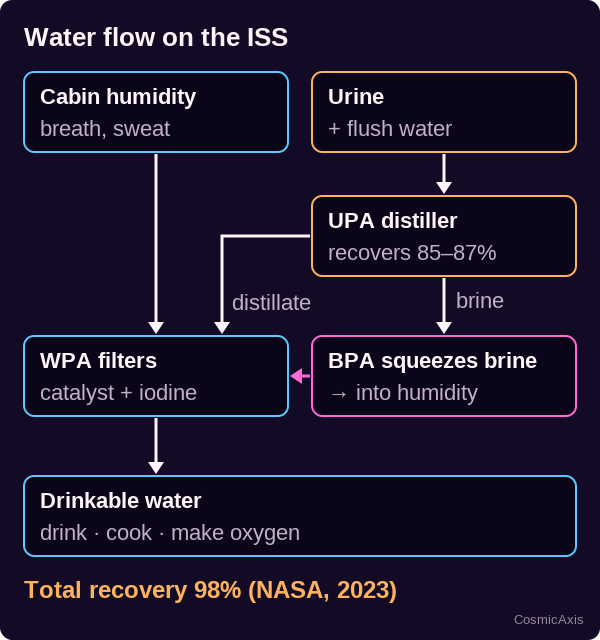
Astronauts on the ISS drink recycled water from cabin humidity, sweat and urine: the UPA distills urine, the WPA filters, oxidizes and adds iodine, and the BPA extracts the last water from brine. According to NASA (20 June 2023), the water recovery system recovers 98% of water, up from 93–94% before the BPA.
01Knowledge
What is water recycling on a space station?
Water recycling on a space station means capturing humidity, sweat and urine and cleaning them back into drinking water, so that not all water has to be launched from Earth. On the ISS, the Water Recovery System (WRS) recovers 98% of the crew’s water, according to NASA on 20 June 2023.
The WRS has a Urine Processor Assembly (UPA) and a Water Processor Assembly (WPA), launched on 14 November 2008 (ICES-2023-097). From Expedition 19 in 2009, crews began drinking water recycled from humidity and urine (Straub et al., 2010). A third machine, the Brine Processor Assembly (BPA), arrived in March 2021 and raised recovery from 93–94% to 98%.
The WRS belongs to the life support phase of a mission.
How much water does each astronaut need per day?
Each astronaut drinks 2.00 kg of water and uses 0.50 kg to rehydrate food per day, according to the 2022 NASA Baseline Values and Assumptions Document (BVAD).
| Use (1 person, 1 day) | ISS (kg) | Mars transit (kg) | Source, date viewed |
|---|---|---|---|
| Drinking and food | 2.50 | 2.50 | BVAD 2022 table 4-20, 2026-10-02 |
| Urinal flush and hygiene | 0.70 | 0.70 | BVAD 2022 table 4-20, 2026-10-02 |
| Experiments | 2.18 | not defined | BVAD 2022 table 4-20, 2026-10-02 |
| Total | 5.38 | 3.2 | BVAD 2022 table 4-20, 2026-10-02 |
Used water does not vanish: each person on the ISS releases 1.50 kg of urine with flush water and 2.27 kg of humidity per day (BVAD table 4-21), so the water loop can close. The same clean water also feeds the electrolysis machine that makes oxygen (ICES-2023-097). Water was the scarcest resource on Apollo 13: at lander separation the reserves were 5.5 hours of water (Apollo 13 Review Board).
Where does the wastewater on the ISS come from?
Wastewater on the ISS comes from three sources: humidity condensed from cabin air, urine, and water from the Sabatier reactor (ICES-2023-097).
- Humidity: cabin air passes through a cold heat exchanger, at 4.4 °C in the US segment and 14 °C in the Russian segment (ICES-2021-36). Humidity carries little salt, so nearly all of it is recovered.
- Urine: it is mixed at once with a pretreatment solution of chromium trioxide and an inorganic acid, which stops bacteria and keeps urea from breaking down into ammonia (ICES-2023-097). Urine is as salty as seawater, with about 40 g/L of total dissolved solids (ICES-2021-36).
- Sabatier water: the reactor combines CO₂ with hydrogen into water and methane, but it has been out of service since October 2017 (ICES-2026-425).
In weightlessness, water and gas bubbles do not separate into top and bottom by themselves, so the processing line needs its own gas–liquid separators (ICES-2023-097).
How does the UPA turn urine into distilled water?
The UPA distills urine at low pressure: urine evaporates in a spinning centrifuge drum, the vapor is compressed, then condensed on the other side of the same evaporator surface to reuse the heat (ICES-2023-097). This method is called vapor compression distillation.
The UPA is designed to process 9 kg of urine and flush water per day, enough for 6 people, and to recover 85% of the water. The rest is concentrated brine, pumped to the BPA or bagged and discarded (ICES-2026-425). The UPA’s recovery rate has changed with the pretreatment chemical:
- After the 2009 precipitation failure (see the 2009 failure below): lowered to 70%, then 75%.
- 2016: a phosphate-based solution brought the US segment back to 85%; in March 2020 it rose to 87%, with a goal of 90%.
- Russian-segment urine stays at 70% because its pretreatment solution has not changed (ICES-2026-425).
CosmicAxis calculation from the BVAD output figures, assuming all humidity is captured: a UPA at 85% gives 94.0% for the whole system, matching the 93–94% NASA gives for the time before the BPA; a UPA at 70% gives only 88.1%.
How does the WPA filter water into drinking water?
The WPA mixes UPA distillate with condensed humidity, then cleans it in four steps (ICES-2023-097):
- Coarse 300 µm filtering, gas bubble separation, and 0.5 µm particulate filtering.
- A multifiltration bed of adsorbent and ion-exchange resin removes most organics and salts.
- A catalytic reactor oxidizes the remaining organics at high temperature and also kills microorganisms.
- An ion-exchange bed captures byproducts and adds iodine as a biocide.
Conductivity sensors check the water continuously, and water that fails is reprocessed (NASA Marshall). Drinking water must have total organic carbon (TOC) under 3,000 µg/L (ICES-2023-097), no more than 50 CFU/mL of bacteria and no coliforms (BVAD table 4-83).
How does the BPA raise recovery to 98%?
The BPA extracts the last water from the brine the UPA leaves behind, and with the BPA running the whole system reaches 98% (ICES-2026-425). Paragon Space Development built the BPA, installed in March 2021 to test technology for distant missions.
The BPA uses membrane distillation: brine sits in membrane bags that pass only water vapor, warm air carries the humidity into the cabin, and the station’s humidity control condenses it again (ICES-2023-097). From February 2024 to February 2026, the BPA processed about 946 L of brine and returned about 780 L of water (ICES-2026-425), about 82% (CosmicAxis calculation). The first cycles gave the cabin a urine smell, so a separate exhaust filter had to be added (ICES-2023-097).
How does the Russian segment recycle water, and why does it use silver instead of iodine?
The Russian segment recycles humidity with its SRV-K system, which collected 21,165 L of water from cabin air between 2 November 2000 and 1 February 2020 (ICES-2021-36). Russian water is kept clean with silver ions and US water with iodine, and the two cannot be mixed (ICES-2016-447).
According to NASA report NESC-RP-01518, iodine kills bacteria at 2.5–7.5 mg/L but should be below 0.5 mg/L for drinking, so the US segment removes iodine with activated carbon and ACTEX ion-exchange beds at the tap. Silver kills bacteria at 0.1–0.4 mg/L, and the high end of 0.4 mg/L equals the drinking limit for 1,000 days, so it can be drunk directly despite a metallic taste. US water transferred to the Russian segment must also pass through ACTEX (ICES-2026-425).
The Russian segment does not yet recycle urine reliably: its first unit, installed in 2018, failed in the distillation unit during checkout (ICES-2026-425), so Russian urine goes by container to the US UPA. NASA plans silver for future spacecraft (ICES-2016-447) because the pipe after the iodine remover has no biocide and can grow microbes while a vehicle waits uncrewed (NESC-RP-01518).
02Practice
How do you calculate the water to carry to Mars in Python?
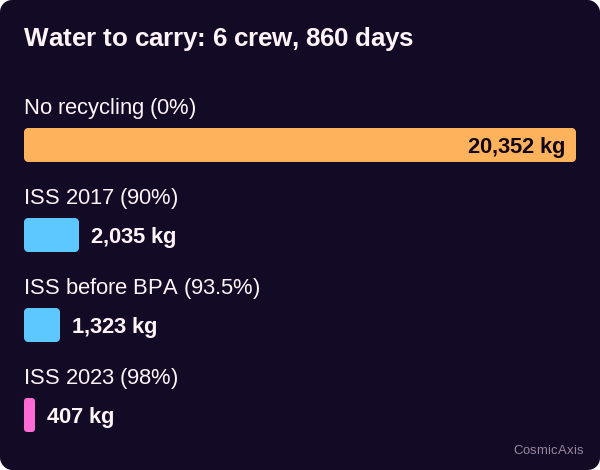
A 6-person, 860-day Mars mission uses 20,352 kg of water, but must carry only 407 kg if it recovers 98% as the ISS does (CosmicAxis calculation). Water to carry equals crew size times days times daily use times the unrecovered share: m = N · D · w · (1 − r). In-situ resource utilization attacks the same mass by making new water at the destination instead of recycling it.
Source
CosmicAxis calculation; NASA BVAD 2022; NASA SP-2009-566
Inputs: 6 people, 180 days out, 500 days on Mars, 180 days back (NASA DRA 5.0; the Hohmann transfer orbit explains the trip time); water use of 3.2 kg/person/day in the vehicle and 4.48 kg at the base (BVAD table 4-20); recovery rates of 90% (NASA Marshall, 2017), 93.5% (the middle of 93–94%) and 98% (NASA, 2023).
N = 6                                          # crew size, NASA DRA 5.0
LEGS = [(180, 3.2), (500, 4.48), (180, 3.2)]   # (days, kg/person/day), BVAD 4-20
RATES = [0.0, 0.90, 0.935, 0.98]               # recovery rate r

use = sum(N * d * w for d, w in LEGS)
print(f"Use {use:,.0f} kg of water")
for r in RATES:
    print(f"r = {r:5.1%}: carry {use * (1 - r):6,.0f} kg")
Use 20,352 kg of water
r =  0.0%: carry 20,352 kg
r = 90.0%: carry  2,035 kg
r = 93.5%: carry  1,323 kg
r = 98.0%: carry    407 kg
The output ran on Python 3.14. Going from 93.5% to 98% adds only 4.5 points but saves 916 kg, because the carried share is proportional to 1 − r: from 6.5% down to 2%. Each kilogram saved also cuts propellant for the same delta-v. The result is only a lower bound: it ignores the mass of machines, spares and reserve water (the ISS keeps at least 818 L, ICES-2023-097).
03Reality
Why did the ISS urine distiller fail in 2009?
The UPA distillation assembly S/N 02 failed on 24 October 2009 because solids built up inside it: calcium sulfate precipitated in the brine when the UPA concentrated urine to 85% recovery (ICES-2016-017).
The sulfate came from sulfuric acid in the pretreatment solution. The calcium came from the body: in microgravity astronauts lose bone, so urine on the ISS holds more calcium than on the ground (ICES-2016-017). Calcium sulfate therefore precipitated right at the 85% the UPA was designed for.
- NASA lowered recovery to 70%, then 75% from 2014 when crews drank more water and urine became less calcium-rich; lower recovery means more water to carry (ICES-2016-017).
- The root fix was switching to phosphoric acid in early 2016, which brought the UPA back to 85% (ICES-2023-097).
The upgraded distillation assembly being installed has run for more than 15,000 hours, over 300% of its predicted life of 4,387 hours (ICES-2026-425).
How did astronauts build the FrankenPump from two broken pumps in 2024?
In 2024 the ISS crew took the working motor from a PCPA pump with a torn tube and fitted it to the good body of a PCPA pump with a failed motor, making the “FrankenPump”; this component-level repair had never been designed to be done in microgravity (ICES-2026-425).
The PCPA pulls gas and vapor out of the distillation assembly to hold a vacuum; without it the UPA stops. In November 2023 a new-generation pump failed early at the motor; the older pump installed in February 2024 ran 4 more months before its tube tore. The FrankenPump ran a few weeks, long enough to wait for a new pump.
During the UPA shutdowns the crew kept about 300 L of urine instead of dumping it, and processed it all once the UPA ran again (ICES-2026-425). With no resupply ship on the way to Mars, failure analysis must cover replacing single components, backlogged urine and reserve water.
04Milestone
Milestone: check yourself
If you can do all of these, move on to the next article in this phase.
- Can you name the order in which water passes through the UPA, BPA and WPA?
- Can you explain why the UPA stops at 85–87%?
- Can you calculate the water to carry for a Mars mission at a 98% recovery rate?
- Can you explain why iodinated water must be treated before drinking, while silver water need not be?
Frequently asked questions
Is recycled water on the ISS safe to drink?
Yes. ISS recycled water must have total organic carbon under 3,000 µg/L (ICES-2023-097), no more than 50 CFU/mL of bacteria and no coliforms (NASA BVAD 2022). Iodine is removed before drinking.
How much water does each astronaut use per day?
Each astronaut drinks 2.00 kg and uses 0.50 kg of water to rehydrate food per day; counting hygiene and experiments, the ISS uses 5.38 kg per person (NASA BVAD 2022).
What is the Water Recovery System?
The Water Recovery System (WRS) is the water recycling system of the US segment of the ISS. It has the UPA urine processor and the WPA water processor, launched on 14 November 2008 (ICES-2023-097).
References
- NASA — Water Recovery Milestone on ISS, 20 June 2023 — accessed
- NASA BVAD 2022, tables 3-31, 4-20, 4-21, 4-83 — accessed
- ICES-2023-097 — Status of ISS Water Management and Recovery — accessed
- ICES-2026-425 — Status of ISS Water Management and Recovery — accessed
- ICES-2016-017 — Status of ISS Water Management and Recovery — accessed
- ICES-2021-36 — Planetary Water Treatment System — accessed
- NASA NESC-RP-01518 — Biocide Impacts, 2021 — accessed
- ICES-2016-447 — Life Support International System Maturation Team — accessed
- NASA Marshall — ECLSS, FL-2017-08-23-MSFC — accessed
- NASA SP-2009-566 — Mars Design Reference Architecture 5.0 — accessed
- Straub et al. — ISS Expeditions 16–20 Potable Water, 2010 — accessed
Cite this article
CosmicAxis. (2026). ISS Water Recycling: How Astronauts Drink Recycled Water. https://cosmicaxis.space/en/iss-water-recycling/