
In-situ resource utilization (ISRU): Moon, Mars and meaning
Source
NASA NTRS 20110012430; NASA NSSDCA Mars Fact Sheet; NASA NTRS 20250004151
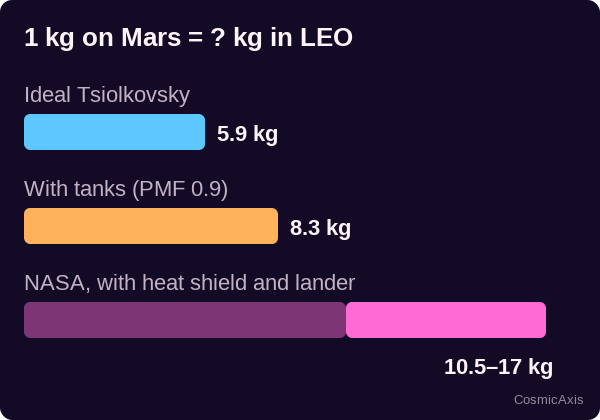
ISRU (in-situ resource utilization) means making oxygen, water and propellant from materials at the destination instead of carrying them from Earth. Each kilogram not landed on Mars saves 10.5–17 kg in low Earth orbit (NASA, 2015). The MOXIE instrument on Perseverance extracted 122 g of oxygen from Martian CO₂ (NASA JPL, 2023).
01Knowledge
What is ISRU, and why do deep-space missions need it?
In-situ resource utilization (ISRU) means taking material at the destination, such as Martian atmospheric CO₂ or lunar water ice, and making oxygen, water and propellant from it instead of carrying them from Earth (NASA JPL, 2023). The reason is mass: each kilogram not landed on the surface of Mars saves 10.5–17 kg that would have to be launched to low Earth orbit (Arney et al., NASA 2015).
A factor that large comes from the Tsiolkovsky rocket equation. Initial mass grows exponentially with delta-v, and every leg (leaving Earth orbit, braking into Mars orbit, landing) multiplies in another factor.
Oxygen is the best target because it is the heaviest part of the propellant. In NASA’s design the Mars Ascent Vehicle (MAV) leaves Earth weighing 15.7 t without oxygen, then loads 22.7 t of liquid oxygen on Mars (Polsgrove et al., 2015). Methane and oxygen suit this plan because of their high specific impulse.
ISRU differs from recycling. Life support systems recirculate the water and air a crew brought along, while ISRU creates new material. ISRU belongs to the deep space operations phase.
What resources can be mined on the Moon and Mars?
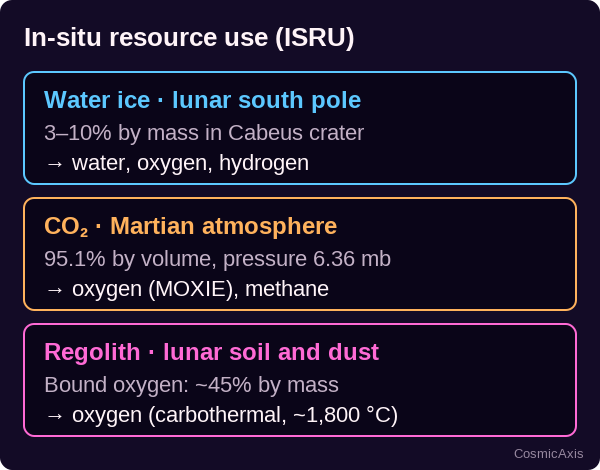
The Moon and Mars offer three resources that NASA studies most: water ice in dark craters near the lunar poles, CO₂ at 95.1% of the Martian atmosphere by volume (NASA NSSDCA), and oxygen bound in the mineral grains of regolith (loose rock dust), about 45% of lunar regolith by mass (Haggerty et al., ICES-2025-200).
| Source | Content (%) | Can yield | Source, accessed |
|---|---|---|---|
| Water ice, Cabeus crater near the lunar south pole | 3–10 by mass | water, oxygen, hydrogen | Elphic, NASA 2011, 2026-10-04 |
| Oxygen bound in lunar regolith | ~45 by mass | oxygen | Haggerty, ICES-2025-200, 2026-10-04 |
| CO₂ in the Martian atmosphere | 95.1 by volume | oxygen, carbon monoxide | NASA NSSDCA, 2026-10-04 |
| Water in Martian soil (design assumption) | 2 by mass | water, hydrogen, methane | Kleinhenz & Paz, NASA 2017, 2026-10-04 |
- Ice in permanently shadowed regions: the floors of some craters near the lunar poles never see sunlight and stay cold enough to hold ice. The ice yields water, oxygen and a hydrogen–oxygen propellant pair; Artemis also targets the south pole.
- Martian CO₂ is everywhere and needs no digging, but the atmosphere is thin: mean surface pressure is 6.36 mb (NASA NSSDCA), so a machine must compress the gas first.
- Oxygen in regolith sits inside silicate minerals and must be heated very hot to release it.
How does MOXIE extract oxygen from Martian CO₂?
MOXIE (Mars Oxygen In-Situ Resource Utilization Experiment) extracts oxygen by solid oxide electrolysis: Martian air is filtered, compressed, and passed through the SOXE electrolyzer from OxEon Energy, where electricity splits CO₂ into oxygen ions and carbon monoxide, and the ions recombine into O₂ (MIT News, 2022).
- Size: 23.9 × 23.9 × 30.9 cm, 17.1 kg, 300 W (NASA Science).
- Operation: a few hours of warm-up, then about one hour of oxygen production (MIT News, 2022).
- Checks: the oxygen is measured for quantity and purity, then vented back to the atmosphere; MOXIE is a technology demonstration and stores no oxygen (MIT News, 2022).
This article describes MOXIE only at system level from public documents; the electrolysis cell materials and detailed operating conditions are outside CosmicAxis’s scope.
What other ways exist to make oxygen, water and fuel in place?
Besides CO₂ electrolysis, NASA studies three more ISRU processes: water electrolysis, the Sabatier reaction and carbothermal reduction of regolith. This article describes them only at concept level, with no do-it-yourself steps, because they involve flammable gas, toxic gas and very high temperatures.
- Water electrolysis splits water into oxygen and hydrogen with electric current. The ISS makes oxygen this way from water recovered by its water recycling system; on the Moon the water would come from ice in dark craters.
- The Sabatier reaction combines CO₂ with hydrogen into methane and water. On the ISS the Sabatier reactor belongs to the CO₂ removal system and the methane is vented overboard; on Mars the methane is fuel. Kleinhenz and Paz’s design (NASA, 2017) makes 6,978 kg of methane and 22,728 kg of oxygen for the MAV.
- Carbothermal reduction uses concentrated sunlight to heat regolith to about 1,800 °C and release its oxygen. In 2024 Sierra Space tested an automated prototype furnace on simulated regolith in a thermal vacuum (TVAC) chamber at NASA JSC (Haggerty et al., ICES-2025-200).
With both methane and oxygen made locally, a spacecraft can refuel for the return trip on Mars itself, which is the idea behind Starship.
02Practice
Calculate it: how many kg in low orbit does each kg of oxygen made on Mars save?
Each kilogram placed on the Martian surface needs 5.9 kg in low Earth orbit by the ideal rocket equation and 8.3 kg once tanks are included, so the 22.7 t of oxygen made in place for the MAV saves about 188 t that would otherwise be launched to orbit (CosmicAxis calculation).
Source
CosmicAxis calculation; Arney et al., NASA NTRS 20160006324
The code covers three legs: leaving a 200 km low Earth orbit (LEO) on a Hohmann transfer, entering low Martian orbit, and landing. Each leg converts delta-v into a mass ratio m₀/m_f = e^(Δv / (Isp · g₀)) with a specific impulse of 360 s; the “with tanks” version sets the propellant to 90% of each stage’s mass, following Arney.
import math

G0, ISP, PMF = 9.80665, 360, 0.9  # m/s²; s and propellant fraction of a methane–oxygen stage (Arney, NASA 2015)
GM_SUN, GM_E = 1.32712440041e11, 398600.435507  # km³/s², NASA JPL
R1, R2, R_LEO = 149.598e6, 227.956e6, 6378.137 + 200  # km, NASA NSSDCA

v_inf = math.sqrt(GM_SUN / R1) * (math.sqrt(2 * R2 / (R1 + R2)) - 1)  # Hohmann
tmi = math.sqrt(v_inf**2 + 2 * GM_E / R_LEO) - math.sqrt(GM_E / R_LEO)
ideal = with_tanks = 1.0
for dv in (tmi * 1000, 2019, 91.9 + 513 + 52.5):  # m/s: leave LEO; enter orbit, land (Arney 2015)
    R = math.exp(dv / (ISP * G0))  # rocket equation m0/mf
    ideal *= R
    with_tanks *= 1 + (R - 1) / (1 - (R - 1) * (1 - PMF) / PMF) / PMF  # add tank mass
print(f"1 kg on Mars = {ideal:.1f} kg in LEO (ideal), {with_tanks:.1f} kg (with tanks)")

O2 = 22728  # kg of oxygen for the MAV, made over 480 days (Kleinhenz & Paz, NASA 2017)
k = O2 / (480 * 24) / 0.012  # versus MOXIE's 12 g/hour (NASA JPL 2023)
print(f"Saves {O2 * with_tanks / 1000:.0f} t in LEO; needs {O2 / 11520:.2f} kg/hour = {k:.0f} MOXIEs")
print(f"Linear MOXIE scaling, 17.1 kg and 300 W each: {k * 17.1 / 1000:.1f} t, {k * 0.3:.0f} kW")
for w in (0.03, 0.10):  # water fraction in Cabeus crater (Elphic, NASA 2011)
    print(f"{w:.0%} ice: {1 / (w * 16 / 18):.0f} t of regolith per 1 t of O2")
Result (Python 3.14):
1 kg on Mars = 5.9 kg in LEO (ideal), 8.3 kg (with tanks)
Saves 188 t in LEO; needs 1.97 kg/hour = 164 MOXIEs
Linear MOXIE scaling, 17.1 kg and 300 W each: 2.8 t, 49 kW
3% ice: 38 t of regolith per 1 t of O2
10% ice: 11 t of regolith per 1 t of O2
- Mass factor: 8.3 kg is below NASA’s 10.5–17 kg because the code ignores the heat shield, landing legs and margins.
- Production rate: making 22.7 t of oxygen in 480 days needs 1.97 kg every hour without a break, 164 times MOXIE’s rate (CosmicAxis calculation).
- Linear scaling is only for comparison: 164 MOXIEs would draw 49 kW, above the 24–30 kW of electric power estimated for NASA’s DRA 5.0 architecture for 25 t of ascent oxygen and 2 t of crew oxygen (Arney et al., 2015).
- Lunar ice: at 3% water, each tonne of oxygen means digging 38 t of regolith; at 10%, only 11 t (CosmicAxis calculation).
- Limits: the code assumes circular, coplanar orbits and takes the delta-v of the last two legs from Arney.
03Reality
What did MOXIE achieve on Mars from 2021 to 2023?
MOXIE made a total of 122 g of oxygen in 16 runs on Mars between 2021 and 7 August 2023, at a peak rate of 12 g per hour, twice NASA’s original goal, with purity of 98% or better (NASA JPL, 9 June 2023). MIT called it the first time a resource on another planet was turned into something usable by humans (MIT News, 2022).
| Date | Result | Source, accessed |
|---|---|---|
| April 2021 | MOXIE made oxygen for the first time, two months after landing | MIT News 2022, 2026-10-04 |
| Late 2021 | 7 runs, day and night, across seasons, each reaching 6 g/hour | MIT News 2022, 2026-10-04 |
| 7 Aug 2023 | 16th and final run: 9.8 g of oxygen | NASA JPL 2023, 2026-10-04 |
The 122 g equals the oxygen a small dog breathes in 10 hours (NASA JPL, 2023). MOXIE’s goal was to prove the technology under real conditions: Martian atmospheric density varies by up to a factor of two over the year (Hoffman, MIT News 2022), and MOXIE ran through a full Martian year.
Principal investigator Michael Hecht (MIT) said the next step is a full system that includes liquefying and storing oxygen, not a MOXIE 2.0 (NASA JPL, 2023).
How did LCROSS find water ice at the lunar south pole?
LCROSS found water by crashing a spent Centaur rocket stage into Cabeus crater near the lunar south pole on 9 October 2009, throwing up about 350 t of material, then flying through the plume to take measurements before impacting itself (NASA Science). On 13 November 2009 NASA announced that water had been found near the south pole.
- Spacecraft: LCROSS (Lunar Crater Observation and Sensing Satellite) launched with the LRO orbiter on 18 June 2009; the impact made a crater about 20 m wide (NASA Science).
- Composition: up to 20% of the ejected material was volatiles such as methane, ammonia, hydrogen and CO₂; in places the ice was nearly pure crystals, found in patches rather than spread evenly (NASA, 21 October 2010).
The impact and orbital measurements differ widely: LCROSS estimated 3–10% water by mass, while an orbital neutron detector saw only about 0.25% in the same area. Elphic et al. (NASA, 2011) suggest the ice may be buried 50–100 cm deep, unevenly distributed, or both. Because 3% and 10% differ by more than three times in the soil that must be dug, ISRU needs drilling and measurement on site before a plant is designed.
04Milestone
Milestone: check yourself
If you can do all of these, move on to the next article in this phase.
- Can you explain why 1 kg made on Mars saves many kilograms in low Earth orbit?
- Can you name the three in-situ resources?
- Can you run the Python code and explain the figure of 164 MOXIEs?
- Can you explain why LCROSS's water measurement differs from the orbital measurement?
Frequently asked questions
Is there oxygen on Mars?
The Martian atmosphere is 0.16% oxygen and 95.1% CO₂ by volume (NASA NSSDCA), so humans cannot breathe it. MOXIE extracted oxygen from that CO₂ (NASA JPL, 2023).
Is there water on the Moon?
Yes. In 2009 the LCROSS mission crashed a rocket stage into Cabeus crater near the lunar south pole. The ejected material held 3–10% water by mass (Elphic, NASA 2011).
Is lunar water drinkable?
Nobody has brought lunar water back to drink. The LCROSS plume held up to 20% volatiles such as methane and ammonia (NASA, 2010), so the water would need purification.
References
- NASA JPL — MOXIE Completes Mars Mission (9 June 2023) — accessed
- NASA Science — Mars 2020 Science Instruments — accessed
- MIT News — MOXIE (31 August 2022) — accessed
- NASA NSSDCA — Mars Fact Sheet — accessed
- NASA NSSDCA — Earth Fact Sheet — accessed
- NASA JPL — Astrodynamic Parameters — accessed
- NASA Science — LCROSS — accessed
- NASA Release — Moon's Buried Treasures (21 October 2010) — accessed
- Elphic et al. — NASA NTRS 20110012430 (2011) — accessed
- Haggerty et al. — ICES-2025-200 (NTRS 20250004151) — accessed
- Polsgrove et al. — Mars Ascent Vehicle Design, NASA 2015 — accessed
- Kleinhenz & Paz — ISRU Propellant Production for MAV, NASA 2017 — accessed
- Arney et al. — ISRU and a Reusable Lander, NASA 2015 — accessed
Cite this article
CosmicAxis. (2026). In-Situ Resource Utilization (ISRU): Moon, Mars, Meaning. https://cosmicaxis.space/en/in-situ-resource-utilization/