
N1 rocket failure: why the Soviet Moon rocket failed four times
Source
Siddiqi, Challenge to Apollo, NASA SP-2000-4408, pp. 681–693, 729–730, 755–756, 819, 822–824
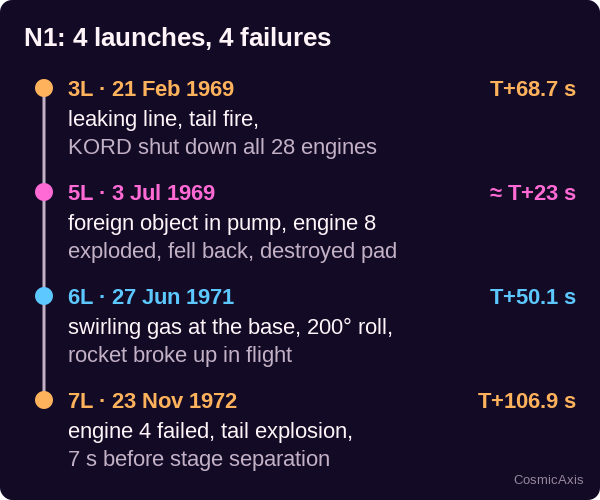
The Soviet N1 Moon rocket failed on all four launches (1969–1972) because its 30-engine first stage had never been tested whole on the ground, so every flight was its first full test: tail fire, debris in a pump, swirling gas causing roll, and an engine failure (Siddiqi, NASA SP-2000-4408).
01Knowledge
What is the Soviet N1 rocket, and how powerful was it?
The N1 is a three-stage super-heavy rocket from Sergey Korolev’s design bureau, built to launch the L3 complex that would land a Soviet cosmonaut on the Moon, a rival to Saturn V in the Apollo program. According to Siddiqi (NASA SP-2000-4408, p. 485), N1’s liftoff thrust was 4,620 tonnes-force, against 3,404 for Saturn V.
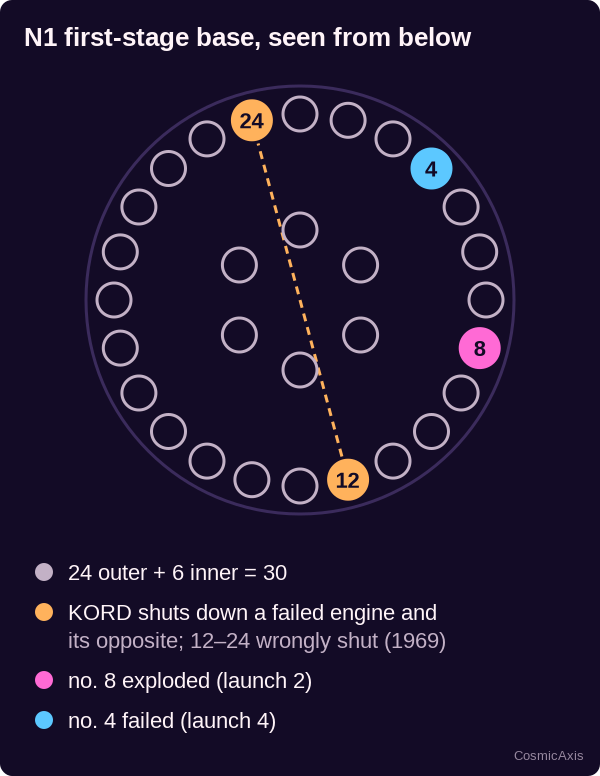
Stage 1 carried 30 NK-15 engines of 154 tonnes-force each: 24 in the outer ring, 6 in the inner ring. All three stages burned liquid oxygen and kerosene in liquid-propellant engines using the staged combustion cycle of Nikolay Kuznetsov’s design bureau; the basics are in how rockets work.
Source
Siddiqi, NASA SP-2000-4408, pp. 485–486, 683, 729, 824; conceptual drawing by CosmicAxis
N1 steered by differential thrust between opposite outer-ring engines, not by swiveling each engine’s de Laval nozzle (Siddiqi, p. 487). Engine numbers in the diagram are illustrative.
Why was the N1 first stage never tested on the ground?
The N1 first stage was never tested whole on the ground because the Soviet Union had no test stand large enough, and a new one would have cost money and time in the race against Saturn V. According to Siddiqi (p. 392), the decision dates from 1963 and the main reason was lack of funds; Korolev also wanted to fly all three real stages at once, which Americans call all-up testing.
To compensate, the design bureau extrapolated static-test results of the 8-engine second stage to stage 1, and relied on KORD to shut down failed engines in flight (Siddiqi, p. 393). The KONRID procedure took 6 engines at random from a batch, fired 2, and if they passed, installed the other 4. Siddiqi (p. 731) concludes that the actual engines on N1 were never fire-tested before installation.
How does KORD shut down failed engines on N1?
When KORD (the engine operation monitoring system) sees an engine fail, it closes that engine’s propellant valves and also shuts down the opposite engine across the center, so thrust stays balanced (Siddiqi, p. 486). With 1 pair lost, the other 28 engines burn up to 168 s; with 2 pairs lost, up to 210 s, instead of the normal 114–120 s.
Siddiqi (p. 393) points out the weakness of this engine-out capability: KORD reacts after a failure and cannot predict one, so it only saves the flight when the failed engine shuts down in time, before it explodes or sets a neighboring engine on fire.
Where did the first N1 launch on 21 February 1969 fail?
The first launch, vehicle 3L at 12:18:07 Moscow time on 21 February 1969, failed because fire in the tail section burned KORD’s own cables, and KORD shut down every engine at second 68.67. Siddiqi (p. 683) reconstructs the sequence from telemetry and wreckage:
- 0.37 s before ignition, KORD wrongly shut down healthy engine 12 and, by the pair rule, engine 24 as well; the rocket still flew the correct trajectory on 28 engines.
- T+5.5 s vibration broke a sensor line; T+23.3 s a 2 mm pressure line ruptured and 340 °C gas mixed with propellant.
- T+54.5 s the tail section caught fire; T+68.67 s the fire shorted KORD’s circuits and KORD shut down all 28 engines.
The rocket reached 27 km and fell about 50 km from the pad; the launch escape system saved the uncrewed descent capsule (Siddiqi, p. 682). Siddiqi (p. 684) names the main problem: no integrated ground testing of stage 1 and no vibration test stand for the engines.
How did the 1969 N1 explosion on the launch pad happen?
The 1969 N1 explosion was the second launch, vehicle 5L at 23:18:32 Moscow time on 3 July 1969: the rocket rose about 200 m, fell back and exploded on the pad roughly 23 seconds after launch (Siddiqi, p. 691). The pad was completely destroyed and the 145 m service tower was thrown off its rails (p. 692). No one was killed or injured, thanks to strict safety rules.
The investigation commission took a year and its members still disagreed. The most likely chain, per Siddiqi (pp. 729–730): 0.25 s before liftoff a metal object, possibly a piece of a pressure sensor’s steel diaphragm, entered the oxidizer pump and made engine 8 explode, wrecking the cable network and neighboring engines. KORD shut down the failed engines one after another until only engine 18 was still running at T+10.15 s; the one-sided thrust tipped the rocket over and it fell onto the pad.
Vehicle 5L belonged to the first batch and had no filter at the pump inlet, although ground tests of the NK-15 had already shown that a metal object entering the oxidizer pump would cause an explosion (p. 730).
Why did the third (1971) and fourth (1972) N1 launches fail?
The third launch failed because the rocket rolled about its axis and the control system could not hold it, and the fourth failed because stage 1 engine 4 blew up the tail section only 7 seconds before stage separation (Siddiqi, pp. 819, 822–824).
Vehicle 6L, launched at 02:15:08 Moscow time on 27 June 1971 (evening of 26 June UTC), was the first with all 30 engines running. At T+14.5 s it had already rolled 14° although the roll-control nozzles were at full deflection; at T+50.1 s, with the roll at 200° and the structure broken, KORD shut down stage 1. N1 chief designer Boris Dorofeyev explained: the two engine rings sit close together and create a low-pressure zone behind the base, and the off-center exhaust pipe of the starter gas generator produced a torque larger than the 6 roll-control nozzles could counter.
Vehicle 7L, launched at 09:11:55 Moscow time on 23 November 1972, had 4 extra roll-control engines (p. 820). The State Commission concluded that the rocket flew normally until T+106.93 s, then a failure of engine 4 destroyed the tail section. Kuznetsov held that the planned shutdown of the 6 central engines caused water hammer that ruptured a liquid oxygen line, but the review groups did not accept this hypothesis (pp. 823–824).
02Practice
How do you compute the reliability of a 30-engine and a 5-engine stage in Python?
Reliability of a multi-engine stage follows the binomial formula of a k-out-of-n system, with one extra parameter c: the share of failures that are “benign”, meaning shut down in time without spreading to another engine. The code below uses only the Python standard library and ran on Python 3.14.6; q = 1% failure per engine per flight is an assumption for comparison, not a measured N1 value.
from math import comb

def stage(n, q, c, k, cap=False):
    # q: probability one engine fails; c: share of failures that are benign (shut down in time, no spread)
    tot, spread = 1 - q, q * (1 - c)
    if cap:  # KORD style: shut down the failed engine and its opposite, counted in pairs
        n, tot = n // 2, tot**2
        lost = (1 - spread)**2 - tot
    else:
        lost = q * c
    # Success: no spreading failure and at most k engines (or pairs) lost
    return sum(comb(n, j) * lost**j * tot**(n - j) for j in range(k + 1))

q = 0.01  # assumption: each engine fails with 1% probability per flight
print(f"{'Stage 1, q = 0.01':<36}{'c = 1.0':>9}{'c = 0.5':>9}")
for name, n, k, cap in [
    ("5 engines, no engine-out", 5, 0, False),
    ("5 engines, lose 1", 5, 1, False),
    ("30 engines, no engine-out", 30, 0, False),
    ("30 engines, KORD, lose 2 pairs", 30, 2, True),
]:
    print(f"{name:<36}{stage(n, q, 1.0, k, cap):>9.4f}{stage(n, q, 0.5, k, cap):>9.4f}")
Stage 1, q = 0.01                     c = 1.0  c = 0.5
5 engines, no engine-out               0.9510   0.9510
5 engines, lose 1                      0.9990   0.9750
30 engines, no engine-out              0.7397   0.7397
30 engines, KORD, lose 2 pairs         0.9970   0.8600
By these results (CosmicAxis own calculation), a 30-engine stage without redundancy keeps only 74%; with KORD and every failure benign, it reaches 99.7%. But when half the failures spread to a neighbor (c = 0.5), the 30-engine stage falls to 86%, below every 5-engine configuration. Three of the four N1 launches ended in spreading failures (fire, explosion).
What can a small rocket project learn from N1’s testing?
A small rocket project learns from N1 that a system must be tested in the configuration closest to flight, because faults often sit where parts act on each other. For a model rocket with certified commercial motors under NAR or Tripoli rules, the lesson applies to electronics and mechanics:
- Test the whole assembly: flight computer, battery, wiring and parachute ejection fitted as for flight, then a simulated flight with shaking, as in a satellite environmental test.
- A safety circuit must not damage the flight itself: shutdown thresholds must be tested and wires shielded, because KORD once shut down healthy engines.
- Put the question “does the failure spread?” in the FMEA table: redundancy cannot rescue a spreading failure.
This is systems engineering thinking: verifying each part is not enough; the whole system must be validated.
03Reality
How was the N1 program cancelled, and what happened to the NK-33 engine?
The N1 program was halted in 1974 and ended for good in 1976, while vehicle 8L with the new NK-33 engine set was being prepared (Siddiqi, pp. 825–838). That engine set was built from 1970 to be restartable and to be tested on the ground before flight, exactly what the NK-15 lacked (pp. 731–732).
- 19 May 1974: Defense Minister Andrey Grechko signed the order to stop launches; on 24 June 1974 Valentin Glushko, chief designer of NPO Energiya, suspended all N1-L3 work (p. 832).
- February 1976: the decree approving Energiya-Buran ended N1-L3; Glushko had the remaining rockets and documents destroyed. N1-L3 had cost 3.6 billion rubles up to 1 January 1973 (pp. 837–838).
- Until January 1977, Kuznetsov kept testing: 40 NK-33 engines ran an average of 7,000–14,000 s without failure (p. 837), and he kept 94 engines in storage (p. 846).
Aerojet Rocketdyne converted the NK-33 into the AJ26 for the Antares rocket; on 28 October 2014 an Antares carrying cargo to the ISS exploded more than 15 seconds after launch because of a liquid oxygen turbopump in one AJ26, and NASA noted that the two companies lacked knowledge of the NK-33’s failure history (NASA IRT, 2015). In Russia, Soyuz-2.1v used one NK-33A in its central block (RKTs Progress), first flying on 28 December 2013 and last on 5 February 2025; according to an anonymous source cited by RIA Novosti, only a few NK-33 engines remain in storage.
How did Saturn V testing differ from N1?
Saturn V also flew its first mission all-up like N1, but every S-IC stage was static-fired with all 5 F-1 engines on a test stand before shipping to the launch site (Bilstein, NASA SP-4206, pp. 206–208). NASA dropped the stage-by-stage test flights, not the ground tests.
| Test | N1 (stage 1) | Saturn V (S-IC stage) | Source, date viewed |
|---|---|---|---|
| First flight | All 3 real stages | All 3 real stages (AS-501) | Siddiqi p. 392; Bilstein p. 349, 2026-10-03 |
| Static firing of the whole stage 1 | No test stand | Huntsville and Mississippi stands | Siddiqi p. 392; Bilstein p. 207, 2026-10-03 |
| Test of the engines that will fly | No; 2 of a batch of 6 fired | Average of 650 s static firing per F-1 | Siddiqi p. 731; Bilstein p. 354, 2026-10-03 |
The lesson of N1 is not that many engines are wrong, but that a many-engine stage must be tested together before flight. The same question at smaller scale lies behind the Falcon 1 failures, and Ariane 5 flight 501 is another case of a system meeting conditions it had not been tested under. The other articles in the rocket propulsion phase go deeper into each subsystem.
04Milestone
Milestone: check yourself
If you can do all of these, move on to the next article in this phase.
- Can you list the four N1 launches, with the second each one failed and the cause?
- Can you explain why KORD shuts down the opposite engine, and why KORD itself helped doom the first launch?
- Can you run the Python code and see the 30-engine stage lose to a 5-engine stage when failures spread to the neighboring engine?
- Can you say how Saturn V, which also flew "all-up", differed from N1 by static-firing every S-IC stage on a test stand?
Frequently asked questions
Did the Soviet Union land on the Moon?
The Soviet Union never put a person on the Moon. No N1 completed a flight; Defense Minister Grechko ordered N1 launches stopped on 19 May 1974, and a 1976 decree ended the N1-L3 program (Siddiqi, pp. 832, 837).
Did the 1969 N1 explosion kill anyone?
The 3 July 1969 explosion killed and injured no one thanks to strict safety rules, although the pad was destroyed. Some estimates cited by Siddiqi put the blast near 250 tonnes of TNT (Siddiqi, p. 691).
Was N1 more powerful than Saturn V?
N1 had a liftoff thrust of 4,620 tonnes-force, more than Saturn V's 3,404 (Siddiqi, p. 485). But the 1963 design aimed at 75 t to low orbit, against 130 t for Saturn V (Siddiqi, p. 392).
References
- Asif A. Siddiqi — Challenge to Apollo: The Soviet Union and the Space Race, 1945–1974, NASA SP-2000-4408 (2000) — accessed
- Roger E. Bilstein — Stages to Saturn: A Technological History of the Apollo/Saturn Launch Vehicles, NASA SP-4206 — accessed
- NASA Independent Review Team — Orb-3 Accident Investigation Report, Executive Summary, 9 October 2015 — accessed
- RKTs Progress — Ракета-носитель «Союз-2-1В» — accessed
- RIA Novosti — Блок выведения "Волга" со спутником "Аист" отделился от "Союза-2.1В", 28 December 2013 — accessed
- RIA Novosti — Запуск ракеты "Союз-2.1в" стал последним в истории, 6 February 2025 — accessed
Cite this article
CosmicAxis. (2026). N1 Rocket Failure: Why All Four Soviet Launches Failed. https://cosmicaxis.space/en/n1-rocket-failure/