
Artificial gravity on spacecraft
Source
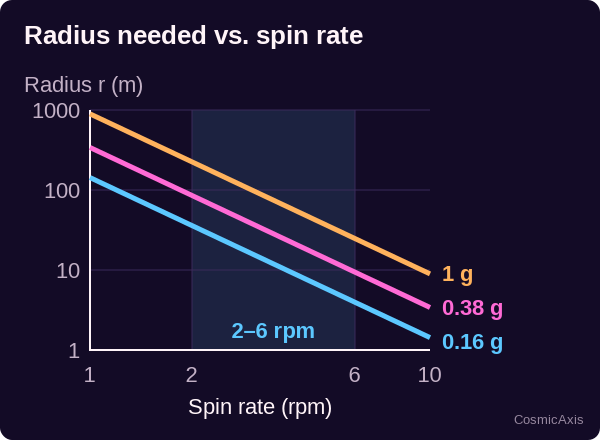
CosmicAxis calculation r = a/ω²; rpm limits from Hall, JBIS 52 (1999), table 1
Artificial gravity is the floor pushing on a person as a spacecraft spins about an axis, with acceleration a = ω²r. One g at 2 rpm needs a 224 m radius; at 10 rpm only 8.9 m, but motion sickness is likely (CosmicAxis calculation, Hall 1999). No crewed spacecraft uses it today.
01Knowledge
What is artificial gravity and how is it made?
Artificial gravity is the feeling of weight produced by acceleration: when a spacecraft spins, its floor keeps pushing people toward the axis, so they feel pressed against the floor. Under gravity alone an object falls freely, which is weightlessness in orbit (Hall 1999).
There are two ways to recreate the feeling of weight: spin the ship (centripetal acceleration ω²r, which costs no propellant once the spin is steady) or fire engines continuously, like an elevator that keeps accelerating.
Gravity is measured in g = 9.80665 m/s² (NIST SP 330), the same unit as the g-force at launch. The Moon has 1.62 m/s² (0.165 g) and Mars 3.73 m/s² (0.380 g), per NASA NSSDC.
Why do long-duration spacecraft need artificial gravity?
Long missions need artificial gravity because extended weightlessness degrades bone, muscle, circulation and eyesight, the main risks tracked by NASA’s Human Research Program (HRP):
- Bone: load-bearing bone such as the spine and hip loses 1–1.5% of density per month on 4–6 month missions (HRP, 2025).
- Muscle: 55–63% of long-duration ISS crew lost more than 10% of knee or ankle muscle strength despite daily exercise (HRP, 2024).
- Body fluids: about 2 liters of fluid shifts from the lower to the upper body (NASA HHP, 2025).
- Eyes: about 70% of ISS crew on 6-month stays show signs of spaceflight-associated neuro-ocular syndrome (SANS), such as optic disc swelling (NASA HHP, 2025).
On the ISS the main countermeasure is exercise. A crewed trip to Mars on a Hohmann transfer orbit takes months each way, and the crew must then walk at 0.38 g.
Clément et al. (NASA, 2007) argue that 2–3 g for about 1 hour a day may be enough instead of continuous 1 g; this hypothesis has not been tested in space.
How is artificial gravity calculated with a = ω²r?
Artificial gravity at the floor equals the square of the angular speed times the radius: a = ω²r, with ω in rad/s and r measured from the axis to the floor (Hall 1999). To convert from revolutions per minute (rpm): ω = rpm × 2π / 60.
Example: 1 g at 6 rpm has ω = 0.628 rad/s, so r = a / ω² = 24.8 m. Radius scales with the inverse square of spin rate: halve the spin rate and the radius quadruples; slow it by 5 times and it grows 25 times. That is why 1 g needs 224 m at 2 rpm but only 8.9 m at 10 rpm, and 0.38 g needs 85 m and 3.4 m (CosmicAxis calculation, cover chart).
How fast can people spin before they get sick?
Studies from 1962–1985 set the comfortable spin limit at 2 to 6 rpm, but later experiments show people can adapt to 10 rpm if the rate is raised gradually (Hall 1999; Clément et al. 2015).
The cause is the inner ear: turning the head out of the spin plane makes the vestibular system report a false rotation, which causes motion sickness (Hall 1999).
| Author, year | Min. gravity | Max. gradient per meter | Max. rpm | Min. rim speed (m/s) | Source (viewed 2026-10-02) |
|---|---|---|---|---|---|
| Hill & Schnitzer, 1962 | 0.035 g | — | 4 | 6 | Hall 1999, table 1 |
| Gilruth, 1969 | 0.3 g | 8% | 6 (optimum 2) | — | Hall 1999, table 1 |
| Stone, 1973 | 0.1 g | 25% | 6 | 10 | Hall 1999, table 1 |
| Cramer, 1985 | 0.1 g | 0.03 g | 3 | 7 | Hall 1999, table 1 |
The main data come from the 5 m radius Slow Rotation Room in Pensacola, with 30 test subjects in total (Clément et al., NASA 2007). At 1 rpm almost nobody had symptoms; at 10 rpm even pilots had not fully adapted after 12 days (Graybiel 1977, cited in Hall 1999). Raising the rate in 9 steps over 16 days avoided sickness (Graybiel 1969).
How do the head-to-foot gradient and the Coriolis force affect people?
A small spinning habitat makes the head lighter than the feet, and makes walking feel heavier or lighter because of Coriolis acceleration (Hall 1999).
Source
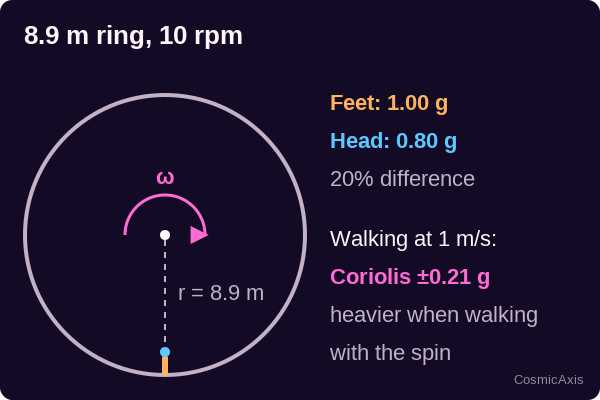
CosmicAxis calculation a = ω²r, a_Coriolis = 2ωv
- Head-to-foot gradient: a scales with r, so the head is lighter than the feet by a fraction 1.8 / r. The 8.9 m habitat gives 1.00 g at the feet and 0.80 g at the head.
- Coriolis acceleration: an object moving in a rotating frame feels an extra 2ωv, which is 0.21 g when walking at 1 m/s at 10 rpm. Walking along the rim, apparent gravity is A = (V ± v)² / r (Hall 1999): 1.22 g with the spin and 0.80 g against it (CosmicAxis calculation).
The ratio of Coriolis to gravity is 2v / V, where V is the rim speed, so low distortion needs a large radius.
Spinning ring, tether or short-radius centrifuge: which design?
Three designs have been studied: a large spinning ring, a spinning tethered spacecraft and a short-radius centrifuge; none has flown with people to counter physical deconditioning (Clément et al. 2015).
- Large spinning ring: living at 1 g all day; by Stone’s limit it needs a 22 m radius (Hall 1999), at the price of a large structure and a sealed rotating joint.
- Tethered spacecraft: a crew module and a counterweight on a long tether, spinning slowly. Korolev proposed (1965–1966) a 300 m tether at 1 rpm for 0.16 g (Clément 2007).
- Short-radius centrifuge: 1.5–2 m, the person lying down with the head near the axis; one design gives 1 g at the feet but 0.38 g at the head at 20.8 rpm (Clément 2007).
In NASA’s 21-day bed-rest study, the group spun for 1 hour a day (+2.5 Gz at the feet) lost 6% of aerobic capacity, not statistically significant, against 10% in the control group (HRP 2024).
Choosing a design is a systems engineering problem. Another approach is to shorten the trip with a nuclear thermal rocket.
02Practice
How do you calculate radius, rpm, head-to-foot gradient and Coriolis in Python?
The Python code below computes radius, rim speed, head-to-foot gradient and Coriolis while walking for 1 g, 0.38 g and 0.16 g, then checks two real-spacecraft numbers. The 1.8 m height and 1 m/s walking speed are CosmicAxis assumptions.
from math import pi

G0 = 9.80665  # m/s², standard gravity (NIST)
HEIGHT = 1.8  # m, person's height (assumption)
WALK = 1.0    # m/s, walking speed (assumption)

def omega(rpm):
    return rpm * 2 * pi / 60  # rpm to rad/s

def g_at(rpm, r):
    return omega(rpm) ** 2 * r / G0  # a = ω²r, expressed in g

print("  g  rpm  r (m)  rim (m/s)  head lighter  Coriolis/g")
for g in (1.0, 0.38, 0.16):
    for rpm in (2, 6, 10):
        w = omega(rpm)
        r = g * G0 / w**2  # r = a/ω²
        if r < HEIGHT:
            continue
        print(f"{g:4.2f} {rpm:3} {r:6.1f} {w * r:9.1f} {HEIGHT / r:12.0%} {2 * w * WALK / (g * G0):10.0%}")

r = G0 / omega(10) ** 2
for name, v in (("with", WALK), ("against", -WALK)):
    print(f"1 g, 10 rpm, walking {name} the spin: {(omega(10) * r + v) ** 2 / r / G0:.2f} g")

print(f"Gemini 11, 55 deg/min, 19 m from center: {g_at(55 / 360, 19):.5f} g")
print(f"Nautilus-X demo, 30 ft diameter, 10 rpm: {g_at(10, 30 * 0.3048 / 2):.2f} g")
Output from Python 3.14.6:
  g  rpm  r (m)  rim (m/s)  head lighter  Coriolis/g
1.00   2  223.6       46.8          1%         4%
1.00   6   24.8       15.6          7%        13%
1.00  10    8.9        9.4         20%        21%
0.38   2   85.0       17.8          2%        11%
0.38   6    9.4        5.9         19%        34%
0.38  10    3.4        3.6         53%        56%
0.16   2   35.8        7.5          5%        27%
0.16   6    4.0        2.5         45%        80%
1 g, 10 rpm, walking with the spin: 1.22 g
1 g, 10 rpm, walking against the spin: 0.80 g
Gemini 11, 55 deg/min, 19 m from center: 0.00050 g
Nautilus-X demo, 30 ft diameter, 10 rpm: 0.51 g
Three lessons (CosmicAxis calculation):
- Slow spin barely distorts but is huge: 1 g at 2 rpm has only a 1% head-to-foot difference and 4% Coriolis, at a cost of a 224 m radius.
- Low gravity distorts more: at 6 rpm, Coriolis is 13% of 1 g but 80% of 0.16 g, because 2ωv does not shrink with the gravity level.
- The last two lines match real spacecraft, as the next two sections show.
Exercise: find the spin rate for a 4.6 m ring at 0.38 g. Compute it on paper only; do not test it with a swivel chair or homemade equipment.
03Reality
How did Gemini 11 (1966) test artificial gravity with a tether?
Gemini 11 is the only crewed spacecraft so far to spin for artificial gravity: on 14 September 1966, Pete Conrad and Dick Gordon tied their capsule to an Agena stage with a tether and spun the pair (Clément et al., NASA 2007).
Gordon attached a 100 ft (30 m) tether; Conrad spun the two vehicles at 38 and then 55 °/min for about 3 hours. The crew felt nothing, and saw only a released camera drift back toward the cockpit (NASA History, 2021).
Two NASA sources disagree: the NASA history article (2021) gives about 0.00015 g, while the chapter archived by NASA (Clément et al., 2007) gives a 36 m tether, 0.15 rpm and a cockpit 19 m from the center feeling 0.0005 g.
The Python section supports the second figure: 55 °/min at 19 m gives 0.00050 g, and to get 0.00015 g the cockpit would have to sit only 5.7 m from the center, far less than half the tether (CosmicAxis calculation). Gemini 11 only proved that a tethered pair can spin.
Why does the ISS have no centrifuge, and what is Nautilus-X?
The ISS has never had a centrifuge because both centrifuge projects were cancelled, and Nautilus-X (NASA, 2011) is only a proposal; as of October 2026 no crewed spacecraft uses artificial gravity.
- CAM (Centrifuge Accommodation Module): JAXA built a 2.5 m diameter centrifuge, 0.01–2 g, for small organisms, planned for launch in April 2006 (JAXA). NASA’s HRP artificial gravity report (2015) records that the plan was cancelled.
- AGREE (Artificial Gravity with Ergometric Exercise): a short-radius centrifuge with pedals, selected to fly in 2009 and cancelled in 2013 because its vibration would damage the ISS joint structure (NASA HRP, 2015).
- Nautilus-X: a NASA Johnson proposal (Holderman, 26 January 2011) for a 6-person vehicle flying 1–24 months, estimated at 3.7 billion USD; the first step is a 30 ft (9.1 m) test centrifuge ring attached to the ISS, costing 84–143 million USD, spinning at 10 rpm for 0.51 g. Neither step has been built.
Orion in the Artemis program has no spinning section, and Starship is also designed for long flights in weightlessness. More topics are in the deep space operations hub.
04Milestone
Milestone: check yourself
If you can do all of these, move on to the next article in this phase.
- Can you calculate the radius needed for 0.38 g at 4 rpm?
- Can you explain why a small spinning habitat makes the head lighter than the feet, and why walking with the spin feels heavier?
- Can you explain why two NASA sources disagree on the artificial gravity of Gemini 11?
Frequently asked questions
Is centrifugal force artificial gravity?
Inside a spinning ship a person feels pushed outward, as if by centrifugal force. From outside, the floor pushes the person toward the axis with acceleration ω²r. Both descriptions are the same artificial gravity.
Do spacecraft have gravity?
A spacecraft in orbit still feels Earth's pull, but ship and crew fall together, so people float. No crewed spacecraft is spinning to create gravity today.
Is there a gravity generator?
No device makes gravity without acceleration. Every known method uses spin (a = ω²r) or continuous thrust in one direction, like an elevator that keeps accelerating.
References
- NASA HHP — Cardiovascular and Vision (2025) — accessed
- NASA HRR — Risk of SANS (2025) — accessed
- NASA HRP — Bone Changes (2025) — accessed
- NASA HRP — Muscle, Aerobic (2024) — accessed
- NASA HRP — Artificial Gravity v5.0 (2015) — accessed
- NIST SP 330 — accessed
- Hall, JBIS 52 (1999) — accessed
- Clément et al. — History of Artificial Gravity (NASA, 2007) — accessed
- Clément et al. — Frontiers 9:92 (2015) — accessed
- NASA History — Gemini XI (2021) — accessed
- JAXA — Centrifuge — accessed
- Holderman (NASA JSC) — Nautilus-X (2011) — accessed
- NASA NSSDC — Planetary Fact Sheet — accessed
Cite this article
CosmicAxis. (2026). Artificial Gravity: How Spinning Spacecraft Create It. https://cosmicaxis.space/en/artificial-gravity/