
Kepler's laws of planetary motion
Source
NASA Science — Orbits and Kepler's Laws; conceptual diagram by CosmicAxis
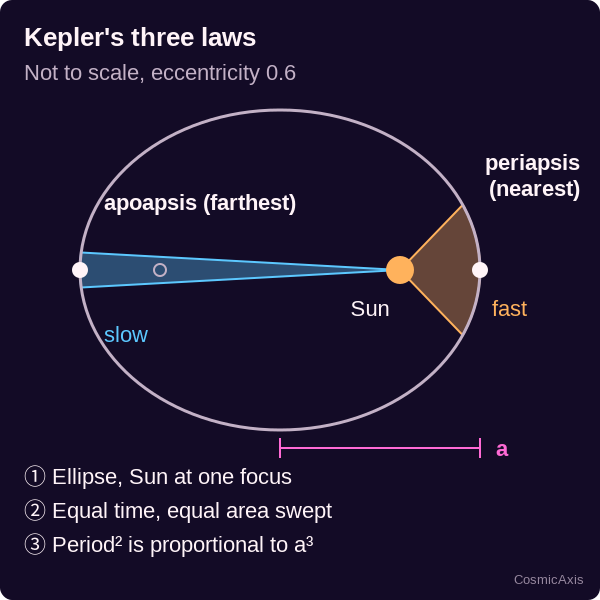
Kepler's laws: planets move on ellipses with the Sun at one focus; a line from planet to Sun sweeps equal areas in equal times; the square of the period is proportional to the cube of the semi-major axis (NASA). Newton's form T² = 4π²a³/GM gives the ISS a 93-minute period (calculated by CosmicAxis).
01Knowledge
What are Kepler’s three laws of planetary motion?
Kepler’s laws of planetary motion describe how planets move around the Sun, as NASA states them:
- First law (orbits): every planet moves on an ellipse, with the Sun at one focus of the ellipse.
- Second law (areas): a line joining a planet to the Sun sweeps out equal areas in equal intervals of time.
- Third law (periods): the square of a planet’s orbital period is proportional to the cube of the semi-major axis of its orbit.
Johannes Kepler (1571–1630) published the first two laws in Astronomia Nova in 1609 and the third in Harmonices Mundi in 1619 (NASA Science). Kepler did not know about gravity when he found them; Isaac Newton later used these same laws to build the law of universal gravitation.
The three laws are the starting point of orbital mechanics. Replace “planet” with “satellite” and “Sun” with “Earth” and they still hold: NASA Goddard applies the third law to artificial satellites exactly as Newton applied it to the Moon.
What are the semi-major axis, eccentricity, periapsis and apoapsis of an elliptical orbit?
An elliptical orbit is described by two numbers: the semi-major axis a (half of the longest diameter) and the eccentricity e (the distance between the two foci divided by the major axis). A circle is an ellipse with eccentricity 0 (NASA, Basics of Space Flight).
- Semi-major axis a sets the period, through the third law.
- Eccentricity e runs from 0 (circle) to nearly 1 (very flat).
- Periapsis and apoapsis are the nearest and farthest points of the orbit, at distances r = a(1 − e) and r = a(1 + e) from the focus.
The names depend on the central body. Around Earth they are perigee and apogee; around the Sun, perihelion and aphelion.
Earth’s orbit is nearly circular: eccentricity 0.0167, perihelion 147.095 million km, aphelion 152.100 million km (NASA NSSDCA). The Moon’s orbit around Earth is flatter, with eccentricity 0.0549.
What does Kepler’s second law say about speed at periapsis and apoapsis?
Kepler’s second law says a body moves fastest at periapsis and slowest at apoapsis, and that the product of distance and speed is the same at both points: r_p · v_p = r_a · v_a.
Proof: during a very short time Δt at periapsis or apoapsis, the velocity is perpendicular to the radius, so the joining line sweeps a thin triangle of area r · v · Δt / 2. That area is the same at both points, so r_p · v_p = r_a · v_a. In Newtonian mechanics this is conservation of angular momentum, because gravity always points toward the center.
Earth gives a real-number check: the aphelion-to-perihelion distance ratio is 152.100 / 147.095 = 1.034, and NASA NSSDCA lists a maximum orbital speed of 30.29 km/s and a minimum of 29.29 km/s, a ratio that is also 1.034.
How do you derive Kepler’s third law and Newton’s form T² = 4π²a³/GM?
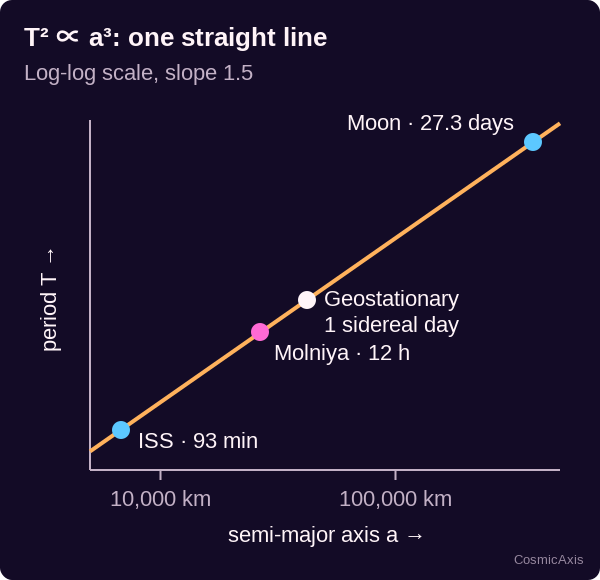
Kepler’s third law in Newton’s form says the square of the period equals 4π² times the cube of the semi-major axis divided by GM: T² = 4π²a³/GM, where GM is the gravitational constant times the mass of the central body.
Source
NASA JPL, NASA NSSDCA, NASA Earth Observatory, CelesTrak; calculated by CosmicAxis
The derivation for a circular orbit of radius r follows the NASA Goddard textbook “From Stargazers to Starships”:
- Gravity supplies the centripetal force: GMm / r² = m · v² / r, so v² = GM / r. At Earth’s surface this is the first cosmic velocity, the circular-orbit speed that sits below escape velocity.
- One lap is 2πr long and takes time T, so v = 2πr / T.
- Substituting: 4π²r² / T² = GM / r, hence T² = (4π² / GM) · r³.
The satellite mass m cancels, so a 1 kg satellite and a station of hundreds of tonnes at the same altitude share the same period. For an ellipse, the formula holds with r replaced by the semi-major axis a: two ellipses with the same a have the same period however flat they are, which is why the flight time of a Hohmann transfer orbit is exactly half the period of the transfer ellipse.
A more exact form uses the total mass, T² = 4π²a³ / G(M + m), because both bodies orbit their common center of mass (the barycenter). For a satellite, m is negligible; for the Moon it is not. A semi-major axis of 384,400 km gives a period of 27.45 days using Earth’s GM alone and 27.28 days when the Moon’s GM is added, closer to NASA NSSDCA’s measured 27.3217 days (calculated by CosmicAxis).
02Practice
How do you calculate the ISS period, geostationary radius and periapsis speed in Python?
Calculating an orbital period with Kepler’s third law needs only GM and Python’s built-in math module. The code below computes the ISS period, the geostationary radius, the Moon’s period, and the periapsis and apoapsis speeds of a Molniya orbit.
import math

# GM in km³/s², NASA JPL
GM_EARTH = 398600.435507
GM_MOON = 4902.800118
# Equatorial radius in km, NASA NSSDCA
R = 6378.137

def period(a, gm):
    # Kepler's third law in Newton's form, seconds
    return 2 * math.pi * math.sqrt(a**3 / gm)

def semi_major_axis(T, gm):
    # inverse of the third law: a (km) from period T (seconds)
    return (gm * (T / (2 * math.pi)) ** 2) ** (1 / 3)

def speed(r, a, gm):
    # vis-viva equation, km/s
    return math.sqrt(gm * (2 / r - 1 / a))

# ISS, mean altitude 421 km (CelesTrak TLE, 28 Sep 2026)
print(f"ISS: {period(R + 421, GM_EARTH) / 60:.1f} min")

# geostationary: period = 1 sidereal day, 86,164.09054 s (NASA JPL)
r_geo = semi_major_axis(86164.09054, GM_EARTH)
print(f"Geostationary: r = {r_geo:.0f} km, v = {speed(r_geo, r_geo, GM_EARTH):.2f} km/s")

# Moon, a = 384,400 km: Earth only, then Earth + Moon
T1 = period(384400, GM_EARTH) / 86400
T2 = period(384400, GM_EARTH + GM_MOON) / 86400
print(f"Moon: {T1:.2f} days (M), {T2:.2f} days (M + m)")

# Molniya: 12 h period, eccentricity 0.722 (NASA Earth Observatory)
e = 0.722
a = semi_major_axis(12 * 3600, GM_EARTH)
rp, ra = a * (1 - e), a * (1 + e)
print(f"Molniya: a = {a:.0f} km, altitude {rp - R:.0f} km and {ra - R:.0f} km")
print(f"  {speed(rp, a, GM_EARTH):.2f} and {speed(ra, a, GM_EARTH):.2f} km/s")
# share of time in the far half of the ellipse (Kepler's equation)
print(f"  {(0.5 + e / math.pi) * 100:.0f}% of the time in the far half")
Output on the CosmicAxis machine (Python 3.14):
ISS: 93.0 min
Geostationary: r = 42164 km, v = 3.07 km/s
Moon: 27.45 days (M), 27.28 days (M + m)
Molniya: a = 26610 km, altitude 1020 km and 39445 km
  9.63 and 1.56 km/s
  73% of the time in the far half
Each line matches an independent measurement. The 93.0-minute period matches the CelesTrak TLE of 28 September 2026 (15.4868 revolutions per day). The 42,164 km radius matches the figure NASA Earth Observatory gives for geostationary orbit, where a satellite flies at 3.07 km/s.
The last line uses Kepler’s equation M = E − e · sin E: the half of the ellipse around apoapsis corresponds to E from 90° to 270°, so it takes 1/2 + e/π of the period.
Exercise: compute Mars’s period from a semi-major axis of 227.956 million km and the Sun’s GM of 1.32712440041 × 10¹¹ km³/s² (NASA JPL), and compare it with NASA NSSDCA’s 686.980 days. Then compute the period of Vanguard-1 (perigee 654 km, apogee 3,969 km) and compare it with the 134.2 minutes NASA lists.
03Reality
How did Kepler find the three laws in Tycho Brahe’s data?
Kepler found the three laws by fitting the Mars observations of the Danish astronomer Tycho Brahe, not by a theory of force. Kepler worked as Tycho’s assistant in Prague, and Tycho gave him the problem of Mars’s orbit (NASA Science).
NASA explains why Mars was the key: of the planets Tycho measured in detail, Mars has the most eccentric orbit, so a circle could not fit it. The result was Astronomia Nova in 1609 (laws 1 and 2) and Harmonices Mundi in 1619 (law 3).
Kepler’s name is also on NASA’s Kepler space telescope, launched on 6 March 2009 and retired on 30 October 2018. It monitored star brightness to catch the slight dips when a planet crosses a star, and found more than 2,600 exoplanets (NASA).
Why do Molniya satellites use a long elliptical orbit?
Molniya satellites use a long ellipse because Kepler’s second law makes them move very slowly near apoapsis, so they hang over a high-latitude region for hours. A Molniya orbit has an inclination of 63.4°, an eccentricity of 0.722 and a period of 12 hours, and it spends about two-thirds of its time over one hemisphere (NASA Earth Observatory).
Russian engineers devised the orbit because a geostationary satellite sits above the equator, so the polar regions always see it near the horizon (NASA Earth Observatory). In the Python output above, the satellite sweeps past periapsis at 1,020 km altitude and 9.63 km/s, then crawls through apoapsis at 39,445 km and 1.56 km/s, 6.2 times slower. The result of 73% of the time in the far half agrees with NASA’s “about two-thirds”.
The third law fixes the size of the ellipse. A 12-hour period forces a semi-major axis of 26,610 km, so the slow high part of the orbit repeats over the same region by day and by night (NASA Earth Observatory). GPS satellites also circle every 12 hours, but on a nearly circular orbit of radius 26,560 km, close to what the third law gives. Changing the orbit after launch costs delta-v, so mission designers choose a and e from the start.
On every orbit a satellite is still falling around Earth; NASA calls this free fall, the cause of weightlessness on a space station. Computing periods, periapsis and apoapsis with Kepler’s laws is everyday work for a mission designer.
04Milestone
Milestone: check yourself
If you can do all of these, move on to the next article in this phase.
- Can you state the three Kepler's laws without looking at the book?
- Can you derive T² = 4π²r³/GM for a circular orbit from gravity and centripetal force?
- Can you use the second law to recompute the ratio of Earth's aphelion to perihelion speed?
- Can you run the Python code and add Mars's period to compare with 686.980 days?
Frequently asked questions
Who discovered that orbits are ellipses?
Johannes Kepler found that planetary orbits are ellipses while analyzing the Mars observations of the Danish astronomer Tycho Brahe. He published laws 1 and 2 in Astronomia Nova in 1609 and law 3 in Harmonices Mundi in 1619 (NASA Science).
What is the Kepler space telescope?
NASA's Kepler space telescope, named after Johannes Kepler, launched on 6 March 2009 and retired on 30 October 2018. It found planets by measuring the slight dimming of a star when a planet crosses it, and discovered more than 2,600 exoplanets (NASA).
Do Kepler's laws apply to artificial satellites?
Kepler's laws hold for any body orbiting a much heavier one, including satellites around Earth. Vanguard-1 flew an ellipse with perigee 654 km and apogee 3,969 km and a period of 134.2 minutes (NASA); the third law gives 134.4 minutes (calculated by CosmicAxis).
References
- NASA Science — Orbits and Kepler's Laws — accessed
- NASA — Basics of Space Flight, Chapter 3: Gravity & Mechanics — accessed
- NASA — Basics of Space Flight, Chapter 3: How Orbits Work — accessed
- Stern — From Stargazers to Starships, §21 Kepler's Third Law, NASA Goddard — accessed
- NASA JPL — Astrodynamic Parameters — accessed
- NASA NSSDCA — Earth Fact Sheet — accessed
- NASA NSSDCA — Moon Fact Sheet — accessed
- NASA Earth Observatory — Catalog of Earth Satellite Orbits — accessed
- CelesTrak — ISS (ZARYA) TLE — accessed
- NASA Science — Kepler / K2 — accessed
Cite this article
CosmicAxis. (2026). Kepler's Laws of Planetary Motion: Equations, Derivation. https://cosmicaxis.space/en/keplers-laws/