
Fire in space: how do flames burn in microgravity?
Source
NASA OCHMO-TB-008 Rev A (2023); Dietrich et al., NTRS 20000005087 (1999)
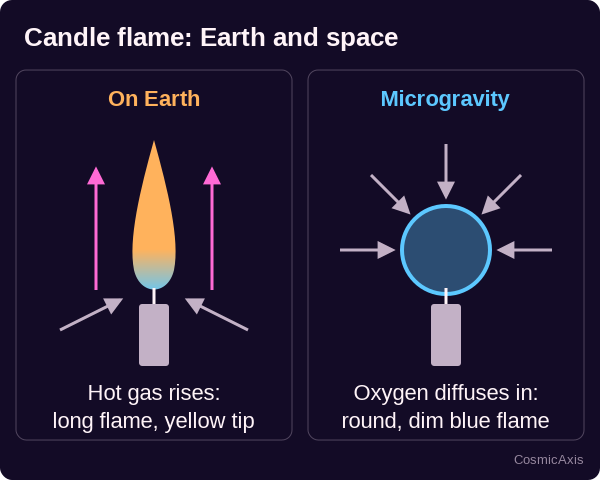
Fire in space burns only inside a vehicle with air, because a vacuum has no oxygen. In microgravity hot gas does not rise, so flames are round, blue and slow: a candle on Mir burned for up to 45 minutes (NASA). The Saffire experiments showed CO and CO₂ are a bigger threat than heat.
01Knowledge
Can fire burn in space?
Fire can burn in space, but only inside a vehicle or station that has air; outside, there is no oxygen to burn.
Per the NASA OCHMO-TB-008 fire protection summary (11/2023), burning needs fuel, oxygen and ignition energy. It also explains how rockets work in a vacuum: a rocket carries its own oxidizer.
A crewed vehicle has all three: air, wiring, fabric and plastic. Escape routes are limited, so fire threatens the crew at once (TB-008) and fire protection belongs to the life support phase.
Why is a flame in microgravity round and blue?
A flame in microgravity is round because there is no buoyancy: hot gas does not rise, so oxygen reaches the flame only by diffusion from all directions (NASA TB-008).
Convection disappears for the reason given in why astronauts float. For a flame:
- Blue color, little soot. No flow carries soot up to the tip. A candle burned on the space shuttle in 1992 started yellow, then turned dim blue (Dietrich et al., 1999).
- Slow burning, easy self-extinction. Burned gas is not swept away and surrounds the flame. The shuttle candle went out in under 60 seconds because its holder blocked oxygen; on Mir, with a more open holder, a candle burned up to 45 minutes.
How do ventilation fans make a spacecraft fire more dangerous?
Fans make a fire more dangerous because they replace convection: they blow fresh oxygen onto the fire and let it spread in every direction (NASA TB-008). Spacecraft must still run fans, because life support needs airflow so exhaled CO₂ does not pool.
- Smoke detectors sit in ventilation ducts. Smoke does not rise, so detectors go in the ventilation system and equipment bays (TB-008).
- CO confirms a fire. The ISS samples its air continuously; rising CO confirms a fire (TB-008).
What is a cool flame, discovered on the ISS?
A cool flame is a low-temperature, nearly invisible kind of burning that NASA discovered in 2012 in the FLEX experiments on the ISS (NASA, 7/2021). A heptane droplet that seemed out kept burning with no visible flame, at a temperature 2.5 times lower than a candle (NASA, 2020).
- Two extinctions: the hot flame goes out first, the cool flame later.
- Burns for minutes on the station, but dies almost at once on the ground; it produces CO and formaldehyde.
Per Nayagam (NASA Glenn, 2013), it can persist after the hot flame is out and release flammable vapor that may reignite.
How are spacecraft materials tested for flammability under NASA-STD-6001B?
Cabin materials must pass the upward flame propagation test, Test 1 of NASA-STD-6001B (Harper et al., ICES-2017-509). Per TB-008, the main protection is materials proven fire-resistant, such as Nomex and GORE-TEX.
- A 30 cm sample stands vertically and is ignited at the bottom by a chemical igniter strong enough to guarantee ignition.
- The atmosphere is the worst case expected on the vehicle, typically 30% oxygen at 70.3 kPa.
- The sample fails if it burns more than 15 cm, or if burning fragments fall and ignite the K-10 paper below.
- Five consecutive samples must pass.
How do oxygen concentration and cabin pressure change a fire?
Richer oxygen or higher pressure lowers the ignition temperature of materials and makes flames hotter, so each vehicle must declare its permitted pressure and oxygen percentage (NASA TB-008).
Astronauts breathe by oxygen partial pressure, so lower cabin pressure needs a higher oxygen percentage, and fire gets easier. The Apollo 1 fire was the price of pure oxygen.
| Test condition | Pressure (kPa) | Oxygen (%) | O₂ partial pressure (kPa, CosmicAxis calculation) | Source, date accessed |
|---|---|---|---|---|
| Saffire VI-2 | 54.1 | 31.0 | 16.8 | ICES-2024-365, 2026-10-02 |
| Test 1, usual worst case | 70.3 | 30 | 21.1 | ICES-2017-509, 2026-10-02 |
| Max oxygen at which Nomex still passes Test 1 | 70.3 | 25.0 | 17.6 | ICES-2017-509, 2026-10-02 |
Saffire VI deliberately lowered pressure and raised oxygen to simulate a future crewed vehicle (NASA Glenn, 2/2024).
What does the ISS crew do when there is a fire?
The ISS crew works through these steps until the fire is out (NASA TB-008):
- Announce the fire; software stops fans and closes the module’s ventilation valves.
- Don breathing masks, then cut power to equipment in the module.
- Use a portable extinguisher; if signs of fire remain, power down the whole module.
- If the air is still toxic, leave, close the hatch and isolate the module until scrubbers bring CO, HCN and HCl within limits.
The station started with water-foam extinguishers in the Russian segment and CO₂ ones in the US segment. Smoke-filter masks do not filter CO₂, so whoever discharges a CO₂ extinguisher needs a separate oxygen breathing apparatus (Rodriguez and Young, NASA, 2013). NASA therefore built a fine water mist extinguisher: 9 units replacing the CO₂ ones reached the station in 2016 (NASA Spinoff 2020), though the 2023 TB-008 still lists CO₂ extinguishers for the US segment.
02Practice
Calculation: how much does a small fire raise CO₂ in a spacecraft?
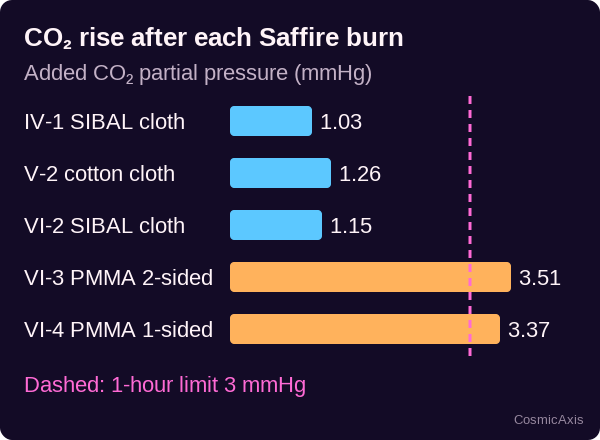
A PMMA plastic sheet releasing 1,280 kJ in the 16.7 m³ Cygnus raises CO₂ partial pressure by 2.80 mmHg in the calculation below; the measurement was 3.51 mmHg, above the 1-hour average limit of 3 mmHg (CosmicAxis calculation; ICES-2024-365). The calculation uses only published NASA numbers: do not burn test materials or run fire or oxygen experiments at home.
Each gram of oxygen burned releases 13.1 kJ (Huggett method). Burning completely, cotton (C₆H₁₀O₅) gives 6 CO₂ per 6 O₂ and PMMA (C₅H₈O₂) gives 5 CO₂ per 6 O₂. Partial pressure is moles times gas constant times temperature over volume: p = n · R · T / V.
R, T, MMHG = 8.314, 295.15, 133.322   # J/(mol·K); assumed 22 °C; Pa per mmHg
KJ_PER_G_O2 = 13.1                     # Huggett 1980: heat released per gram of O2 burned

def p_co2(q_kj, co2_per_o2, v_m3):    # added CO2 partial pressure, mmHg
    n_co2 = q_kj / KJ_PER_G_O2 / 32.0 * co2_per_o2
    return n_co2 * R * T / v_m3 / MMHG

# burn, heat released kJ, CO2/O2, volume m3, measured mmHg (ICES-2024-365)
for name, q, r, v, meas in [("VI-2 SIBAL cloth", 580, 1.0, 16.7, 1.15),
                            ("VI-3 PMMA", 1280, 5 / 6, 16.7, 3.51)]:
    print(f"{name}: computed +{p_co2(q, r, v):.2f} mmHg, measured +{meas} mmHg")
for v in (10.0, 5.0):                  # same PMMA fire, smaller compartment
    print(f"Compartment {v:4.1f} m3: +{p_co2(1280, 5 / 6, v):.2f} mmHg")
# VI-2 SIBAL cloth: computed +1.52 mmHg, measured +1.15 mmHg
# VI-3 PMMA: computed +2.80 mmHg, measured +3.51 mmHg
# Compartment 10.0 m3: +4.68 mmHg
# Compartment  5.0 m3: +9.37 mmHg
Output from Python 3.14. Computed values differ from measurements by +32% (cloth) and −20% (plastic): the sensor sat away from the fire, the gas was not mixed, and some carbon became CO and smoke. The lesson is in the last two lines: CO₂ partial pressure is inversely proportional to volume, so the same fire in 5 m³ pushes CO₂ to 9.37 mmHg, 3 times the limit. A CO₂ scrubber is sized for breathing, not for a fire.
03Reality
How did the 1997 fire on Mir unfold?
The Mir fire broke out at 22:35 Moscow time on 23 February 1997, when a lithium perchlorate oxygen canister in the Kvant-1 module caught fire; the 6 people aboard put it out and no one was hurt (NASA release, 24 February 1997).
Oxygen “candles” were burned when the station held more than 3 people; that day 6 were aboard for a crew handover (NASA).
- A blowtorch-like flame: about 0.9 m long, with sparks and molten metal, blocking the way to the Soyuz docked at the rear of Kvant-1 (NASA History, 2022).
- No way to cut off the oxygen: the canister makes its own, so the fire ended only when it ran out (TB-008). The crew wore masks and sprayed foam from 3 extinguishers of 2 liters each.
- Two NASA sources differ: the 1997 release says about 90 seconds of fire and 5–7 minutes of thick smoke; the 2022 article dates it 24 February and says the flame lasted a few minutes.
Life support cleared the smoke within hours. TB-008’s lesson: a small fire can produce a great deal of CO, so spacecraft must measure toxic gases, not only smoke. NASA also counts the Apollo 13 oxygen tank explosion of 1970 as the first recorded fire-related accident without buoyancy.
What did the Saffire experiments on Cygnus show about spacecraft fires?
Saffire showed that the main danger of a spacecraft fire is CO, CO₂ and smoke, not heat: fires of 1.5–3.2 kW heated only the area next to the flame (Urban et al., ICES-2024-365).
Saffire was 6 experiments over 8 years, burned in the Cygnus cargo vehicle after it left the ISS. Saffire-I on 14 June 2016 burned a 0.4 × 1 m cloth for about 8 minutes; the previous largest space fire experiment was note-card size (NASA Glenn). Saffire-VI ended on 9 January 2024 when Cygnus burned up on atmospheric reentry (NASA Glenn, 2/2024).
Source
Urban et al., ICES-2024-365, table 2
- Heat was the lesser worry: gas leaving the test duct reached 77 °C, but near the module hatch it was only 20–25 °C.
- CO neared dangerous levels: the two PMMA burns (780 and 1,200 seconds) raised CO by 308–320 ppm, above the 24-hour spacecraft maximum allowable concentration (SMAC) of 100 ppm and near the 1-hour level of 425 ppm.
- Smoke detection came late: with a 1 mg/m³ threshold, the detector alarmed at second 981 of the VI-3 burn, after most toxic gas had been released.
04Milestone
Milestone: check yourself
If you can do all of these, move on to the next article in this phase.
- Can you explain why a flame in microgravity is round and blue?
- Can you name the two conditions that make a material fail Test 1 of NASA-STD-6001B?
- Can you run the Python code and explain why the same fire is more dangerous in a smaller spacecraft?
- Can you state the lesson about carbon monoxide from the 1997 fire on Mir?
Frequently asked questions
Does fire need oxygen?
Yes. Per NASA OCHMO-TB-008, burning needs fuel, oxygen and ignition energy. A vacuum has no oxygen, so no flame; rockets carry their own oxidizer.
What is a cool flame?
A cool flame is a low-temperature, nearly invisible burn NASA discovered in 2012 on the ISS: a fuel droplet that seemed out kept burning, 2.5 times cooler than a candle.
Why are flames in space blue?
No rising hot gas carries soot to the tip, so almost no glowing yellow soot forms. A candle on the space shuttle started yellow, then turned dim blue (NASA).
References
- NASA OCHMO-TB-008 Rev A — Fire Protection (11/2023) — accessed
- Dietrich et al. — Candle Flames in Non-Buoyant Atmospheres (1999) — accessed
- NASA — 20 Breakthroughs from 20 Years of Science aboard the ISS (2020) — accessed
- NASA — Cool Flames Created During a First for ISS Research (2021) — accessed
- Nayagam — Cool Flames in Space, ISSRDC 2013 — accessed
- Harper et al. — NASA-STD-6001B Test 1, ICES-2017-509 — accessed
- Rodriguez and Young — ISS Fine Water Mist Portable Fire Extinguisher (2013) — accessed
- NASA Spinoff 2020 — Zero-Leak Valve — accessed
- NASA JSC — Small Fire Extinguished on Mir (24 Feb 1997), archived copy — accessed
- NASA History — 25 Years Ago: Fire Aboard Space Station Mir (2022) — accessed
- NASA Glenn — Saffire-I (23 Jun 2016) — accessed
- NASA Glenn — Flame Burns Out on Spacecraft Fire Experiment (14 Feb 2024) — accessed
- Urban et al. — Saffire VI, ICES-2024-365 — accessed
Cite this article
CosmicAxis. (2026). Fire in space: how flames burn in microgravity. https://cosmicaxis.space/en/fire-in-space/