
Deep Space Network: How NASA Talks to Distant Spacecraft
Source
NASA DSN; DSN 810-005 module 301 Rev. N (longitudes of DSS-14, 43, 63)
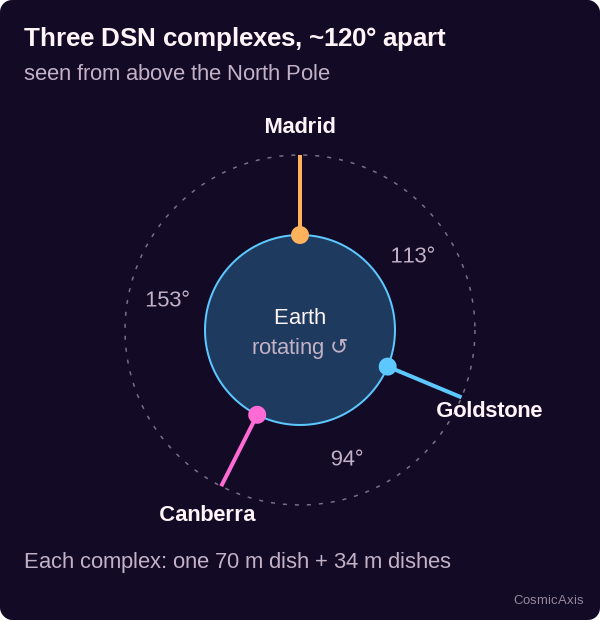
The Deep Space Network (DSN) is NASA's antenna network at Goldstone, Madrid and Canberra, about 120° of longitude apart so that one site always sees a distant spacecraft. On 4 Oct 2026, a Voyager 1 signal takes 23 hours 53 minutes to reach a 70 m dish, arriving at about 2 × 10⁻¹⁹ W (CosmicAxis calculation from JPL).
01Knowledge
What is the Deep Space Network, and why does it have exactly three sites?
The Deep Space Network (DSN) is NASA’s antenna network, run by JPL, with three complexes at Goldstone (California, USA), near Madrid (Spain) and near Canberra (Australia), about 120° of longitude apart so that as Earth turns, a distant spacecraft is always above the horizon of at least one complex (NASA JPL).
- Real positions: the 70 m dishes DSS-14, DSS-63 and DSS-43 are 113°, 153° and 94° of longitude apart (DSN 810-005 module 301; CosmicAxis calculation); 120° is the average.
- Antennas: each complex has one 70 m dish and two to five 34 m dishes; each antenna can send commands to only one spacecraft at a time (Taylor, JPL DESCANSO).
- “Deep space”: missions farther than 2 million km from Earth (Category B, DSN 810-005 module 201); low Earth orbit satellites use other networks.
- History: the DSN’s predecessor was formed in January 1958; on 20 July 1969 it received the first downlink from Apollo 11 at the Moon. Customers now include lunar missions such as Artemis and spacecraft at Lagrange points (NASA).
The DSN supports mission control during deep-space operations.
How long does a signal from a distant spacecraft take to reach Earth?
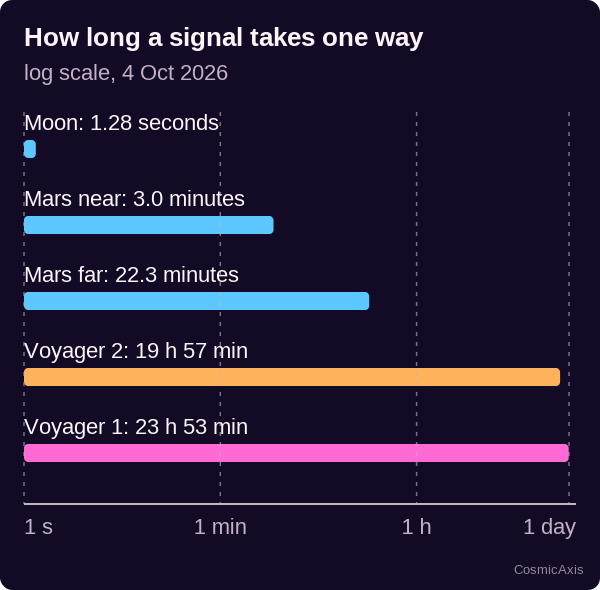
Radio travels at the speed of light, 299,792,458 m/s (NIST), so the one-way light time is distance divided by that speed: 1.28 seconds to the Moon, 3.0 to 22.3 minutes to Mars, and 23 hours 53 minutes to Voyager 1 on 4 Oct 2026 (CosmicAxis calculation from NASA NSSDCA and JPL Horizons).
Source
NASA NSSDCA; JPL Horizons 4 Oct 2026; CosmicAxis calculation
- Moon: 384,400 km (NSSDCA), a round trip of about 2.6 seconds. A crew needs about 3 days for it on a trajectory to the Moon.
- Mars: 54.6 to 401.4 million km (NSSDCA). Landers must act alone: Perseverance’s Mars entry, descent and landing lasted about 7 minutes, but a signal needed 11 minutes 22 seconds to reach Earth (JPL, 2021).
- Voyager: Voyager 2 is 21.54 billion km away and Voyager 1 is 25.77 billion km (JPL Horizons). A command to Voyager 1 and its reply take almost two days (round-trip light time).
CosmicAxis calculates that Voyager 1 passes one light-day (25.9 billion km) around mid-November 2026. Both spacecraft got that far with gravity assists.
Which frequency bands does the DSN use, and why must the dishes be 70 m wide?
The DSN communicates in three microwave bands that the ITU reserves for deep space, S, X and Ka (DSN 810-005, module 201); dishes must be huge because signal power falls with the square of distance, and a Voyager 1 signal reaches a 70 m dish at only about 2 × 10⁻¹⁹ W (CosmicAxis calculation).
| Band | Uplink, Earth to spacecraft (MHz) | Downlink, spacecraft to Earth (MHz) | Source, date accessed |
|---|---|---|---|
| S | 2,110–2,120 | 2,290–2,300 | DSN 810-005 module 201, 2026-10-04 |
| X | 7,145–7,190 | 8,400–8,450 | DSN 810-005 module 201, 2026-10-04 |
| Ka | 34,200–34,700 | 31,800–32,300 | DSN 810-005 module 201, 2026-10-04 |
The DSN used mainly S band in the 1960s–1970s, X band in the 1980s–1990s, and moved gradually to Ka band from the 2000s (Taylor, JPL DESCANSO).
In a link budget, free-space path loss grows by 6 dB each time the distance doubles; from the 909 km of a CubeSat to the 25.77 billion km of Voyager 1 that adds 149 dB (CosmicAxis calculation). The DSN compensates in three ways (JPL DESCANSO Voyager Telecommunications, tables 5-3, 5-4):
- Big dish: a 70 m dish has a gain of 74.0 dBi in X band.
- Cold receiver: system temperature of 21.1 K, a noise floor of −185.4 dBm/Hz.
- Slow bits: Voyager sends cruise data at 160 bit/s.
How does the DSN measure position and navigate a distant spacecraft?
The DSN navigates distant spacecraft with three radio measurements: two-way Doppler shift for velocity along the line of sight, ranging for distance, and delta-DOR for the angle on the sky (Taylor, JPL DESCANSO). Far from Earth there is no GPS signal, so the ground computes the spacecraft’s position.
- Two-way Doppler: the station sends a carrier up, the onboard transponder multiplies its frequency by a fixed ratio (880/749 for X-band up, X-band down, DSN 810-005 module 201) and sends it back; the station compares it with its own, more stable reference clock.
- Ranging: the station measures the phase delay of a ranging signal sent up and returned, which gives the round-trip light time and the distance.
- Delta-DOR: two stations at different complexes (Goldstone–Madrid or Goldstone–Canberra) listen to the spacecraft and then to a quasar of known position; the difference in arrival time at the two stations gives the spacecraft’s angle, and each measurement takes about 1 hour.
The navigators of Mars Climate Orbiter also used range and Doppler, and the 1999 failure showed that good measurements still give a wrong orbit when momentum-desaturation impulses are recorded in the wrong units.
02Practice
How do you calculate the delay and received power from Voyager 1 in Python?
A few dozen lines of Python give the delay and received power from Voyager 1: first reproduce JPL’s 1996 Voyager 2 link budget, then change the distance to Voyager 1 on 4 Oct 2026 (JPL Horizons).
Parameters (Voyager Telecommunications, JPL DESCANSO, Mar 2002, tables 5-3, 5-4): X-band traveling-wave tube amplifier in low mode 12 W, 3.66 m high-gain antenna 48.2 dBi, 70 m dish 73.7 dBi, system temperature 21.12 K, Eb/N0 threshold 2.34 dB. The 34 m dish (68.3 dBi, 30.5 K) comes from the MarCO table in the link budget article; the code assumes Voyager 1 still transmits 12 W.
import math

C, K = 299_792_458, 1.380649e-23   # m/s, J/K (NIST)
F = 8415e6                         # Hz, Voyager X band

def fspl(d_km):                    # free-space path loss in dB
    return 20 * math.log10(4 * math.pi * d_km * 1e3 * F / C)

for name, d in [("Moon", 384_400), ("Mars, farthest", 401.4e6),
                ("Voyager 1", 2.5771e10)]:
    t = d * 1e3 / C
    print(f"{name}: {t:.2f} s = {t / 60:.1f} min")

# DESCANSO Article 4, tables 5-3, 5-4: 12 W, 48.2 dBi, 160 bit/s, threshold 2.34 dB
def margin(d, g_station, t_sys):
    p = 40.9 + 48.2 - 0.1 - fspl(d) - 0.04 + g_station    # dBm at the receiver
    eb_n0 = p - 1.47 - 10 * math.log10(160 * K * t_sys * 1e3) - 0.72  # power split, losses
    return p, eb_n0 - 2.34

for name, d, g, t in [("Voyager 2, 1996, 70 m", 7.273e9, 73.7, 21.12),
                      ("Voyager 1, 2026, 70 m", 2.5771e10, 73.7, 21.12),
                      ("Voyager 1, 2026, 34 m", 2.5771e10, 68.3, 30.5)]:
    p, m = margin(d, g, t)
    print(f"{name}: received {p:.1f} dBm = {10 ** (p / 10) / 1e3:.1e} W, margin {m:+.1f} dB")

print(f"LEO CubeSat (-118.4 dBm) is stronger than Voyager 1 by {-118.4 - margin(2.5771e10, 73.7, 21.12)[0]:.0f} dB")
Moon: 1.28 s = 0.0 min
Mars, farthest: 1338.93 s = 22.3 min
Voyager 1: 85962.80 s = 1432.7 min
Voyager 2, 1996, 70 m: received -145.5 dBm = 2.8e-18 W, margin +13.3 dB
Voyager 1, 2026, 70 m: received -156.5 dBm = 2.2e-19 W, margin +2.3 dB
Voyager 1, 2026, 34 m: received -161.9 dBm = 6.4e-20 W, margin -4.7 dB
LEO CubeSat (-118.4 dBm) is stronger than Voyager 1 by 38 dB
CosmicAxis ran the code on 4 Oct 2026 (Python 3.14.6). The Voyager 2 line matches the JPL table (−145.5 dBm, margin 13.3 dB), so the model is sound. For Voyager 1 today, a 70 m dish receives only 2.2 × 10⁻¹⁹ W, margin 2.3 dB; a 34 m dish alone is 4.7 dB short, matching JPL’s 2002 forecast that 34 m dishes could receive 160 bit/s from Voyager 1 only until about 2024 (table 1-1). A low Earth orbit CubeSat signal is 38 dB stronger, about 6,300 times.
How can you see which spacecraft the DSN is talking to with DSN Now?
DSN Now is a NASA page (eyes.nasa.gov/apps/dsn-now) showing which spacecraft each dish at Goldstone, Madrid and Canberra is pointing at, in which band, whether it is sending or receiving, and the round-trip light time to the spacecraft.
- Watch the handover: open the page three times, 8 hours apart; as Earth rotates, the same spacecraft passes from Canberra to Madrid and then Goldstone.
- Check the round trip: halve the round-trip light time to a Mars spacecraft, multiply by 299,792.458 km/s, and compare with the Mars distances above.
- Hunt for Voyager 2: it is far south of the ecliptic, so only Canberra sees it (JPL DESCANSO, 2002).
03Reality
How was Voyager 1 repaired from 24 billion km after it went silent in 2023?
Voyager 1 stopped sending readable data on 14 November 2023 although it still accepted commands; JPL found a failed memory chip in the flight data subsystem (FDS), relocated the code, and on 20 April 2024 the spacecraft sent engineering data again (NASA, 22 Apr 2024).
The FDS is one of Voyager 1’s three computers; it packs science and engineering data before the transmitter sends them to Earth (NASA, 4 and 22 Apr 2024).
- Early March 2024: a “poke” command read back the FDS memory; about 3% was corrupted, suspected to be one chip.
- No fix for the chip: no free area was large enough, so the code was split into pieces and relocated.
- 18 April 2024: the piece that packs engineering data was sent; the signal takes about 22.5 hours each way, so the reply came on 20 April.
- 13 June 2024: all four science instruments were again returning usable data (NASA).
Commands to Voyager need a 70 m dish with a 20 kW S-band transmitter (JPL DESCANSO, 2002). Lesson: software on a computer launched in 1977 must still be patchable remotely.
How fast is laser communication with DSOC on the Psyche spacecraft?
The Deep Space Optical Communications (DSOC) experiment on the Psyche spacecraft sent ultra-high-definition video by near-infrared laser at 267 Mbit/s on 11 December 2023, about 1.7 million times Voyager’s 160 bit/s (NASA; CosmicAxis calculation).
- 14 November 2023: first light from nearly 16 million km.
- 29 July 2024: farthest, 288 million miles, about 463 million km (CosmicAxis unit conversion).
- September 2025: the 65th and last pass, at about 351 million km.
At 249 million miles the rate fell to 8.3 Mbit/s (NASA): a laser beam is narrower than radio but still weakens with the square of distance.
04Milestone
Milestone: check yourself
If you can do all of these, move on to the next article in this phase.
- Can you calculate the one-way light time to the Moon, Mars and Voyager 1?
- Can you explain why the three DSN complexes are about 120° of longitude apart?
- Can you reproduce the 1996 Voyager 2 link budget table and then change it to Voyager 1 today?
- Can you name the three ways the DSN measures the position of a distant spacecraft?
Frequently asked questions
How far away is Voyager 1?
On 4 Oct 2026, Voyager 1 is 25.77 billion km from Earth (JPL Horizons), so light takes 23 hours 53 minutes one way. CosmicAxis calculates that the spacecraft passes one light-day around mid-November 2026.
What waves does deep space communication use?
Distant spacecraft use microwave radio in S band (2.3 GHz), X band (8.4 GHz) and Ka band (32 GHz), which the ITU reserves for deep space (DSN 810-005). Near-infrared lasers are being tested, as on the Psyche spacecraft (DSOC).
What is DSN Now?
DSN Now is a NASA web page that shows, almost live, which spacecraft each Deep Space Network dish is talking to, in which band, and whether it is sending or receiving.
References
- NASA, Deep Space Network — accessed
- NASA JPL, Deep Space Network — accessed
- DSN 810-005, module 201 Rev. D, Frequency and Channel Assignments (Sep 2020) — accessed
- DSN 810-005, module 301 Rev. N, Coverage and Geometry (Apr 2022) — accessed
- Taylor, The Deep Space Network: A Functional Description, JPL DESCANSO — accessed
- Ludwig, Taylor, Voyager Telecommunications, JPL DESCANSO Article 4 (Mar 2002) — accessed
- NASA JPL, Horizons System (Voyager 1, Voyager 2) — accessed
- NASA NSSDCA, Moon Fact Sheet — accessed
- NASA NSSDCA, Mars Fact Sheet — accessed
- NASA Science, Engineers Pinpoint Cause of Voyager 1 Issue (4 Apr 2024) — accessed
- NASA Science, Voyager 1 Resumes Sending Engineering Updates (22 Apr 2024) — accessed
- NASA Science, Voyager 1 Returning Science Data From All Four Instruments (13 Jun 2024) — accessed
- NASA, Deep Space Optical Communications (DSOC) — accessed
- NASA Eyes, DSN Now — accessed
- NIST, speed of light in vacuum — accessed
Cite this article
CosmicAxis. (2026). Deep Space Network: Antennas, Locations, How It Works. https://cosmicaxis.space/en/deep-space-network/